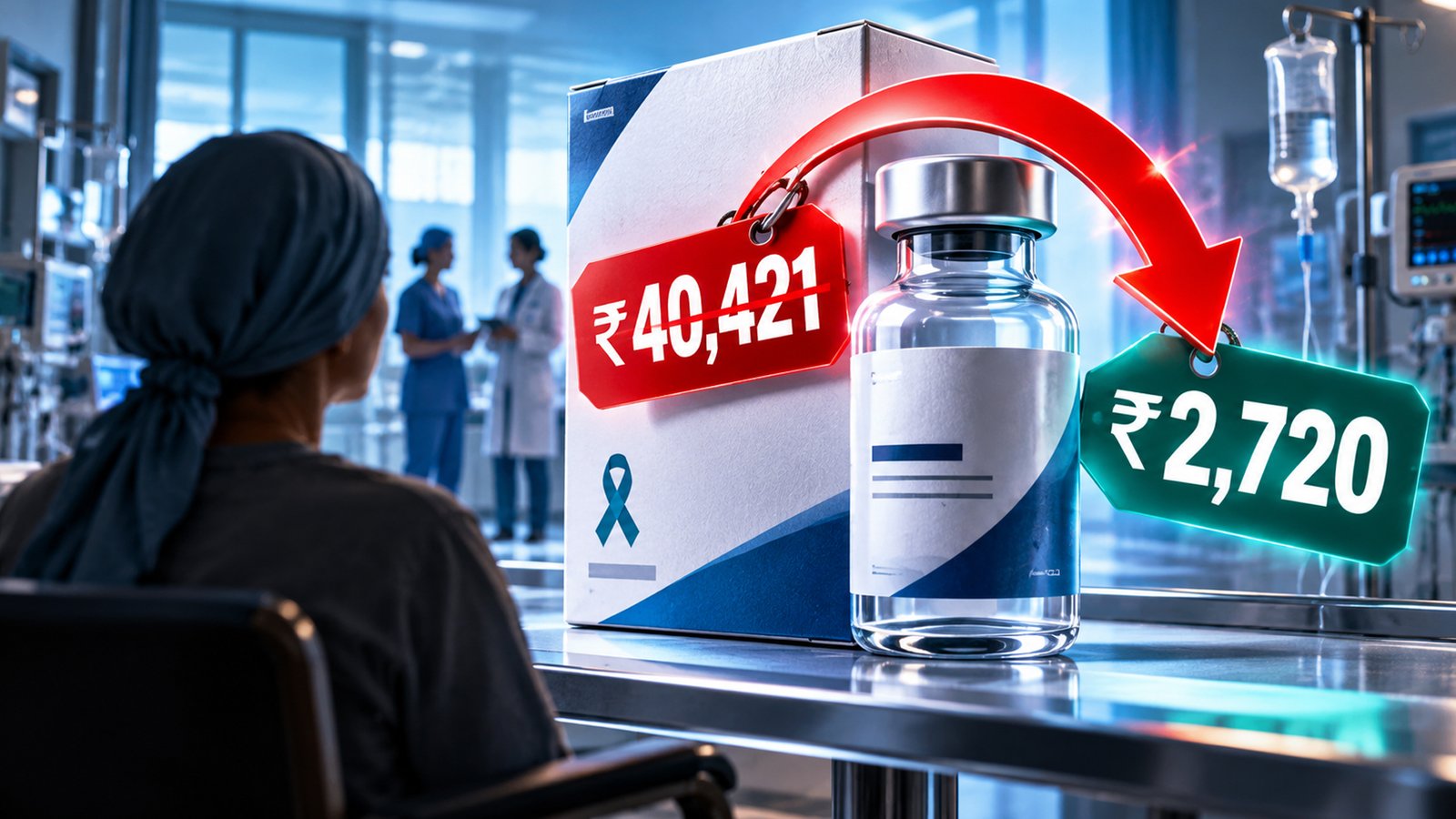
Sharp reductions in the prices of several cancer medicines in India have renewed questions about excessive pricing and the affordability of life-saving treatment. The National Pharmaceutical Pricing Authority (NPPA) has revised the maximum retail prices (MRPs) of 543 cancer drug brands and pack sizes after the government capped trade margins on 137 non-scheduled anti-cancer medicines at 30%. The revised prices will take effect from November 9, 2026.
While some generic and biosimilar cancer drugs have become significantly cheaper, several expensive medicines remain unaffected. The contrast has raised concerns among health experts about whether controlling trade margins alone can make cancer treatment affordable for patients who pay for medicines out of their own pockets.
The government introduced the trade margin cap to reduce excessive mark-ups across the pharmaceutical supply chain. Trade margins refer to the difference between the price at which a medicine is supplied to distributors and the maximum retail price charged to patients. By limiting these margins, the government aims to ensure that patients benefit from lower medicine prices.
The latest NPPA list shows that the impact varies considerably across medicines and brands. Palbopro, a brand of palbociclib used to treat certain types of breast cancer, has seen the price of its 125 mg pack of 21 capsules fall from Rs 40,421.33 to Rs 2,720, a reduction of more than 93%.
The price of Samtepa, a brand of the chemotherapy medicine thiotepa, has dropped from Rs 80,071.86 to Rs 7,150.33 for a 100 mg vial. Abiralive, which contains abiraterone acetate and is used in prostate cancer treatment, has seen its 250 mg pack of 120 tablets fall from Rs 28,000 to Rs 4,840.
Other medicines have also recorded substantial reductions. The price of Womazol, an anastrozole brand used in breast cancer treatment, has fallen from Rs 458.85 to Rs 39.52 for a pack of 10 tablets. Ivzumab, a bevacizumab brand used for certain colorectal, lung and kidney cancers, has seen the price of its 400 mg vial decline from Rs 69,852.12 to Rs 13,512.
These reductions could provide meaningful relief to patients who require repeated doses or prolonged treatment. However, the savings depend on the particular medicine and brand prescribed, meaning not every patient will benefit equally.
The biggest concern is that several high-cost cancer medicines have not become cheaper. Keytruda, an immunotherapy drug containing pembrolizumab and used to treat multiple cancer types, remains priced at Rs 2,16,500 for a 100 mg vial. Other expensive medicines, including Tagrisso, Tecentriq and Imfinzi, have also remained unchanged in the revised price comparison.
The reason lies in how the trade margin cap works. The regulation limits the amount that distributors and other intermediaries can add to a medicine’s price, but it does not automatically reduce the price set by the manufacturer. When a drug has substantial mark-ups along the supply chain, the cap can produce steep reductions. When the manufacturer’s starting price is already high and competition is limited, the impact may be much smaller.
Differences between brands containing the same active ingredient further illustrate the problem. While Ivzumab has become considerably cheaper, the price of Avastin, another bevacizumab brand, remains around Rs 1.24 lakh for a 400 mg vial. Such differences matter because patients may face very different bills depending on the brand prescribed and its availability.
The latest price changes follow an October 17 order by the NPPA imposing a 30% trade margin cap on 137 non-scheduled anti-cancer medicines. The regulator’s revised list is based on information submitted by pharmaceutical companies up to October 27. Some prices were not yet reflected in the available company filings, and the list may be updated as further information is submitted.
The issue has also drawn attention from the Supreme Court, which has questioned the high mark-ups on essential medicines and the financial burden they place on patients. The broader debate centres on whether stronger price regulation is needed to ensure that access to life-saving treatment does not depend primarily on a family’s ability to pay.
Cancer treatment expenses extend beyond medicines to include surgery, radiation, diagnostic tests, hospitalisation and follow-up care. Even a substantial reduction in one drug may not make the overall treatment affordable for families without adequate health insurance.
Experts argue that improved pricing transparency, greater competition from generic medicines and stronger regulation could help reduce costs. However, the latest revisions demonstrate that trade margin controls have limits, particularly for patented medicines with few competing alternatives.
The new prices offer significant relief in some cases, but the continued high cost of several advanced cancer treatments highlights the need for a broader approach to affordable cancer care in India.