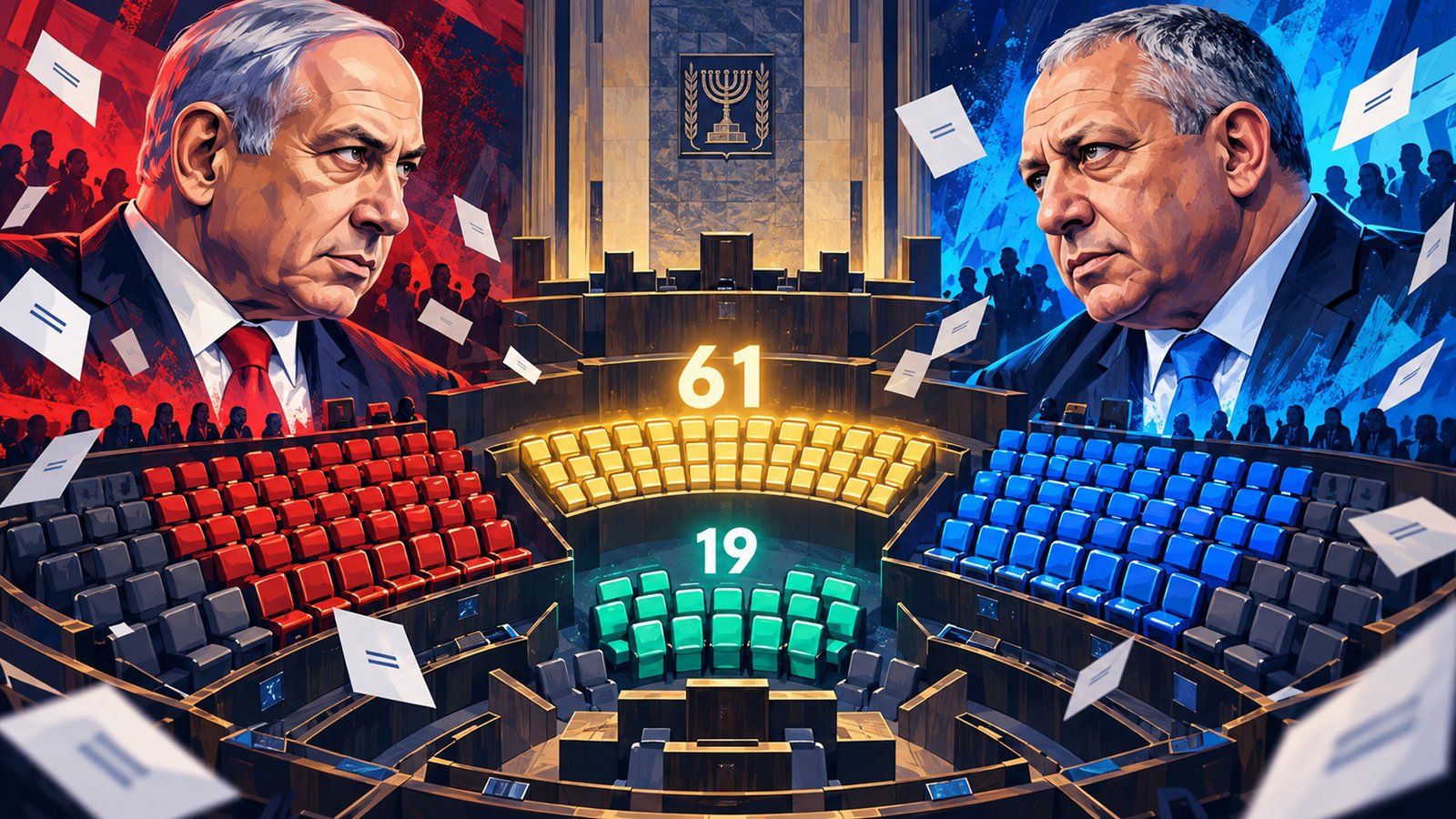
Israel’s parliamentary election has left the country facing political uncertainty, with neither Prime Minister Benjamin Netanyahu’s right-wing bloc nor the opposition alliance led by Gadi Eisenkot securing enough seats to form a government independently. With nearly 90% of votes counted on Thursday, October 29, Netanyahu’s bloc was projected to win 53 seats in the 120-member Knesset, while Eisenkot’s alliance was expected to secure 48. Arab-led parties, meanwhile, were on course to win a record 19 seats, potentially giving them significant influence over the next government.
The results have complicated the political calculations for both camps. A government needs the support of at least 61 members of the Knesset, Israel’s parliament, to command a majority. Netanyahu’s bloc is eight seats short of that threshold, while Eisenkot’s alliance needs another 13. Arab-led parties could theoretically provide the numbers required for an alternative government, but cooperation remains politically difficult because several opposition leaders have ruled out forming a coalition with them.
The election, held on Tuesday, October 27, was widely viewed as a test of Netanyahu’s leadership following the Hamas-led attacks of October 7, 2023, and the subsequent wars involving Israel and neighbouring territories. The campaign also reflected public divisions over national security, military service, the economy and the country’s future direction.
Netanyahu remains a central figure in Israeli politics despite his bloc falling short of a parliamentary majority. His Likud party emerged as the largest individual party, with 26 seats in the partial count. However, the combined performance of his right-wing and ultra-Orthodox allies will determine whether he can return to power.
Eisenkot, a former Israeli military chief who leads the Yashar party, entered the election seeking to assemble an alternative government. His alliance includes parties with differing political priorities, making coalition negotiations challenging even if additional support becomes available.
The election also revealed a significant shift in the representation of Arab citizens of Israel. The Joint List and Ra’am, two Arab-led political groupings, were projected to win 19 seats together, their strongest combined performance to date. Their previous high was 15 seats, according to reports.
The increase followed strong participation by Arab voters, many of whom hoped to prevent Netanyahu and his far-right allies from retaining power. Arab citizens make up a significant minority of Israel’s population but have frequently faced challenges in translating their votes into influence over national policymaking.
Joint List leader Yousef Jabareen has indicated that his alliance could support an alternative government from outside a coalition, although it would not necessarily join the administration. Ra’am leader Mansour Abbas has been more open to the possibility of participating in a governing arrangement.
However, the opposition faces a difficult choice. Several of its leaders have previously rejected cooperation with Arab-led parties, limiting the options available to Eisenkot. Centre-left politician Yair Golan has called for the opposition to consider working with Arab parties, arguing that their increased representation could help bring about political change.
The counting process is not yet complete. Special ballots, including votes cast by soldiers, diplomats, prisoners and people unable to vote at their regular polling stations, remain to be processed. These votes are counted separately to verify that voters have not cast ballots more than once.
Although the remaining ballots could alter the final distribution of seats, the broad political picture is not expected to change dramatically. The final official results are expected to be published on November 4.
The results have also exposed tensions within Israeli politics. Netanyahu’s Likud party alleged that Arab parties had engaged in electoral wrongdoing, prompting calls for investigations. The allegations have not been established, and claims of fraud should not be treated as proven facts.
President Isaac Herzog has urged political leaders to approach government formation with an open mind and make efforts to avoid another election. Under Israel’s parliamentary system, the president consults political parties before assigning a candidate the task of forming a government.
Coalition negotiations could take weeks, with parties expected to bargain over ministerial positions, policy priorities and legislative commitments. If no candidate can assemble a viable majority, Israel could face another election, prolonging political uncertainty.
As of now, Netanyahu’s bloc leads the count but cannot govern alone, while Eisenkot’s opposition has yet to demonstrate that it can unite enough parties to replace him. The gains made by Arab-led parties have given them a potentially decisive role, even as ideological differences complicate cooperation. The final vote count and subsequent negotiations will determine whether Israel forms a new coalition government or remains locked in a political stalemate.