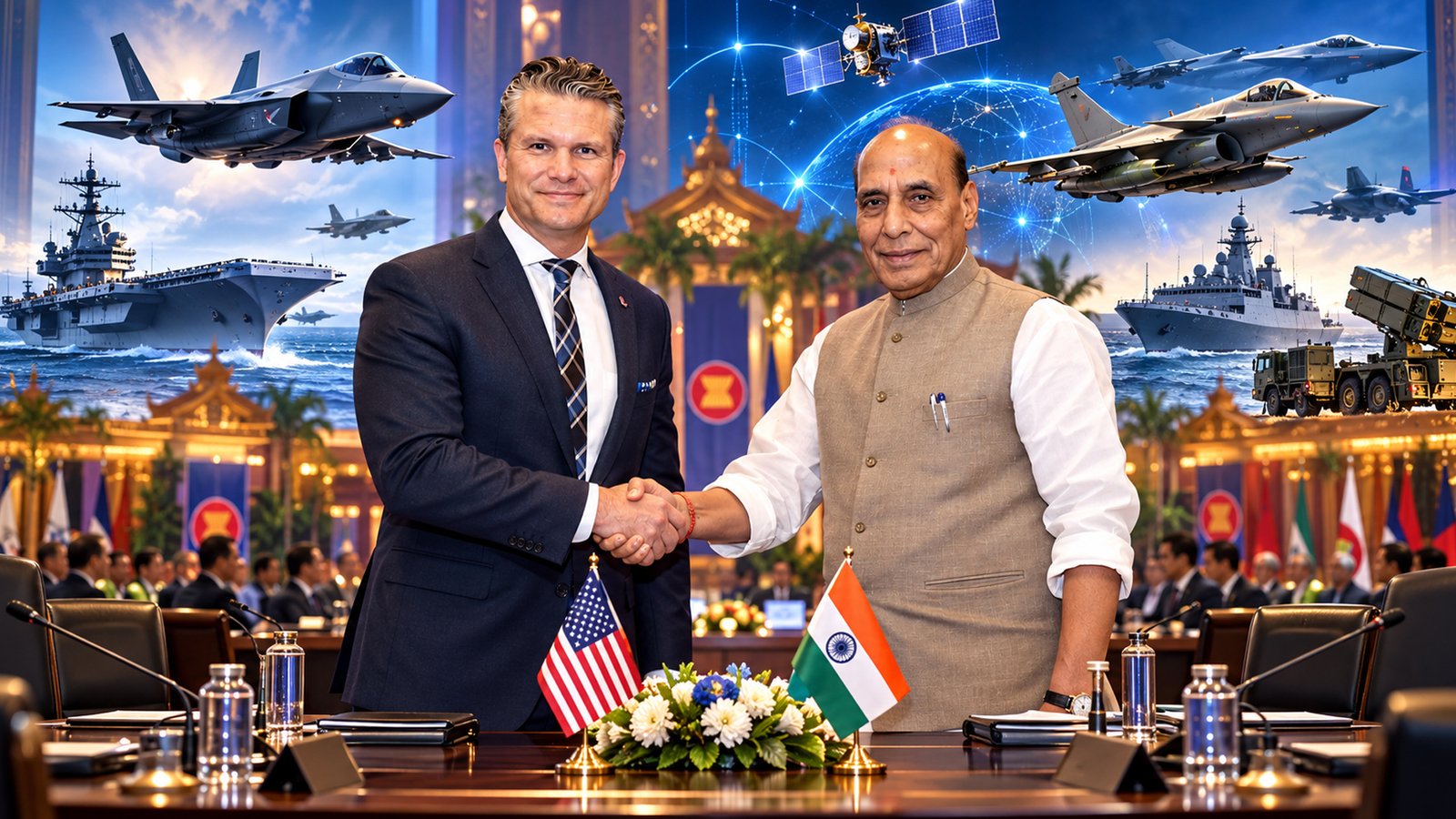
India and the United States have reviewed progress under their 10-year defence cooperation framework, with Defence Minister Rajnath Singh and US Secretary of War Pete Hegseth discussing ways to deepen military and strategic ties. The meeting took place in Cebu, the Philippines, on October 28, on the sidelines of the 13th ASEAN Defence Ministers’ Meeting-Plus (ADMM-Plus).
The discussions focused on military technology, information-sharing and the co-production of defence equipment, areas that both countries consider important to their long-term strategic partnership. The ministers also reviewed the evolving security situation in the Indo-Pacific, where maritime security and regional stability remain significant concerns.
Singh described the meeting as excellent in a post on social media. He said the two sides had reviewed progress under the 10-year India-US Defence Framework and were working towards greater strategic convergence in technology, information-sharing and joint production.
He added that the partnership remained a cornerstone for a free, open and secure Indo-Pacific. Hegseth also referred to the meeting, saying the two sides had marked the first anniversary of the framework for their Major Defence Partnership and explored ways to strengthen cooperation further.
The review comes at a time when India and the US are seeking to expand defence collaboration while navigating wider differences in their bilateral relationship.
The 10-year framework, signed in October 2025, provides a broad direction for defence cooperation over the coming decade. It aims to build on existing agreements and encourage closer coordination between the two militaries, as well as stronger links between their defence industries.
Military technology and defence production are central to the arrangement. Greater cooperation in these areas could help the countries exchange expertise, improve interoperability and explore opportunities to manufacture defence equipment jointly. Information-sharing is another key component, supporting coordination and a better understanding of shared security challenges.
The framework does not, by itself, announce a specific new arms deal. Instead, it sets the direction for future cooperation, with progress depending on discussions, implementation and decisions taken by both governments.
India-US defence ties have expanded over the past decade through a series of agreements designed to improve military coordination and access to technology. The United States designated India a Major Defence Partner in 2016, opening the way for closer defence and technology cooperation.
The two countries subsequently signed the Logistics Exchange Memorandum of Agreement in 2016, allowing their armed forces to use each other’s facilities for logistics support, repairs and replenishment. The Communications Compatibility and Security Agreement, signed in 2018, strengthened secure communications and interoperability. In 2020, they concluded the Basic Exchange and Cooperation Agreement, which facilitates the exchange of geospatial information relevant to defence operations.
These agreements have created a foundation for more regular military engagement. The latest framework seeks to build on that foundation by identifying priorities for the next decade, including defence industrial collaboration and the development and sharing of advanced capabilities.
Regional security was another important part of the Singh-Hegseth discussions. The Indo-Pacific has become a major focus of strategic engagement for both countries, given its importance to global trade, shipping routes and the balance of power in Asia. Cooperation on maritime security and military readiness is therefore likely to remain high on their agenda.
The ministers also reaffirmed their shared commitment to counter terrorism, according to reports on the meeting. Singh stressed the need for a firm approach towards countries that support, train or fund terrorist organisations, while Hegseth reiterated US support for India’s fight against cross-border terrorism. The discussions highlighted how defence cooperation extends beyond equipment and technology to broader security concerns.
Singh is leading India’s delegation at the two-day ADMM-Plus meeting, being held on October 28 and 29. The forum brings together the member states of the Association of Southeast Asian Nations (ASEAN) and eight dialogue partners: India, the United States, China, Russia, Japan, South Korea, Australia and New Zealand. The Philippines is chairing the forum this year.
The gathering provides an opportunity for defence ministers to discuss regional and international security issues and strengthen cooperation across the region. Singh is also holding bilateral meetings with counterparts from participating countries to review existing partnerships and identify areas for further engagement.
He separately met Australian Deputy Prime Minister and Defence Minister Richard Marles to discuss bilateral defence cooperation, military interoperability and regional security challenges. Singh said India attached great importance to its comprehensive strategic partnership with Australia in promoting a free, open and secure Indo-Pacific.
The meetings in Cebu underline India’s effort to maintain strong defence relationships with key partners while engaging with a wider regional security network. For New Delhi and Washington, the next challenge will be turning the framework’s broad goals into practical outcomes, including sustained technology cooperation, stronger defence production links and closer coordination on regional security.
The review signals continued momentum in India-US defence ties, although the pace of progress will depend on implementation and the ability of both sides to align their strategic and industrial priorities.