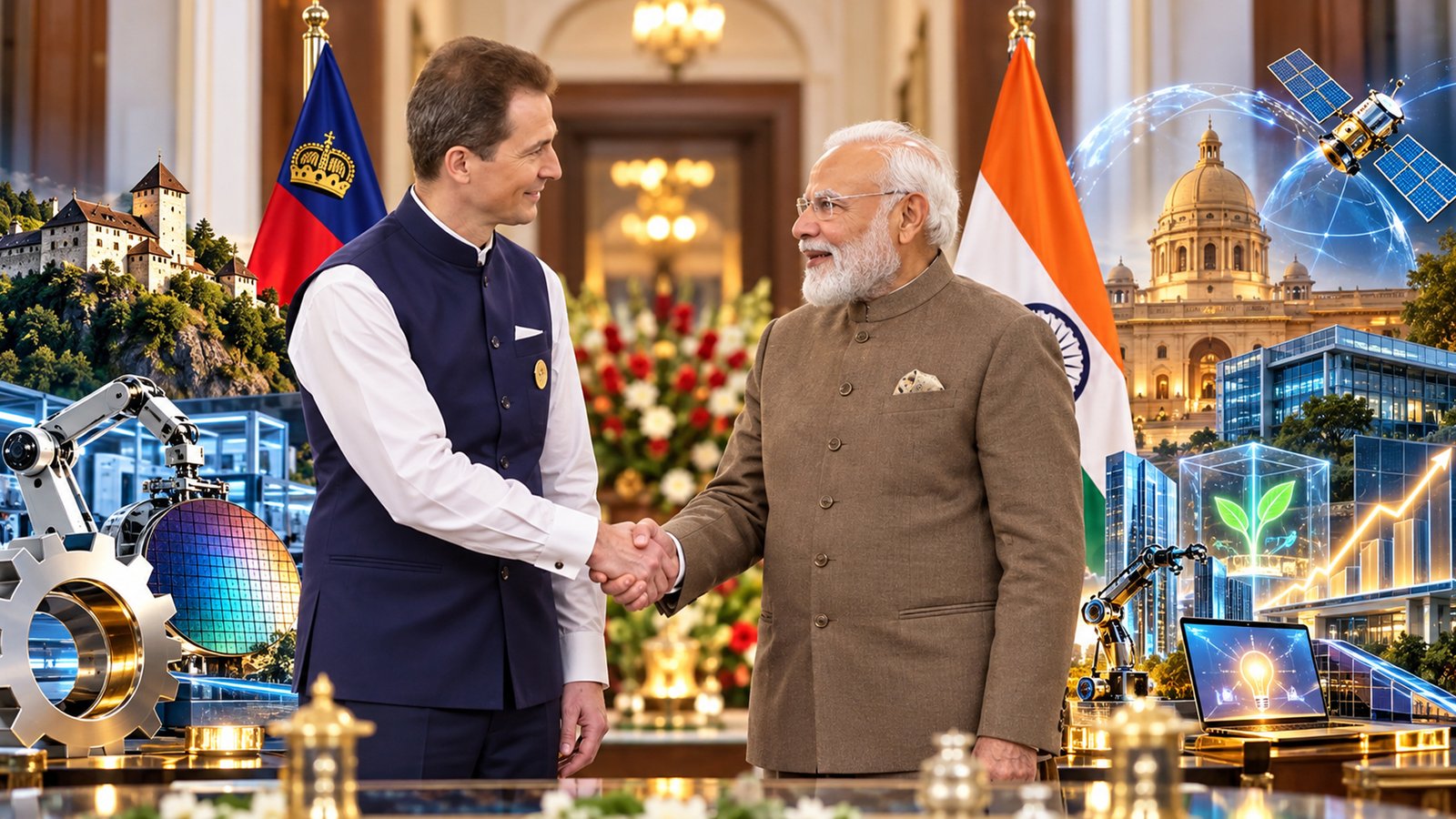
Prime Minister Narendra Modi and Liechtenstein’s Hereditary Prince Alois held talks in New Delhi on October 27 to strengthen bilateral relations, with trade, investment, technology and advanced manufacturing emerging as key areas of cooperation. The meeting also focused on opportunities created by the India-European Free Trade Association (EFTA) Trade and Economic Partnership Agreement (TEPA), which completed its first year of implementation in October.
The discussions at Hyderabad House brought fresh attention to India’s growing economic engagement with the small European principality. Both sides explored ways to expand investment, promote innovation and build stronger links between businesses, institutions and skilled professionals.
PM Modi said the two leaders reviewed progress under the trade and economic partnership agreement and discussed opportunities to increase investment flows and deepen economic cooperation. The Prime Minister described the discussions as wide-ranging and aimed at strengthening India-Liechtenstein relations across several sectors.
The meeting forms part of Prince Alois’s four-day state visit to India, accompanied by his wife, Hereditary Princess Sophie, senior officials and a business delegation. The visit is significant for both countries as they seek to translate the trade agreement into practical partnerships and new commercial opportunities.
Trade, technology and talent in focus
The two countries identified trade, technology and talent as important pillars of future cooperation. According to officials, discussions covered trade and investment, advanced manufacturing, science, technology, innovation, financial services, agriculture, space, education and skills development.
The possibility of a double taxation avoidance agreement was also discussed. Such an arrangement could provide greater clarity on tax obligations for businesses and investors operating across the two countries, potentially supporting cross-border investment and commercial activity. However, no final agreement on the proposal was announced.
Liechtenstein has specialised industries and expertise in advanced manufacturing, precision engineering, financial services and innovation. India, meanwhile, offers a large market, an expanding manufacturing base and a substantial pool of skilled workers. Officials see opportunities to bring these strengths together through investment, technology partnerships and training initiatives.
External Affairs Ministry officials said the focus was on moving beyond diplomatic engagement towards concrete projects, institutional links and business partnerships. The challenge will be to convert the areas identified during the talks into outcomes that benefit companies and workers in both countries.
India-EFTA agreement enters second year
The India-EFTA TEPA is central to the renewed engagement. Signed in March 2024 after nearly 16 years of negotiations, the agreement entered into force on October 1, 2025. EFTA comprises Iceland, Liechtenstein, Norway and Switzerland.
Under the pact, EFTA states have committed to endeavouring to facilitate $100 billion in investment in India over 15 years, with the potential to support one million direct jobs. The investment commitment is an important element of the agreement, alongside provisions intended to improve market access and encourage economic cooperation.
The agreement’s first anniversary has given both sides an opportunity to assess progress and identify areas where its benefits can be expanded. For India, the pact could help attract capital and expertise in manufacturing, technology and other priority sectors. For EFTA businesses, it offers access to India’s growing economy and opportunities to develop long-term commercial partnerships.
The agreement does not automatically guarantee that the full investment target will be realised. Actual investment will depend on business decisions, project development, market conditions and the policy environment. Officials have therefore stressed the importance of implementation and sustained engagement with industry.
President Murmu highlights economic opportunities
Prince Alois and Princess Sophie received a ceremonial welcome at Rashtrapati Bhavan on October 27 from President Droupadi Murmu and Prime Minister Modi. The royal couple later met the President, who hosted a banquet in their honour. They also paid tribute to Mahatma Gandhi at Raj Ghat.
The President said India and Liechtenstein could build a mutually beneficial partnership by combining Liechtenstein’s strengths in advanced manufacturing, innovation and financial services with India’s workforce, manufacturing capacity and growing market.
She noted opportunities for collaboration in fintech, agricultural research, sustainable infrastructure, healthcare and material sciences. She also highlighted the scope for skill development and vocational training through partnerships between businesses and educational institutions.
External Affairs Minister S. Jaishankar also met Prince Alois and discussed bilateral relations. He said the partnership was gaining momentum, supported by opportunities under the India-EFTA agreement.
Fresh push for bilateral cooperation
The engagement continued on October 28, when Commerce and Industry Minister Piyush Goyal met Prince Alois to discuss economic cooperation and investment opportunities under TEPA. Goyal highlighted India’s manufacturing capabilities, reform agenda and efforts to improve the ease of doing business.
The meetings reflect a shared interest in expanding economic ties beyond conventional trade. Advanced manufacturing, financial services, technology and skills could provide avenues for longer-term collaboration, while business delegations can help identify practical investment opportunities.