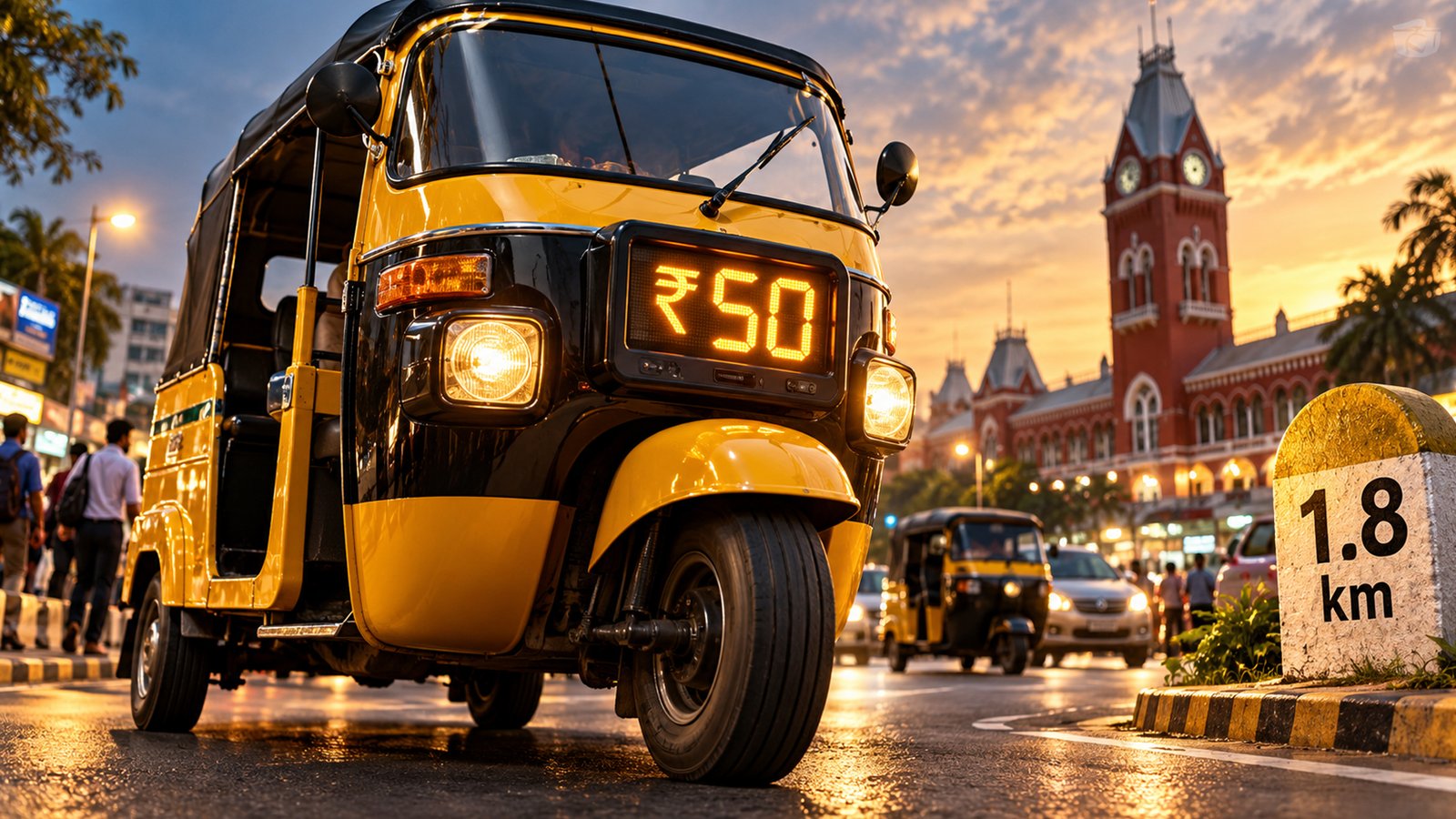
Passengers using auto-rickshaws in Tamil Nadu will face higher travel costs after the state government revised fares for the first time in 13 years. The minimum fare has been doubled from ₹25 to ₹50 for the first 1.8 kilometres, while the charge for every additional kilometre has increased from ₹12 to ₹25.
The revised fare structure covers contract carriage autorickshaws operating in the Chennai Metropolitan Area and other regions of Tamil Nadu. The government notified the new rates in the Tamil Nadu Government Gazette on October 27, replacing earlier fare notifications issued in 2013 and 2014.
The decision addresses long-standing demands from auto-rickshaw drivers, who have argued that rising fuel prices, vehicle maintenance expenses, insurance premiums and other operating costs have made the old fares increasingly difficult to sustain. At the same time, the increase is likely to affect household budgets, particularly for commuters who depend on autos for short daily journeys.
Under the new structure, passengers will pay ₹50 for the first 1.8 km and ₹25 for every additional kilometre. Waiting charges have been fixed at ₹1 per minute. The government has also prescribed higher rates for night journeys and travel involving ghat roads.
What are the new auto fares?
The revised rates represent a substantial increase over the fare structure that had remained in place for more than a decade. The earlier minimum fare was ₹25 for the first 1.8 km, followed by ₹12 for every additional kilometre. The new minimum fare doubles the initial charge, while the per-kilometre rate more than doubles.
For journeys involving ghat roads, the minimum fare has been set at ₹60, with an additional charge of ₹30 for every kilometre. The ghat fare is fixed at 1.2 times the regular minimum fare, reflecting the separate rate prescribed for these routes.
Night-time journeys will cost 1.5 times the regular fare between 10 pm and 5 am. The waiting charge will be ₹1 per minute under the revised structure.
The notification directs the State Transport Authority and the concerned Regional Transport Authorities to implement the revised rates. It was issued under Section 67 of the Motor Vehicles Act, 1988, which provides the legal framework for regulating fares and related transport matters.
Why has Tamil Nadu revised auto fares?
Auto-rickshaw fares had remained unchanged since August 2013 in Chennai, with a subsequent notification in October 2014 extending the fare framework to other districts. Over the years, drivers’ organisations repeatedly sought a revision, citing rising expenses and the difficulty of maintaining their livelihoods under the existing rates.
Drivers’ unions had sought a higher minimum fare of ₹60 for the first 1.5 km and ₹30 for each additional kilometre. Consumer organisations, meanwhile, proposed a minimum fare of ₹50 for the first 1.8 km or 2 km, followed by additional distance-based charges.
The government’s decision adopts the ₹50 minimum for the first 1.8 km, but fixes the additional distance charge at ₹25 per kilometre. The revision therefore reflects a compromise between demands for better earnings and concerns about the cost of travel for passengers.
The issue has also been the subject of judicial attention. The Madras High Court had previously called for a revision of auto fares, adding pressure on the authorities to address a fare structure that had become outdated.
Impact on daily commuters
The fare increase will be particularly relevant to office workers, students, senior citizens and other passengers who regularly use auto-rickshaws to reach bus stops, railway stations, hospitals and workplaces. Even short journeys will now start at a higher minimum charge, while longer trips will become more expensive because of the increased per-kilometre rate.
Night-time travel could carry a further cost, as the revised rules prescribe a fare 50% higher than the regular rate between 10 pm and 5 am. Waiting charges may also add to the final bill when traffic congestion or delays extend a journey.
The higher rates could provide some relief from increased operating costs for drivers. However, the impact on earnings will depend on passenger demand, the number of trips completed and competition from app-based transport services and bike taxis.
Transport authorities tasked with implementation
The Home Department’s Transport-I division issued the notification through Government Order No. 366 dated October 27. The order supersedes the earlier notifications dated August 25, 2013, and October 16, 2014, and directs the relevant transport authorities to put the revised fare structure into effect.
The change establishes a common revised framework for contract carriage autorickshaws across Chennai and other parts of the state. Passengers and drivers will need to familiarise themselves with the updated rates, including the separate provisions for ghat routes, waiting time and night journeys.
After 13 years without a fare revision, Tamil Nadu has reset the cost of auto-rickshaw travel in response to pressure from drivers and rising expenses. The key challenge now will be balancing fair compensation for drivers with affordable and transparent fares for the public.