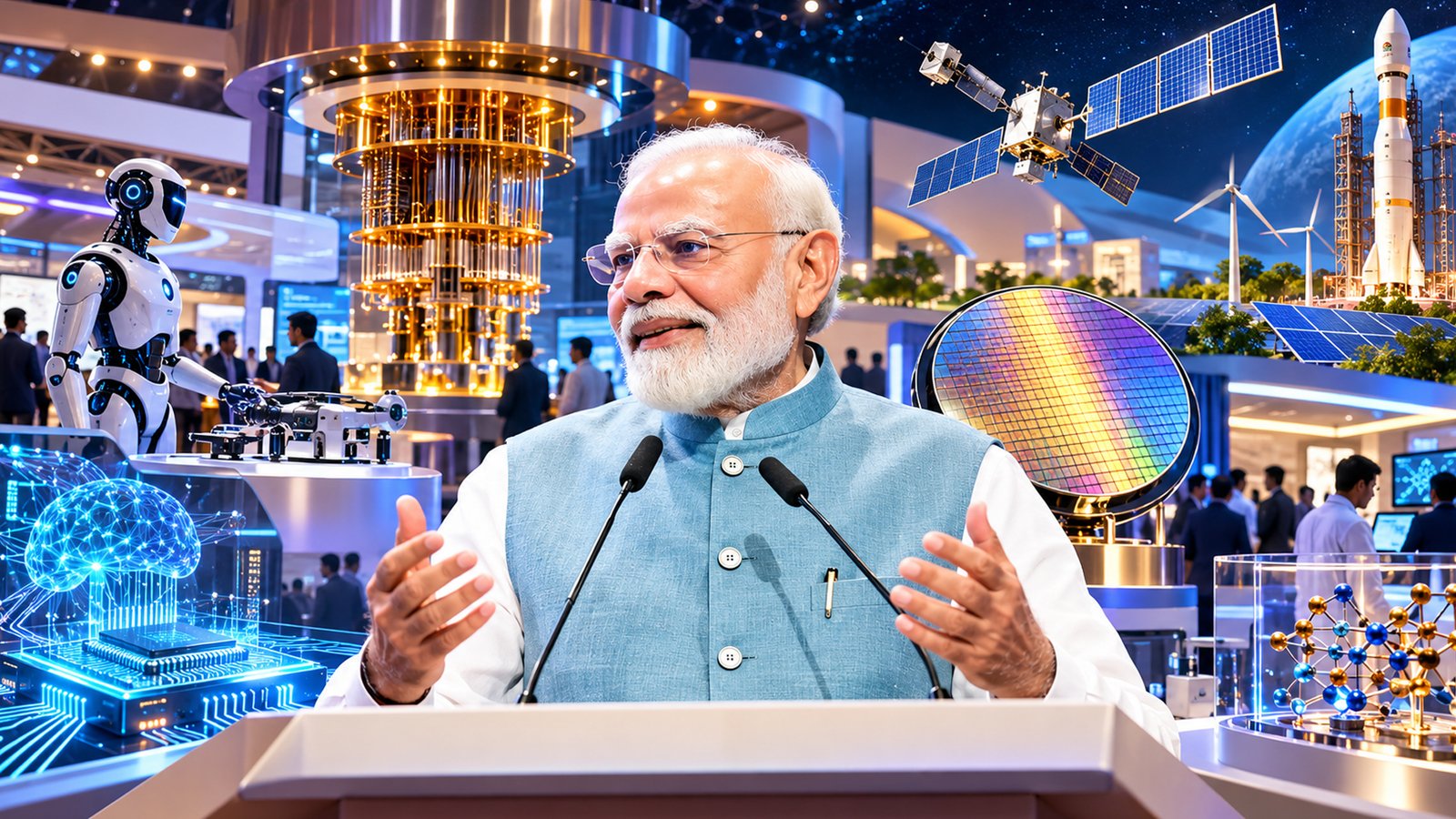
Prime Minister Narendra Modi inaugurated the Emerging Science, Technology and Innovation Conclave (ESTIC) 2026 in New Delhi on October 27, calling on scientists, researchers and startups to develop technologies that strengthen India’s self-reliance and address real-world challenges. He urged participants to move beyond discussions and set measurable targets for scientific breakthroughs, prototypes and products over the next three years.
The three-day conclave, being held at Bharat Mandapam from October 27 to 29, brings together scientists, policymakers, industry leaders, academics, startups and international experts. Its focus is on building India’s research capabilities and accelerating the journey from scientific discoveries to practical applications. The event covers 12 thematic areas, including artificial intelligence (AI), biotechnology, semiconductors, advanced materials, manufacturing, healthcare, energy, climate and ocean sciences.
Addressing the gathering, he said India should no longer remain a follower of technologies developed elsewhere but should aim to create original innovations and help shape global technological progress. He highlighted the country’s achievements in space exploration, nuclear energy, indigenous digital infrastructure and semiconductor manufacturing as examples of its growing scientific capabilities.
The Prime Minister recalled India’s development of indigenous COVID-19 vaccines, its Mars mission and the Chandrayaan-3 landing near the Moon’s south pole. He said these achievements reflected a growing confidence among Indian scientists and demonstrated the potential to develop solutions for challenges faced by other countries.
Research funding and innovation
PM Modi highlighted the government’s commitment to research, development and innovation, recalling the announcement of a ₹1 lakh crore funding commitment at the previous edition of the conclave. According to the Prime Minister, government support of ₹12,000 crore for technologies approaching market readiness over the past year has attracted an equal commitment of ₹12,000 crore from private investors.
This represents a combined commitment of ₹24,000 crore towards research and development, he said. The investment is intended to help bridge the gap between laboratory research and commercial applications, encouraging businesses to support promising technologies and bring them to market.
He also pointed to the growth in India’s patent filings. Annual filings have increased from fewer than 50,000 a decade ago to nearly 1.5 lakh in the previous year. He described the rise as evidence of a broader shift towards a stronger research and innovation culture.
The government has been seeking greater participation from private industry, universities and startups to expand the country’s research ecosystem. Such collaboration is important for developing technologies that can compete internationally while addressing India’s domestic requirements.
Focus on critical technologies
Nuclear energy featured prominently in PM Modi’s address. He highlighted progress in India’s indigenous 500-megawatt Prototype Fast Breeder Reactor, which achieved first criticality earlier this year. The milestone marks an important step in developing advanced nuclear technology and strengthening long-term energy security.
He also referred to developments in the space sector, including an Indian startup placing a satellite into orbit on its first attempt using a domestically developed rocket. India’s satellite docking capabilities were another achievement cited as evidence of progress in advanced space technology.
The Prime Minister said India was expanding its capabilities in artificial intelligence, semiconductors and battery storage. He noted that the country had introduced its own AI model and begun shipping domestically manufactured semiconductor chips to international markets.
These developments, he said, could help reduce dependence on imported technologies and strengthen India’s position in strategically important industries. Building domestic capabilities in critical technologies is also important for economic resilience and national security.
AI must support scientific thinking
PM Modi also cautioned scientists against relying on artificial intelligence without independently checking its results. While AI can accelerate routine work and improve productivity, he said researchers must retain the ability to question assumptions, verify information and test conclusions through experiments.
He argued that the time saved through AI should allow scientists to investigate more complex problems rather than limit independent thinking. The responsibility for confirming the accuracy of AI-generated answers, he stressed, must remain with researchers.
The Prime Minister also called for stronger safeguards against emerging threats involving AI, synthetic biology and autonomous systems. He highlighted the need for AI-based and quantum security solutions to protect financial networks, critical infrastructure and national security.
Science that improves everyday life
The address placed particular emphasis on making scientific progress useful to ordinary citizens. PM Modi said innovation should strengthen healthcare, agriculture, education, employment and disaster resilience instead of remaining confined to research laboratories.
He cited emerging technologies in brain monitoring, wireless communications, specialised nutrition, semiconductors and industrial waste management as examples of research that could deliver practical benefits. He also referred to a brain imaging facility at IIT Madras designed to support research into neurological diseases.
ESTIC 2026 features around 150 deep-tech startup stalls and a Global Connect Networking Event involving more than 300 invited participants from academia, research institutions and industry in India and abroad. These initiatives aim to encourage collaboration and help researchers connect with potential investors and commercial partners.
Concluding his address, PM Modi urged every researcher, industry leader, startup founder and student to identify a concrete technological goal for the next three years. He said the conclave should produce measurable outcomes rather than remain an exchange of ideas.