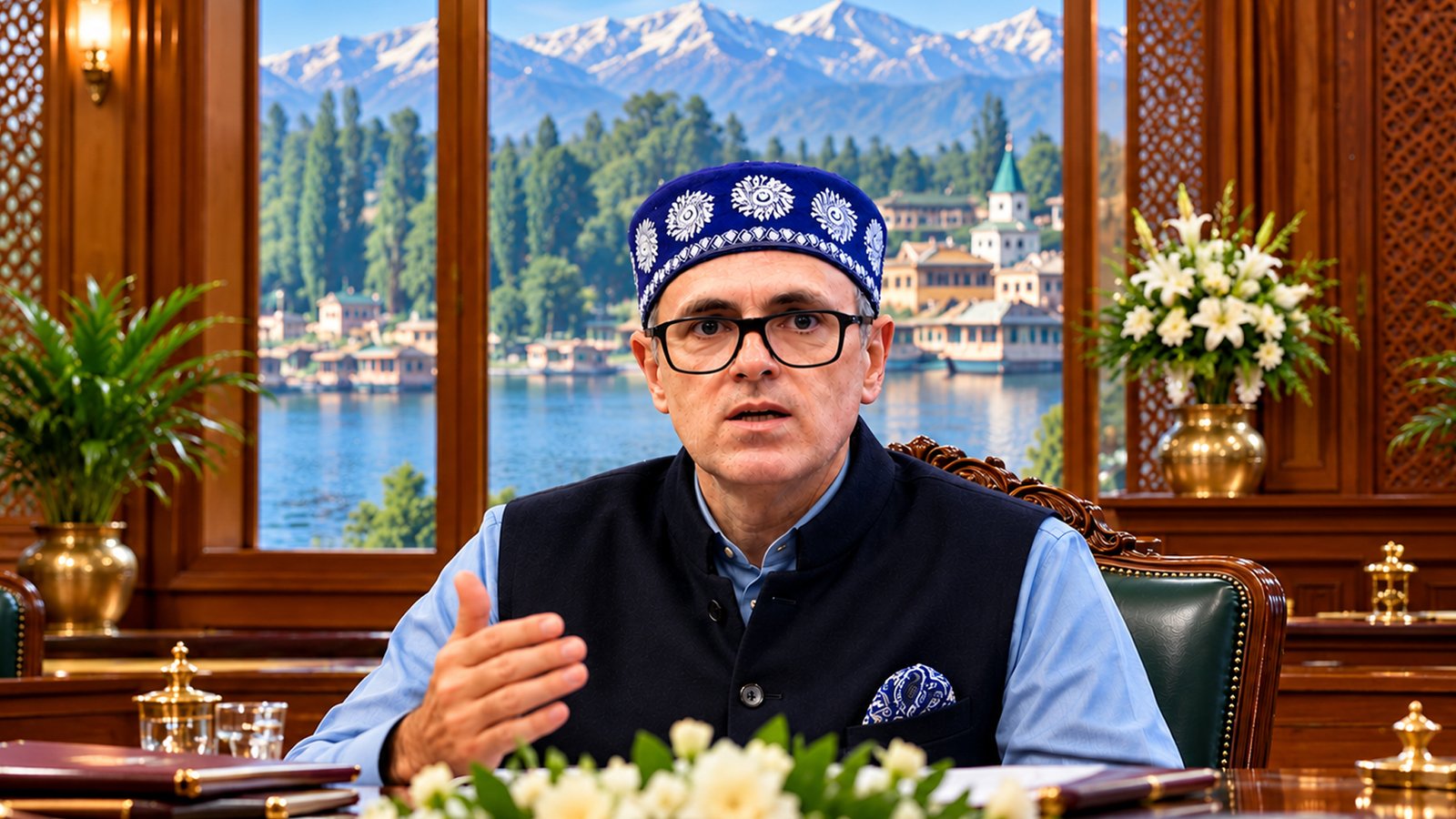
Jammu and Kashmir Chief Minister Omar Abdullah expanded his Council of Ministers on October 27, inducting four National Conference (NC) legislators in a reshuffle that has triggered discontent within the ruling party and raised questions about regional representation. The expansion brought experienced leaders back into the government, but the decision to appoint four politicians from the Kashmir Valley while dropping the cabinet’s sole representative from mainland Jammu has added to the controversy.
Ali Mohammad Sagar, Shameema Firdous, Mir Saifullah and Altaf Ahmad Wani, popularly known as Altaf Kaloo, took the oath of office and secrecy at Lok Bhawan in Srinagar. Lieutenant Governor Manoj Sinha administered the oath in the presence of Omar Abdullah and senior National Conference leaders.
The reshuffle also saw Independent legislator Satish Sharma dropped from the ministry. Sharma had represented the Chhamb constituency in the Jammu division and held the sports and technical education portfolios. His removal means mainland Jammu no longer has a representative in the cabinet, although the Jammu region continues to have two ministers from the Pir Panjal area.
The expansion takes the Council of Ministers to its maximum permitted strength of nine, including the chief minister. Under the Jammu and Kashmir Reorganisation Act, 2019, the council cannot exceed 10 per cent of the 90-member Legislative Assembly.
The appointments bring several familiar political figures into the administration. Ali Mohammad Sagar, a senior National Conference leader and seven-time legislator, has extensive experience in government. He served in earlier administrations led by Farooq Abdullah and Omar Abdullah and has represented constituencies in Srinagar for decades.
Mir Saifullah, who represents Trehgam in north Kashmir, is another experienced politician who has previously held ministerial office. Shameema Firdous, the MLA from Habba Kadal in Srinagar, is a prominent party leader and has headed the National Conference women’s wing. Her induction increases the number of women in the cabinet to two, alongside Sakina Itoo.
Altaf Ahmad Wani, known as Altaf Kaloo, represents Pahalgam in south Kashmir. His appointment adds another legislator from the Valley to the government and gives the cabinet representation across parts of central, north and south Kashmir.
The selections appear to reflect the party leadership’s preference for experienced legislators and leaders with established constituencies. However, the choice has also left several politicians who expected ministerial positions disappointed.
The cabinet expansion has exposed tensions within the National Conference, with some senior leaders publicly expressing frustration at being left out. Among those reported to be unhappy are Mubarak Gul, Abdul Majid Larmi and Nazir Gurezi.
Gul’s supporters reportedly staged a protest outside the chief minister’s presence at the party headquarters in Srinagar, demanding that he be accommodated in the government. The veteran legislator was appointed the party’s general secretary, but the decision did not immediately resolve the concerns raised by his supporters. Gul has sought time before deciding his next move.
The disappointment reflects the difficult choices facing a party leadership that must balance seniority, electoral strength, regional demands and expectations built up after winning the 2024 Assembly election. With only a limited number of ministerial positions available, several aspirants were bound to be excluded.
National Conference president Farooq Abdullah defended the reshuffle, expressing confidence that the new ministers would work to address people’s problems. The leadership’s challenge now will be to prevent individual grievances from turning into a wider organisational dispute.
The cabinet’s composition has also drawn criticism from the Bharatiya Janata Party. With all four new ministers coming from the Kashmir Valley, seven members of the nine-person council now represent the Valley, while Deputy Chief Minister Surinder Chaudhary and Javid Rana remain the two ministers from the Jammu region.
BJP leader and Leader of Opposition Sunil Sharma criticised the government over what he described as a lack of regional and cultural balance. The criticism places the focus on whether the cabinet adequately reflects the political and social diversity of the Union Territory.
The issue is particularly sensitive because the Jammu and Kashmir government operates under the Union Territory framework, while demands for the restoration of statehood remain central to the region’s politics. The Congress, an alliance partner of the National Conference, has continued to stay out of the cabinet until statehood is restored, though it has maintained support from outside
The immediate task for Omar Abdullah is to allocate portfolios and ensure that the expanded cabinet begins functioning smoothly. Before the swearing-in, the existing ministers had submitted resignations as part of the reshuffle process. The chief minister subsequently met the newly inducted ministers and congratulated them on taking office.
The new appointments may help the government draw on the experience of senior National Conference leaders, but political management will be equally important. The administration must address public concerns while keeping its own legislators and alliance partners engaged.
The cabinet expansion is the first major reshuffle since the National Conference returned to power in 2024. It has strengthened the party’s presence in the government but also created fresh questions about inclusion, regional representation and internal decision-making.