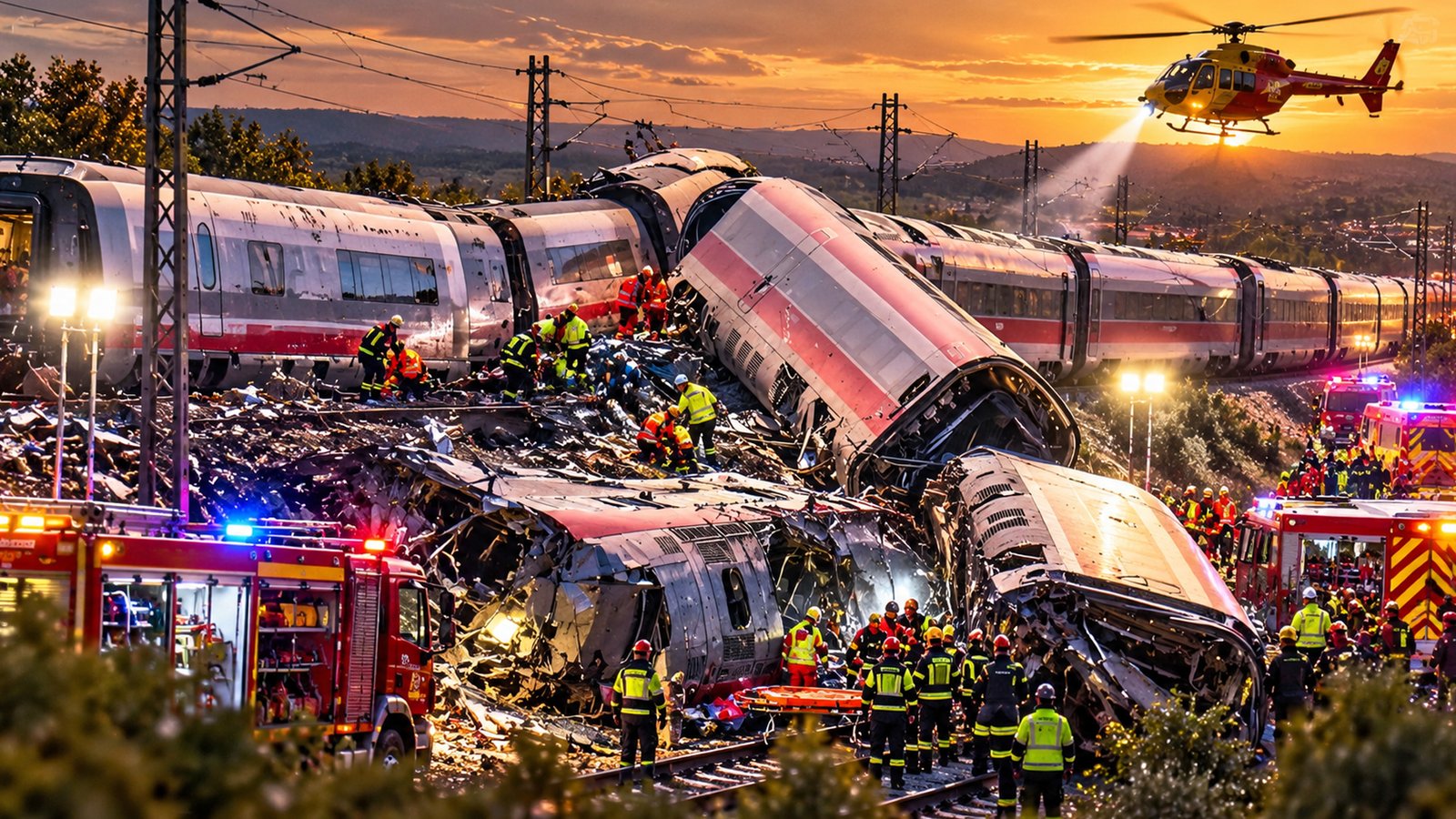
At least 68 people have been killed and around 80 injured after two high-speed trains collided in Spain’s Toledo province, turning a railway corridor into a scene of devastation. The crash happened near Urda, south of Madrid, on Wednesday morning, October 28. Rescue teams worked through wrecked carriages as authorities warned that the final toll could change.
The collision involved a state-run Renfe AVE train travelling from Madrid towards Seville and an Iryo train operated by a private company. Officials said the trains were moving in the same direction when the Renfe train struck the rear of the Iryo, which was stationary on the track. The impact derailed several carriages, with some wreckage tumbling down an embankment.
The trains were carrying more than 500 passengers. Regional authorities said 397 people were aboard the Renfe service and 147 on the Iryo train. At least 68 people died, while about 80 were injured. Fifteen injured passengers were reported to be in a serious condition, and hospitals activated emergency arrangements.
Images from the scene showed twisted metal, overturned carriages and belongings scattered near the tracks. Survivors described a sudden impact that threw passengers against seats and sent luggage flying. Some escaped through broken windows, while others waited for help near the railway line. Passengers said they were initially confused about what had happened and when they would be allowed to leave.
Survivors described a violent impact that threw people from their seats and sent luggage flying. Some helped fellow passengers escape and contacted relatives, while local workers rushed to the wreckage with first-aid supplies.
Firefighters, police, ambulance crews, medical helicopters and military emergency personnel were deployed. Rescue workers focused on reaching the most damaged carriages, helping survivors and recovering bodies. Hospitals reorganised staff and operating theatres to treat injured passengers.
The investigation is focusing on a failure in the railway signalling system and the decisions taken by the central control centre afterwards. Transport Minister Óscar Puente said a computer communications problem caused the LZB safety system to stop working along a stretch of about 63 kilometres at around 8.30am. The system normally monitors train movements and helps ensure trains keep a safe distance.
The failure reportedly caused several trains in the area to stop. Traffic control then took over, and the Renfe train was authorised to resume its journey even though the Iryo train remained stationary further ahead. The collision occurred at about 8.53am. Puente described the decision to restart the train without the system operating as inexplicable and said it should not have been allowed to proceed at normal speed while a stop signal remained active.
The investigation is ongoing, and individual responsibility has not been established. Early accounts point to a possible combination of technical failure and human error, but officials have cautioned against final conclusions. Investigators will examine instructions issued, crew communications and safety procedures.
Prime Minister Pedro Sánchez visited the area and promised a full investigation, saying any negligence or system failures would be brought to light. The government declared three days of national mourning from October 29 to 31. Sánchez said Spain needed to strengthen confidence in its high-speed rail network and described two rail disasters in one year as unacceptable.
The crash has renewed scrutiny of Spanish railway safety. In January, 46 people died in another high-speed rail disaster near Adamuz in Córdoba province. Officials have said the two accidents appear to have different causes, but the latest collision is likely to intensify questions about maintenance, signalling safeguards and train management when automated systems fail.
Spain has one of Europe’s largest high-speed rail networks, connecting cities for commuters and tourists. The Madrid–Seville line was the country’s first high-speed route and continues to rely on the LZB system alongside other safety technology. Investigators will examine whether safeguards were adequate when the signalling system failed and whether operating rules were applied.
Rail services between Madrid and Andalusia were suspended after the crash, disrupting journeys and leaving passengers waiting at stations for updates. Renfe and Iryo activated emergency procedures and offered support to affected families. Relatives were directed to official information channels.
The wreckage must be examined before damaged carriages can be cleared and normal services resume. As Spain mourns the dead, the investigation will be central to explaining how two trains came to occupy the same stretch of track and what changes may be needed to prevent another tragedy.