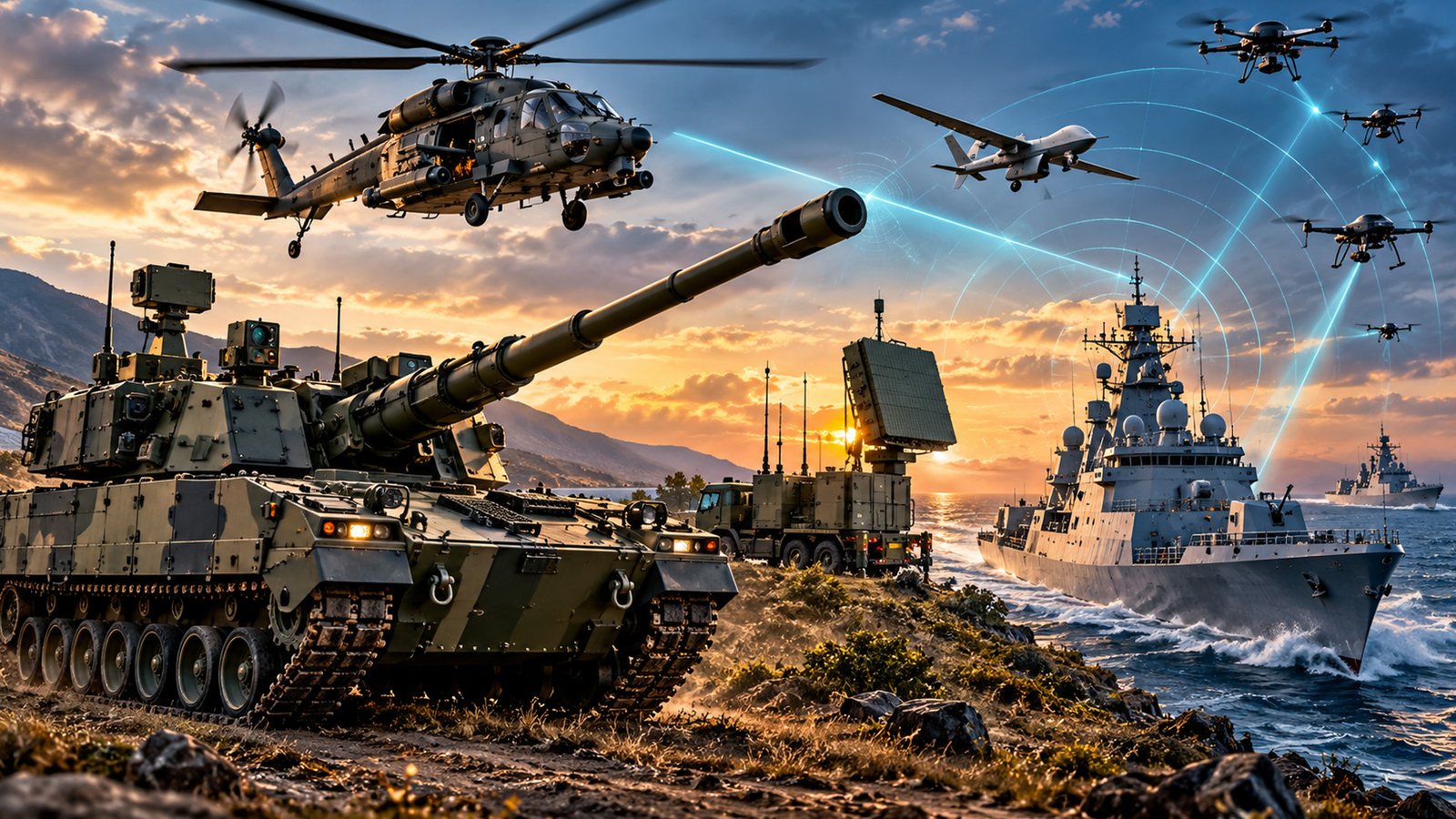
India has taken another major step towards modernising its armed forces, with the Defence Acquisition Council (DAC) clearing capital procurement proposals worth approximately ₹2.12 lakh crore. The approvals cover a wide range of military equipment, including artillery systems, helicopters, drones, air-defence equipment and advanced naval platforms. The decision is expected to strengthen the operational capabilities of the Army, Navy and Air Force while giving a significant push to domestic defence manufacturing.
The council, chaired by Defence Minister Rajnath Singh, granted Acceptance of Necessity (AoN) to the proposals on October 26, 2026. According to the Ministry of Defence, around 82% of the proposed procurement value will be sourced from Indian industry. The move supports the government’s focus on self-reliance in defence production and reducing dependence on imported military equipment.
The approval is an important stage in the procurement process, but it does not mean that contracts have been signed or the equipment has been delivered. Further steps, including procurement procedures and contract negotiations, will determine when the armed forces receive the approved systems.
The proposals cover High Mobility Vehicles, Self-Propelled Tracked Gun Systems, Gun Shot Response Systems, Light Multi-Role Helicopters, Very Short-Range Air Defence Systems and counter-unmanned aerial systems. The council has also cleared proposals involving surveillance drones, integrated surveillance and strike systems, and long-range kamikaze drones.
These acquisitions are intended to address the changing requirements of modern warfare, where mobility, real-time intelligence and the ability to respond quickly to aerial threats have become increasingly important.
High Mobility Vehicles will help troops and equipment move across difficult terrain while improving logistics support. Self-Propelled Tracked Gun Systems will provide mechanised formations with greater mobility and firepower. These systems can move with advancing units, allowing artillery support to keep pace with ground operations.
The Gun Shot Response System is designed to provide troops with real-time information about incoming fire, helping them identify threats and respond more effectively. Meanwhile, Very Short-Range Air Defence Systems will help the Army counter small, low-flying aerial threats. Counter-drone systems are intended to improve the protection of tanks and other armoured vehicles against unmanned aerial attacks.
The proposed surveillance and strike systems will also strengthen the Army’s ability to monitor operational areas and identify potential targets. Long-range kamikaze drones, designed to strike identified targets, could provide additional options for precision attacks. Their inclusion reflects the growing importance of unmanned technology on modern battlefields.
The proposals also cover additional K9 Vajra-T self-propelled artillery guns, according to reports on the clearances. These tracked systems are designed to deliver mobile artillery firepower and can operate in demanding conditions, including high-altitude environments.
The Indian Navy will benefit from approval for Active Offboard Decoy Systems and other major naval platforms. An Active Offboard Decoy System is designed to divert incoming anti-ship missiles away from a vessel, strengthening its protection against modern maritime threats. The proposed naval platforms are expected to incorporate contemporary combat capabilities and improve the Navy’s operational readiness.
For the Indian Air Force, the council cleared proposals for helicopters, air-defence systems, weapons and Mobile X-Band Doppler Weather Radar Systems. Special Utility Helicopters will support important air transport requirements, while the weather radars will provide detailed, localised weather information in forward areas. Such information is important for flight planning, operational safety and mission coordination.
The procurement proposals also underline the increasing role of technology in defence preparedness. Surveillance drones, counter-drone equipment, advanced radar systems and integrated strike capabilities can help military personnel collect information faster, identify threats and coordinate responses across different operational environments.
The emphasis on Indian suppliers is significant for the country’s defence manufacturing sector. Greater domestic procurement can support Indian manufacturers, create opportunities for technology development and strengthen supply chains for specialised military equipment. It can also encourage companies to invest in research, engineering and production capabilities.
India’s defence production reached a record ₹1.78 lakh crore in the financial year 2025-26, compared with ₹1.54 lakh crore in the previous financial year. The government aims to increase annual defence production to ₹3 lakh crore by 2029-30 and has set a defence export target of ₹50,000 crore for the same period.
The latest approvals follow another round of clearances worth approximately ₹1.1 lakh crore in September. Together, the decisions reflect the government’s continuing focus on military modernisation and indigenous manufacturing.
However, the practical impact will depend on how quickly the proposals progress to contracts, production and delivery. For the armed forces, the objective is to secure reliable equipment that meets operational requirements. For Indian manufacturers, the approvals could create substantial opportunities if they translate into orders.
The ₹2.12 lakh crore clearance therefore represents both a military modernisation initiative and a major potential opportunity for India’s defence technology industry.