The dispute over the lighting of the Karthigai Deepam at Thirupparankundram hill in Tamil Nadu has taken a fresh political turn, with allies of Chief Minister C Joseph Vijay questioning the Supreme Court’s latest directive. The Tamil Nadu Congress and Marumalarchi Dravida Munnetra Kazhagam (MDMK), led by Vaiko, have expressed strong objections to the order, citing concerns over religious harmony, federal principles and the limits of judicial intervention.
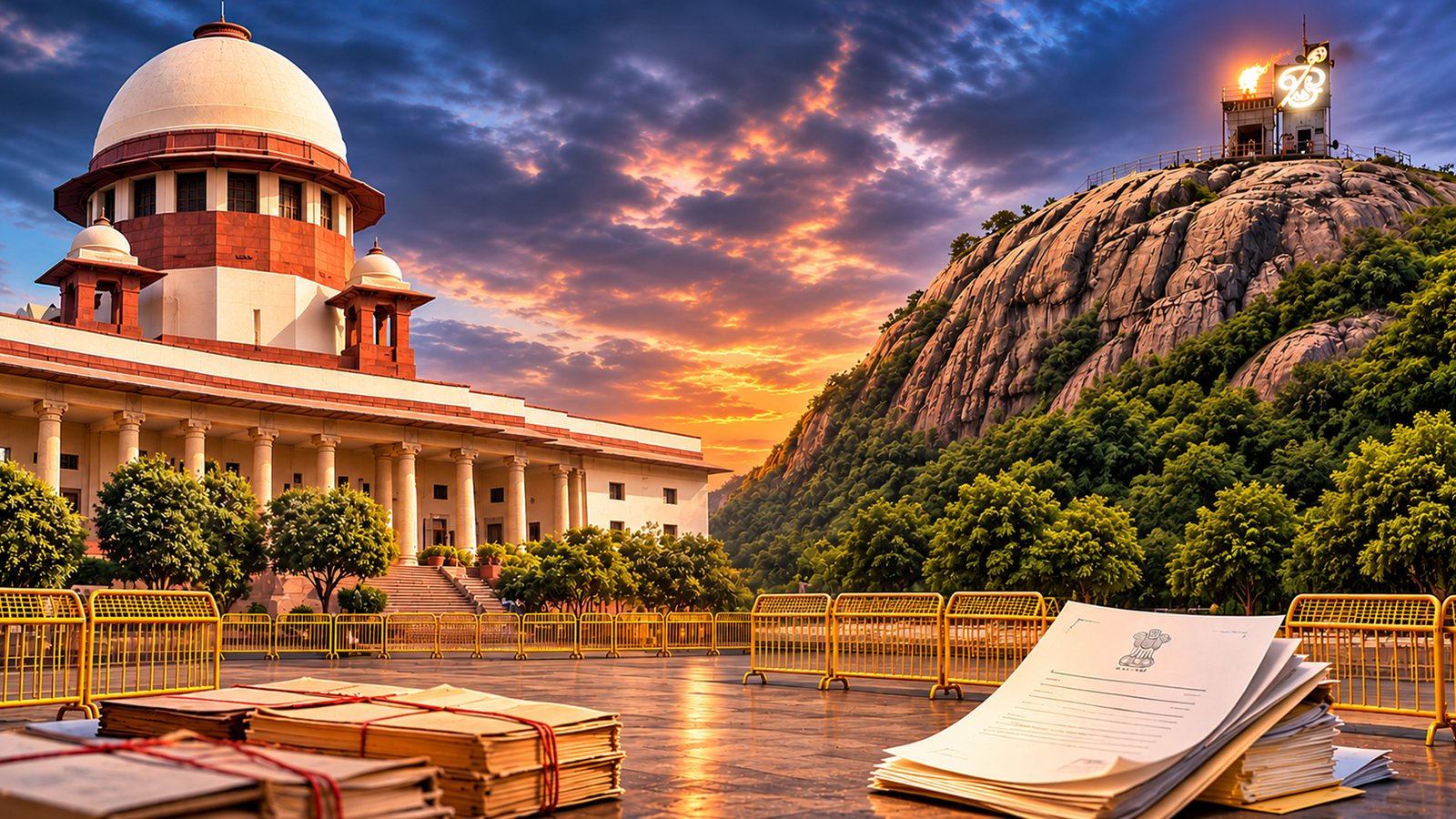
The developments come as preparations are underway for the court-ordered lighting of the ceremonial lamp at the Deepathoon, a stone pillar on Thirupparankundram hill in Madurai. The Supreme Court has directed that the lamp be lit on Saturday, November 28, following the failure of the state authorities to implement its earlier order issued on November 20.
Tamil Nadu Congress Committee president Manickam Tagore has urged the Supreme Court to reconsider its directive. In a statement, he said the party was concerned about the implications of the order for religious freedom, community harmony and the constitutional responsibilities of the state government.
Tagore also questioned the court’s intervention in temple administration, the appointment of a committee comprising retired judges and the deployment of central forces for security arrangements. He argued that the respective roles of the judiciary, state administration and temple authorities needed to be considered.
The Congress leader maintained that upholding the rule of law should go hand in hand with protecting Tamil Nadu’s social harmony and constitutional values. His remarks have drawn a response from the BJP, with party leader Vinoj Selvam taking a swipe at Tagore over his objections.
Vaiko, general secretary of the MDMK and another ally of the ruling Tamilaga Vettri Kazhagam (TVK), has also criticised the Supreme Court’s order. He argued that the directive went against the centuries-old tradition followed at the temple and questioned the court’s intervention, invoking the constitutional principle of secularism.
The opposition from Congress and MDMK has brought the differences within Vijay’s ruling alliance into sharper focus. The CPI(M) and Viduthalai Chiruthaigal Katchi (VCK) have also expressed reservations about the court’s directive, describing it as an issue involving federal principles and the authority of the state.
The controversy centres on the location where the Karthigai Deepam, an important Tamil Hindu festival, should be lit on the hill. Traditionally, the ceremonial lamp has been illuminated at the Deepa Mandapam near the Uchipillaiyar Temple. However, Hindu groups sought permission to light an additional lamp at the Deepathoon, a stone pillar located close to the Hazrat Sultan Sikandar Badusha Auliya Dargah.
On November 20, the Supreme Court permitted the lighting of the lamp at the Deepathoon as a one-time arrangement for this year’s festival. The court clarified that the permission would not establish any additional right of entry, occupation or control over the hilltop or determine the ownership of the disputed location.
However, on November 24, the festival day, the ceremonial lamp was lit at the customary location near the Uchipillaiyar Temple, while the Deepathoon remained unlit. The Tamil Nadu government had also filed a review petition challenging the Supreme Court’s earlier direction.
The matter returned to the Supreme Court on November 27 following contempt petitions alleging non-compliance with its November 20 order. Taking a serious view of the developments, a bench of Justices Aravind Kumar and Vipul M Pancholi directed that the lamp be lit at the Deepathoon on November 28.
The court also issued contempt notices to 15 officials, including the Tamil Nadu Chief Secretary, Director General of Police, Madurai District Collector and officials of the Hindu Religious and Charitable Endowments Department. It sought details of communications among government officials ahead of the November 24 ceremony.
In another significant step, the Supreme Court suspended the temple’s Board of Trustees and appointed two former judges, Justices S Vaidyanathan and V Parthiban, as receivers to oversee the temple administration and ensure compliance with its directions. The court also ordered the deployment of the Central Reserve Police Force (CRPF) to maintain security and protect both the temple and the nearby dargah.
Preparations for Saturday’s ceremony began under heightened security. CRPF personnel took control of security arrangements across the hill, with checkpoints established along the foothills, pathways and hilltop. A 50-metre buffer zone has been maintained around the dargah, while access for Muslim devotees visiting the shrine is being facilitated.
Temporary platforms and scaffolding have been erected around the Deepathoon to help priests carry out the ritual. The Supreme Court-appointed receivers have also consulted the temple’s hereditary priests, known as sthanikars, to finalise the arrangements. The lamp lighting is expected around 5 pm, with only about 20 authorised stakeholders permitted at the hilltop.
Meanwhile, Muslim devotees continued visiting the dargah on Saturday, with security personnel regulating movement to ensure that religious activities at both sites could proceed without disruption.
The BJP has welcomed the Supreme Court’s intervention, with Prime Minister Narendra Modi describing the development as a victory for Lord Murugan. The party has criticised the Vijay government over its handling of the issue.
The opposition AIADMK has also targeted the state government. Party chief Edappadi K Palaniswami said the Supreme Court’s strong remarks had brought embarrassment to Tamil Nadu and urged the government to find an appropriate solution.
With political disagreements deepening and security arrangements tightened, the Thirupparankundram Deepam dispute has moved beyond a disagreement over a religious ritual. The questions surrounding religious practices, judicial authority, temple administration and communal harmony are now at the centre of a wider political and legal debate in Tamil Nadu.