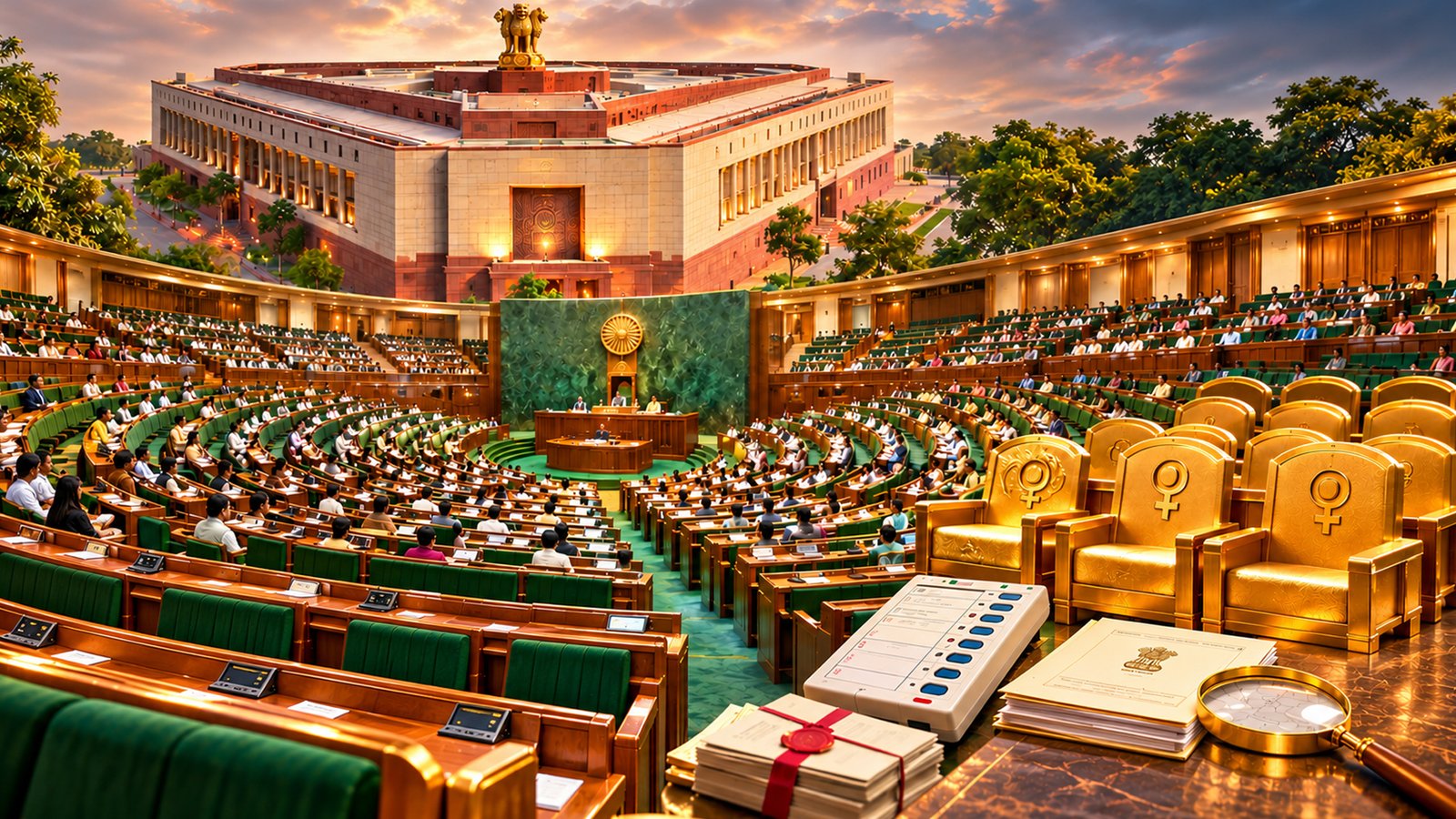
The Centre’s revised Delimitation Bill, which proposes a 50% increase in the strength of the Lok Sabha, has triggered a fresh political debate ahead of the special session of Parliament beginning November 30. The proposal seeks to increase the number of parliamentary seats from the existing 543 to a maximum of 850, while creating a pathway for implementing the 33% reservation for women in the Lok Sabha and state Legislative Assemblies.
The Union Cabinet, chaired by Prime Minister Narendra Modi, cleared two important legislative proposals on November 27. These include the Constitution (132nd Amendment) Bill, 2026, and the Delimitation (Second) Bill, 2026. The government intends to move forward with the proposed changes during the upcoming parliamentary session, with the broader objective of implementing women’s reservation before the 2029 general elections.
Under the revised framework, the Lok Sabha’s strength could rise to a maximum of 850 members. Of these, up to 815 seats would be allocated to states and 35 to Union Territories. The proposal also provides for a 50% increase in the maximum strength of state Legislative Assemblies, raising the ceiling from 500 to 650 members.
One of the significant changes in the revised proposal is the provision for a uniform 50% increase in the existing Lok Sabha seat allocation of every state and Union Territory. This is intended to address concerns that states with lower population growth could lose their relative political representation if seats were redistributed solely on the basis of population.
The proposal also seeks to maintain the existing proportion of parliamentary representation among states until 2051, or until the relevant figures of the first Census conducted after 2051 are published. This provision is particularly important for southern states, which have expressed concerns that a population-based delimitation exercise could reduce their relative influence in Parliament.
The proposed delimitation exercise will use the 2011 Census figures as its basis. A Delimitation Commission will be constituted to redraw constituency boundaries and oversee the allocation of seats. The commission will determine the boundaries of parliamentary and Assembly constituencies in accordance with the revised constitutional framework.
Delimitation is the process of redrawing electoral constituency boundaries and determining the number of seats allocated to different regions. Its purpose is to ensure fair representation by accounting for changes in population. In India, the allocation of Lok Sabha seats among states has remained frozen since 1971, although constituency boundaries were last comprehensively redrawn using the 2001 Census. The freeze was extended through constitutional amendments, with the existing arrangement linked to the first Census conducted after 2026.
The new proposal seeks to establish a different framework by expanding legislative representation while protecting the relative share of states for the coming decades.
A central objective of the legislation is to accelerate the implementation of the Nari Shakti Vandan Adhiniyam, popularly known as the Women’s Reservation Act. Passed by Parliament in September 2023 as the 106th Constitutional Amendment, the law provides for reserving one-third of seats for women in the Lok Sabha, state Legislative Assemblies and the Delhi Assembly.
However, its implementation was linked to the completion of a Census and a subsequent delimitation exercise. This meant that women would have to wait until these processes were completed before the reservation could take effect. The fresh constitutional amendment seeks to address this delay by bringing forward the delimitation process and linking the expansion of legislative seats to the implementation of the women’s quota.
Meanwhile, the proposed legislation has prompted opposition parties to question the government’s approach. At a meeting of INDIA bloc leaders in New Delhi on November 28, opposition parties discussed a common strategy ahead of the special session. The alliance demanded that women’s reservation be implemented within the existing strength of 543 Lok Sabha seats rather than being linked to an expansion of Parliament.
The opposition also called for maintaining the existing proportion of parliamentary representation among states for the next 25 years. Leaders raised concerns about the possible implications of delimitation for federal representation and the balance of political power between states.
The DMK, which had earlier voiced strong reservations about delimitation, announced its support for the revised proposal after a meeting of its MPs chaired by Tamil Nadu Chief Minister MK Stalin. Senior party leader A Raja said the decision followed the inclusion of safeguards intended to protect the state’s parliamentary representation.
The party has consistently argued that states which have successfully controlled population growth should not be disadvantaged through a redistribution of parliamentary seats. The revised provision for a uniform 50% increase has addressed some of these concerns.
The special parliamentary session will begin in the Lok Sabha on November 30, while the Rajya Sabha is scheduled to reconvene on December 2. The session is expected to conclude by December 3.
The constitutional amendment will require a special majority in both Houses of Parliament, with at least two-thirds of members present and voting supporting the legislation. Ratification by at least half of the state legislatures will also be necessary.
The earlier Constitution (131st Amendment) Bill, introduced in April 2026, failed to secure the required two-thirds majority in the Lok Sabha. The accompanying delimitation proposal consequently could not proceed.
The revised legislation now returns to Parliament with additional safeguards and a renewed push for women’s representation. Its passage will depend on the government’s ability to secure the necessary parliamentary support while addressing concerns over the distribution of political representation among states.