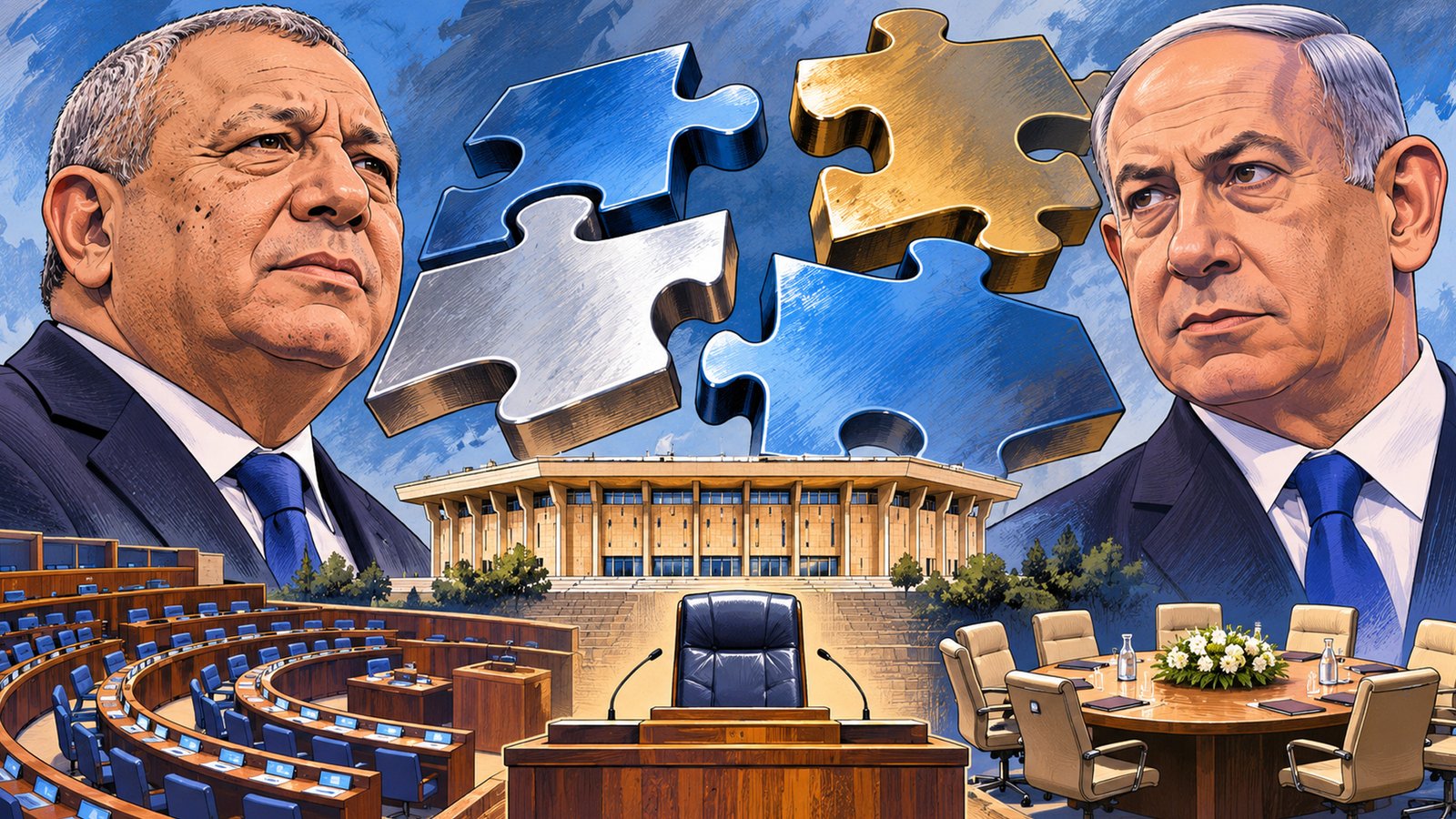
Israeli Prime Minister Benjamin Netanyahu is considering an unusual power-sharing arrangement with political rival Gadi Eisenkot, offering to serve as the second prime minister in a rotational government as efforts to break the country’s political deadlock gather pace.
The reported proposal comes amid intense negotiations following the inconclusive October 27 general election, which left neither Netanyahu’s Likud-led alliance nor the opposition bloc led by Eisenkot with enough seats to form a government independently.
According to media reports, Netanyahu is considering announcing his willingness to join a national unity government in which Eisenkot would serve as prime minister first, followed by Netanyahu. The proposal is reportedly being discussed through unofficial channels, with differences emerging within Netanyahu’s own Likud party over the arrangement.
The development comes at a crucial moment for Eisenkot, leader of the centrist Yashar party, who has been tasked by President Isaac Herzog with forming the next government. His mandate expires on December 6, although he can seek a further 14-day extension.
Election results leave Israel politically divided
The October 27 election produced a fragmented Knesset, Israel’s 120-member parliament. Netanyahu’s Likud-led bloc secured 53 seats, while the opposition alliance led by Eisenkot secured 48. Arab-led parties won a combined 19 seats.
With 61 seats required for a parliamentary majority, neither camp has been able to secure enough support to form a government.
Eisenkot has already made progress in coalition negotiations, reaching agreements with Avigdor Liberman’s right-wing Yisrael Beytenu and Yair Golan’s left-wing Democrats. Together, these parties hold 36 seats, with the potential support of former prime minister Naftali Bennett’s B’Yachad party taking the bloc’s strength to 48.
The agreement with the Democrats provides for four ministerial portfolios, including public security, labour and social affairs, communications, and culture and sport. The party is also expected to receive important parliamentary committee positions.
Eisenkot questions Netanyahu’s intentions
Despite the reported power-sharing offer, Eisenkot remains sceptical about Netanyahu’s willingness to make meaningful compromises.
In a statement on Friday, Eisenkot said representatives of the two parties had held five meetings over two weeks but had failed to make substantial progress on key issues.
He accused Likud of avoiding serious negotiations and attempting to run down the clock until his government-formation mandate expires. Eisenkot also suggested that Netanyahu’s party could be trying to force another election rather than allow an alternative government to take shape.
Among the major disagreements are the proposed establishment of a state commission of inquiry into the security failures surrounding the October 7, 2023, Hamas attack, changes to the judicial system and legislation governing military service for ultra-Orthodox Jewish men.
Eisenkot has called for an independent investigation into the October 7 attacks and changes to the existing military service arrangements. He has also demanded that far-right elements be excluded from the proposed government.
He maintains that a national unity government must involve substantive policy changes rather than simply distributing ministerial positions between political parties.
Liberman warns of political manoeuvre
Avigdor Liberman, whose party is an important partner in Eisenkot’s coalition-building efforts, has warned against accepting Netanyahu’s reported proposal without examining its political implications.
Liberman suggested that the rotating premiership offer could be a strategy to delay the formation of an alternative government and push Israel towards another election.
He argued that Netanyahu could prolong unity negotiations until the deadline approaches and subsequently find reasons to abandon the arrangement.
Eisenkot has reportedly assured Liberman and Golan that he would not enter a unity government with Likud without their approval. Both leaders have previously ruled out joining a government led by Netanyahu.
Meanwhile, Bennett has publicly favoured a national unity government involving Likud and has indicated that he would prefer an arrangement bringing together the major political forces. However, his position has created differences within Eisenkot’s wider opposition bloc.
Arab and ultra-Orthodox parties hold the key
With his existing partners falling short of a majority, Eisenkot must find additional parliamentary support.
One possibility involves securing support from the ultra-Orthodox United Torah Judaism (UTJ) party and the Arab-led United Arab List, known as Ra’am. However, bringing these parties together would require difficult compromises, particularly on military service, religious matters and national security.
Ra’am has reportedly offered to support an Eisenkot-led government’s security decisions throughout its proposed four-year term in exchange for ministerial representation and significant investment in Arab communities.
The party is also seeking measures to address crime in Arab society, improve infrastructure and promote development in Arab towns and mixed cities.
However, the proposal remains politically sensitive, as several of Eisenkot’s potential partners had campaigned against forming alliances with Arab-led or ultra-Orthodox parties.
For Netanyahu, the rotating premiership proposal could offer an opportunity to remain in government despite his bloc’s failure to secure a parliamentary majority. For Eisenkot, accepting the arrangement would require a significant political compromise with the leader he campaigned against.
With the December 6 deadline approaching, Israel’s coalition negotiations have entered a decisive phase. Whether Eisenkot can assemble the required 61 seats or Netanyahu succeeds in negotiating a national unity arrangement remains uncertain. If the current efforts fail, Israel could face another round of political uncertainty and potentially fresh elections.