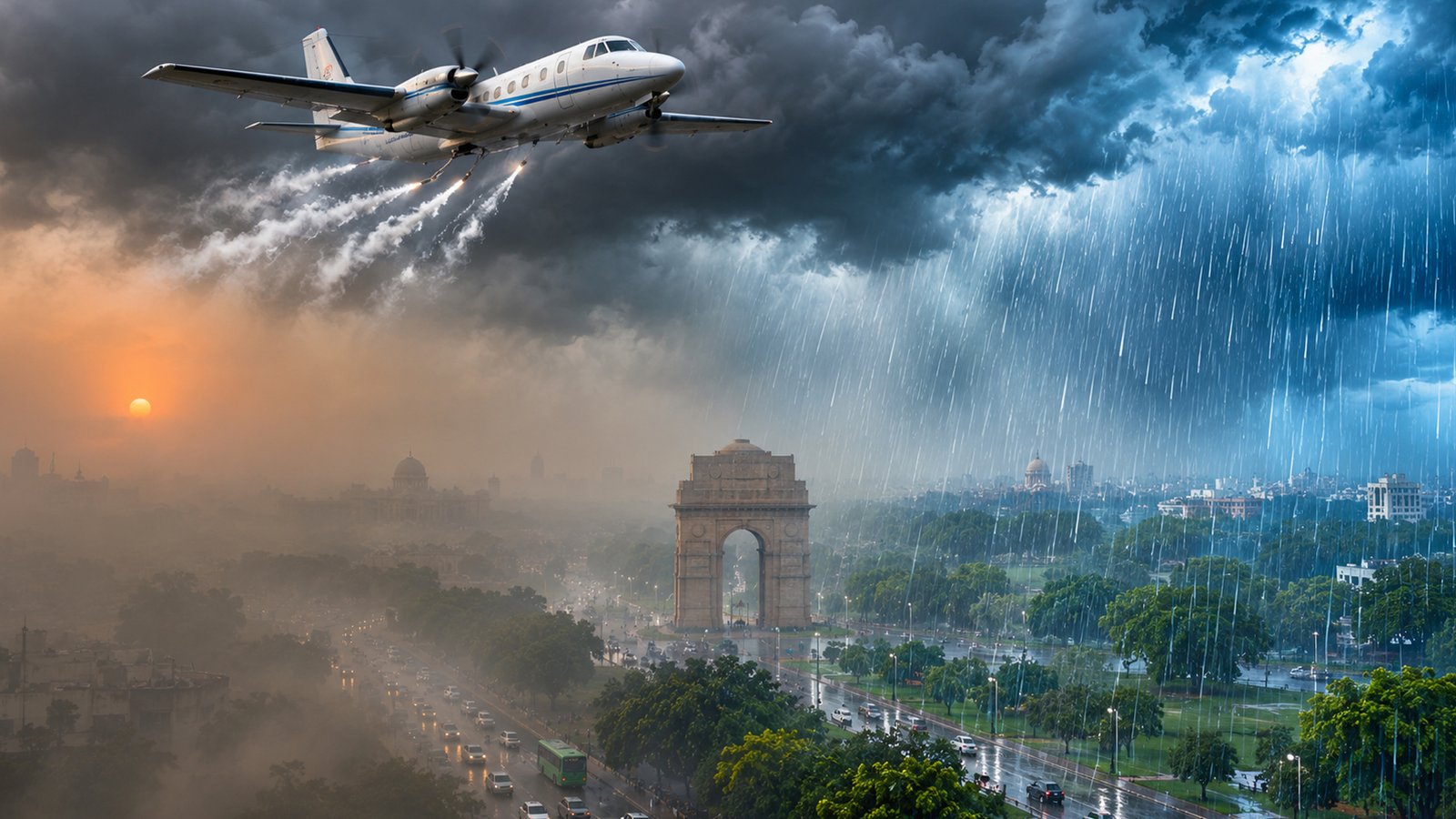
The Delhi government has conducted two rounds of cloud-seeding trials near the Indira Gandhi International (IGI) Airport over the past 15 days as it explores artificial rain as a possible way to tackle the capital’s worsening air pollution. More experiments are likely after Diwali and Chhath, as authorities look for additional measures to deal with the annual winter pollution crisis.
The trials were conducted at an altitude reported to be around 30,000 metres, considerably higher than the approximately 10,000 metres reported during similar cloud-seeding operations in Delhi last year. Government sources said further experiments were being considered, although an official announcement about the proposed operations was unlikely before Diwali.
The latest initiative comes at a time when Delhi’s air quality has deteriorated sharply. On November 5, the city’s average Air Quality Index (AQI) stood at 367 around 10 am, placing it in the very poor category. Several monitoring stations reported severe pollution, with Jahangirpuri recording an AQI of 459.
The government is hoping that cloud seeding, also known as artificial rain, could offer temporary relief by encouraging rainfall and helping remove suspended pollutants from the atmosphere. However, scientists say the technique depends heavily on weather conditions and cannot independently resolve the city’s long-standing pollution problem.
What is cloud seeding and how does it work?
Cloud seeding is a weather-modification technique designed to increase the possibility of precipitation from existing clouds. It involves introducing substances such as silver iodide and sodium chloride into suitable clouds to encourage the formation of water droplets or ice crystals.
These substances act as nuclei around which moisture can collect. As the droplets grow larger and heavier, they may eventually fall as rainfall, provided the atmospheric conditions are favourable.
Aircraft equipped with specialised equipment are commonly used to release chemical flares containing these substances into clouds. The process requires sufficient moisture, suitable cloud formations and appropriate temperatures. It cannot generate rainfall when there are no suitable clouds or adequate atmospheric moisture.
If successful, artificial rainfall could help reduce airborne dust and particulate matter by bringing some pollutants closer to the ground. This could provide temporary improvement in air quality, particularly during periods when pollution levels rise sharply.
IIT Kanpur partnership and previous experiments
Delhi’s cloud-seeding initiative was first launched in collaboration with the Indian Institute of Technology (IIT) Kanpur in 2025. The partnership was formalised through a memorandum of understanding between the Delhi Environment Department and IIT Kanpur on September 25, 2025.
The project was designed as a pilot programme to examine whether artificial rainfall could become an additional emergency measure during severe pollution episodes in the National Capital Region.
Two rounds of experiments were conducted in October 2025. During each operation, eight chemical flares containing silver iodide and sodium chloride were released into the atmosphere. However, neither experiment succeeded in producing rainfall.
The absence of rain was attributed to unfavourable atmospheric conditions, including insufficient moisture. Despite this, the Delhi government subsequently released an assessment claiming that particulate matter levels had declined in the targeted areas following the trials.
The latest experiments are intended to provide more information about the effectiveness of the technique and the relationship between cloud seeding and air pollution.
An important clarification from IIT Kanpur is that inducing rainfall is not the only objective of the current exercise. Scientists are also examining whether cloud seeding has any measurable impact on concentrations of PM2.5 and PM10, even when rainfall does not occur.
PM2.5 refers to fine particles that can penetrate deep into the lungs and enter the bloodstream. PM10 consists of larger airborne particles that can affect respiratory health. Both are important indicators when assessing the severity of air pollution.
More trials likely after Diwali and Chhath
Government sources have indicated that additional cloud-seeding operations could be conducted on two to three dates after Diwali and Chhath, depending on the availability of favourable weather conditions.
The latest trials were conducted around the airport and adjoining areas. Officials are also examining the operational arrangements for future experiments, including flight routes and the availability of suitable clouds.
According to IIT Kanpur officials, trials were carried out earlier in October, including on days close to rainfall. Scientists will have to examine the collected meteorological and pollution data to determine whether the operations contributed to any changes in air quality.
The project has continued beyond the initial winter experiments, with trial flights also being undertaken during other seasons to collect information about atmospheric conditions and the possible effects of the technology.
Can artificial rain solve Delhi’s pollution crisis?
Although cloud seeding offers another possible tool for pollution management, experts have repeatedly pointed out its limitations. Its success depends on the presence of moisture-bearing clouds, and the results cannot be guaranteed.
Rainfall can wash some suspended particles out of the atmosphere, but the improvement is generally temporary. Pollution can return quickly if emissions continue and weather conditions prevent pollutants from dispersing.
Delhi’s air pollution is caused by several factors, including vehicle exhaust, industrial emissions, construction dust, waste burning and crop-residue burning in neighbouring states. Firecracker emissions during Diwali can add to the existing pollution burden.
Low wind speeds and unfavourable weather conditions during winter further worsen the situation by trapping pollutants close to the ground.
The Centre and state governments therefore need sustained action to control emissions across the National Capital Region rather than depend on artificial rainfall alone.
For now, Delhi’s latest cloud-seeding trials represent an attempt to understand whether weather modification can provide additional short-term relief. The findings from these experiments and the proposed post-festival trials will help determine whether artificial rain can play a practical role in the capital’s pollution-control strategy.