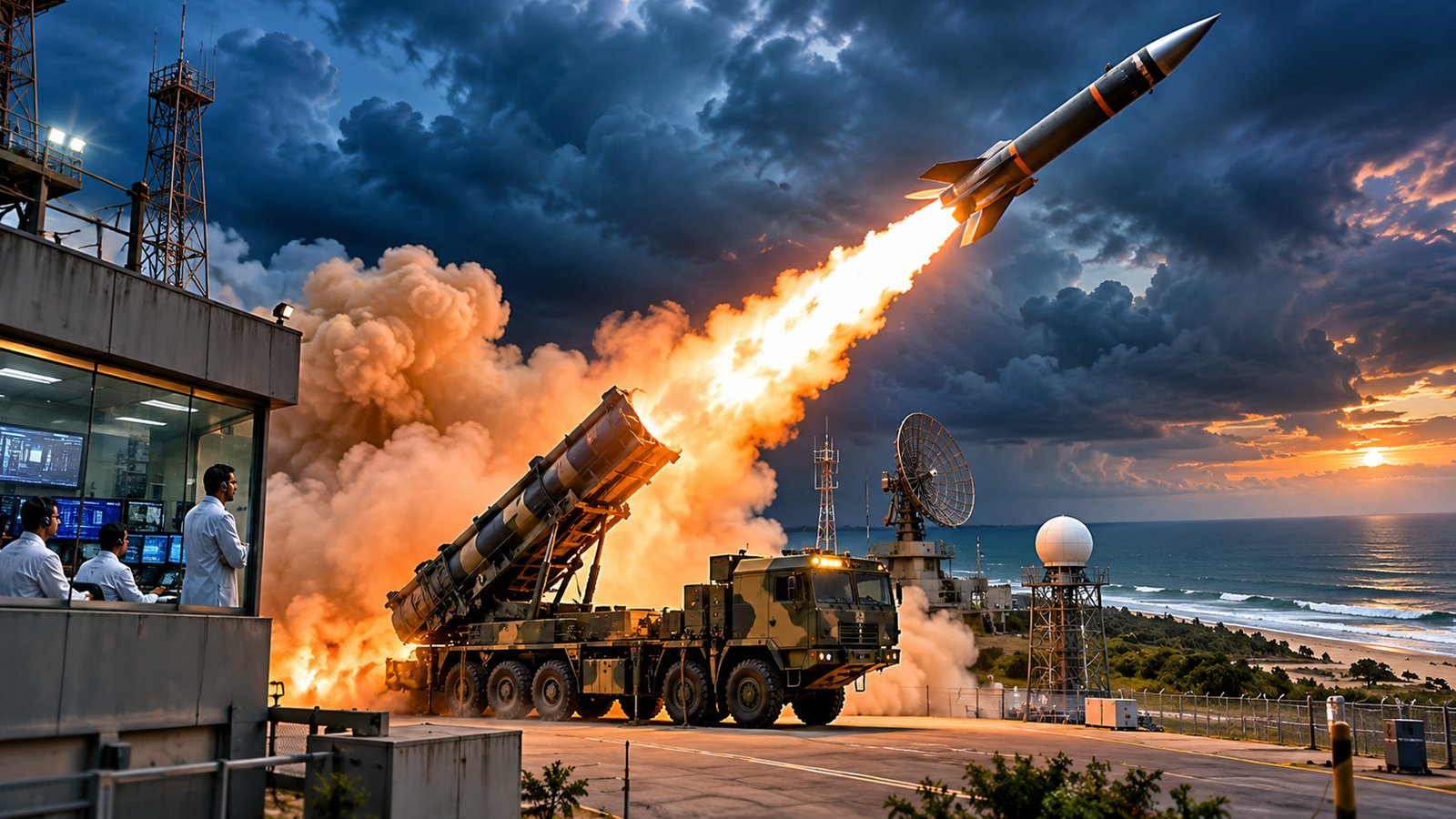
India has successfully flight-tested its indigenously developed Pralay quasi-ballistic missile off the Odisha coast, marking an important step towards strengthening the country’s conventional military capabilities. The latest trial, conducted by the Defence Research and Development Organisation (DRDO), has brought the missile closer to induction into the Indian Armed Forces.
The flight test took place at approximately 11.10 am on November 5, 2026, from Dr APJ Abdul Kalam Island off the Odisha coast. The launch was conducted as part of the missile’s user evaluation trials, with senior DRDO officials, representatives from the defence industry and members of the armed forces present during the exercise.
According to the Ministry of Defence, all the objectives set for the test were successfully achieved. Data collected through various range instruments deployed by the Integrated Test Range (ITR) at Chandipur confirmed the successful completion of the trial.
The ministry said the successful flight test had brought the missile’s induction closer, indicating that the indigenous defence system was nearing an important stage in its development and evaluation process.
Pralay is a short-range, surface-to-surface quasi-ballistic missile developed to carry conventional warheads. It has a reported strike range of 150 km to 500 km and can carry payloads weighing between 500 kg and 1,000 kg.
The missile has been designed to provide the Indian military with a precision-strike capability against a range of targets. Its ability to carry different types of conventional warheads also gives the armed forces flexibility in selecting the appropriate configuration depending on operational requirements.
Unlike conventional ballistic missiles that generally follow a predictable trajectory after launch, quasi-ballistic missiles can make adjustments to their flight paths. This manoeuvrability can make it more difficult for enemy air defence systems to track and intercept them.
The Pralay missile uses solid-propellant technology and incorporates advanced guidance and navigation systems to improve accuracy. These technologies are designed to help the missile maintain its intended flight path and reach designated targets with precision.
Its combination of range, payload capacity and manoeuvrability makes it an important addition to India’s developing conventional missile arsenal.
The Pralay missile has been developed indigenously by Research Centre Imarat (RCI), Hyderabad, in collaboration with other DRDO laboratories. The project reflects India’s continued efforts to strengthen domestic defence manufacturing and reduce dependence on imported military equipment.
Bharat Dynamics Limited (BDL), one of the development-cum-production partners, has manufactured the missile system. The involvement of domestic research organisations and industry partners highlights the role of collaboration in India’s defence production ecosystem.
The latest flight test was conducted in the presence of representatives from the Defence Forces and the industry, making it an important part of the user evaluation process. Such trials allow the armed forces to assess whether a weapon system meets the operational requirements for which it has been developed.
The successful completion of the November 5 test is therefore significant beyond the missile’s technical performance. It also represents progress towards making an indigenously developed weapon system available for military use.
Defence Minister Rajnath Singh congratulated DRDO scientists, members of the armed forces and industry partners following the successful flight test.
He said the missile, equipped with advanced technologies, would further strengthen the technological capabilities and operational preparedness of the Indian military in dealing with emerging security challenges.
Singh also described the successful trial as another significant milestone in India’s efforts to strengthen its indigenous defence capabilities.
Defence Secretary and DRDO Chairman Rajesh Kumar Singh also congratulated the teams involved in developing and testing the missile.
The Defence Ministry highlighted that the test objectives had been validated through data recorded by the various range instruments deployed during the exercise. The successful assessment has increased the possibility of the system moving towards induction in the near future.
The Pralay missile programme is part of India’s broader effort to develop advanced indigenous weapons for its armed forces. Strengthening conventional missile capabilities has become an important component of the country’s defence modernisation plans.
The missile’s ability to strike targets at distances of up to 500 km could provide the armed forces with an additional option for engaging strategic and military targets using conventional warheads.
Its development also highlights the growing role of domestic defence research, manufacturing and technology partnerships in building India’s military capabilities.
With the latest test successfully completed, Pralay has moved closer to its intended role in India’s conventional defence architecture. The achievement also underlines the country’s continued focus on developing home-grown missile technology and building a stronger domestic defence manufacturing base.