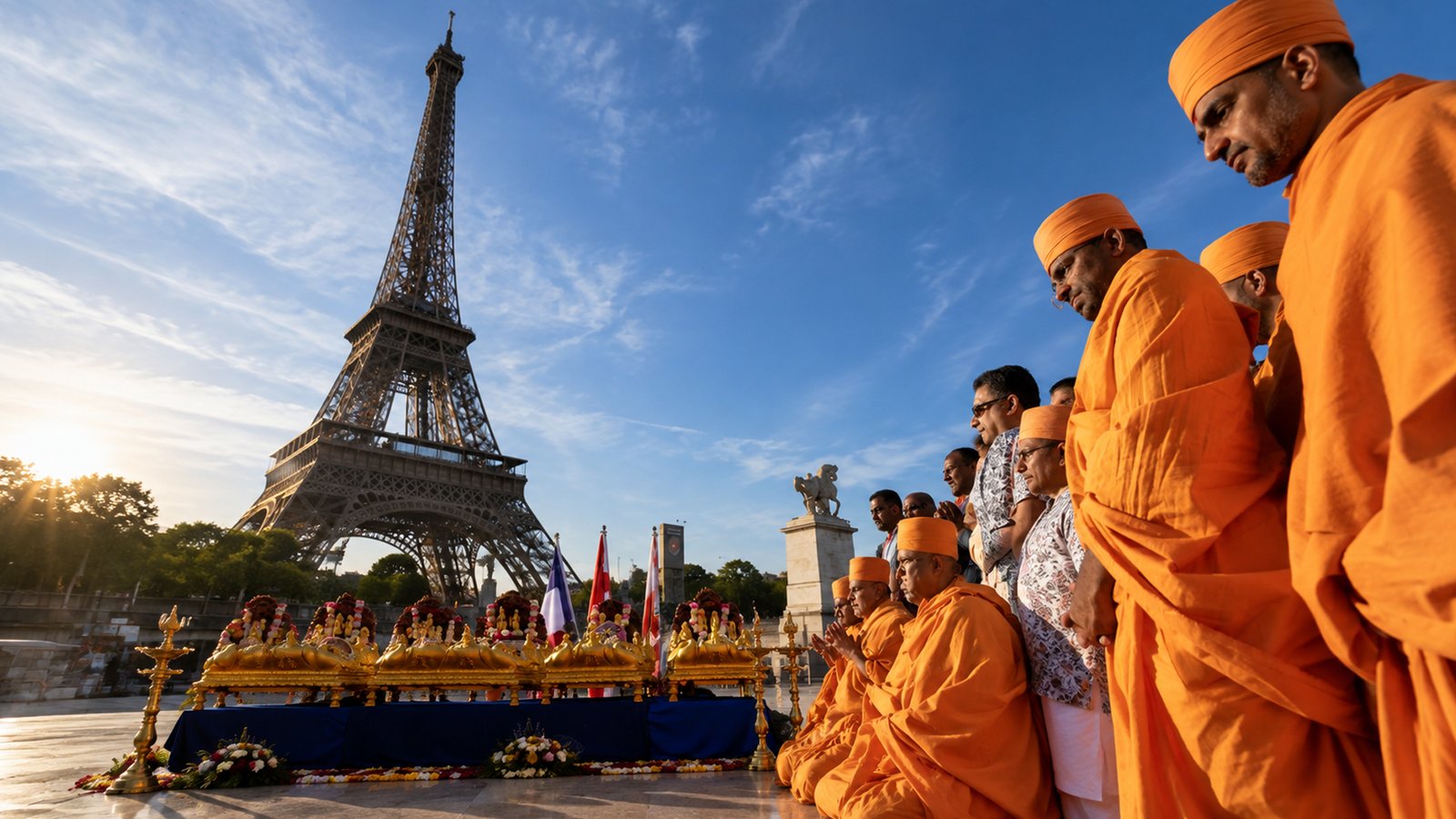
The Eiffel Tower reopened to visitors on Tuesday after a one-day closure triggered by a staff protest over the treatment of female employees during a private visit by a Hindu religious delegation.
The dispute followed a visit by around 100 people associated with the Bochasanwasi Akshar Purushottam Swaminarayan Sanstha (BAPS) on Saturday. According to reports, some female employees were asked to leave their usual workstations while the delegation was at the Paris landmark. Male colleagues were reportedly moved into certain positions instead, while women were kept away from areas being used by the group.
For the employees involved, the issue was not simply about managing a large private group. They questioned why their gender should determine where they could work or whether they could interact with visitors. The reported instructions quickly became a workplace equality issue and prompted employees to challenge the management’s handling of the visit.
The dispute escalated on Monday when staff protested, resulting in the temporary closure of one of the world’s most recognisable tourist attractions. Visitors were unable to enter the Eiffel Tower during the shutdown, creating disruption at a landmark that normally welcomes thousands of tourists each day.
After discussions between workers and management, the Eiffel Tower reopened on Tuesday. The reopening brought an immediate end to the disruption for tourists, but the questions raised by employees remain under scrutiny.
At the centre of the controversy is the company that operates the monument, Société d’Exploitation de la Tour Eiffel (SETE). The operator acknowledged that arrangements had been made during the BAPS visit that restricted interactions between members of the delegation and female employees.
SETE said such an arrangement should not have been accepted. The company apologised and reaffirmed its commitment to equality between men and women. The acknowledgement has also placed the spotlight on the decision-making process inside the organisation, with questions over how such conditions were agreed to and who authorised them.
The BAPS organisation has also expressed regret over the controversy. It said the visit had been planned in advance with the Eiffel Tower’s management and scheduled around the beginning of regular opening hours because of the size of the delegation and a desire to minimise disruption to other visitors.
BAPS said that, to its knowledge, no member of the delegation had been denied access to the Eiffel Tower. The organisation nevertheless apologised to anyone who felt hurt or inconvenienced by what happened and reiterated its commitment to mutual respect.
The delegation’s visit took place as BAPS was marking another important moment in France. Members of the group were in the country for events connected with the opening of the organisation’s first major Hindu temple in France, located in Bussy-Saint-Georges, a suburb east of Paris.
The temple was inaugurated shortly after the Eiffel Tower visit, bringing a large number of BAPS members and supporters to the French capital region. The organisation’s presence in France has therefore received increased attention, making the dispute at the Eiffel Tower particularly prominent.
The controversy has now drawn the attention of French authorities and political leaders. An investigation has been announced to establish exactly what happened during the private visit, how the instructions concerning female staff were communicated and who was responsible for approving them.
Paris officials have backed the employees’ concerns, while political leaders from different parts of France have criticised the reported sidelining of women.
France’s commitment to gender equality has become a central part of the debate. Equality Minister Aurore Bergé criticised the idea that women could be asked to make themselves less visible because of religious or cultural preferences. Other senior politicians, including National Assembly President Yaël Braun-Pivet, Gabriel Attal and Marine Le Pen, also spoke out against the reported treatment of female employees.
The reaction reflects a broader French principle: religious freedom is protected, but it exists alongside the country’s commitment to equality and secular public life. The Eiffel Tower, while operated by a private company, is a major public-facing institution and one of France’s strongest national symbols.
For the employees, the immediate concern appears to be about workplace rights rather than the identity or faith of the visitors. Their argument is that employees should be treated equally and should not be reassigned, removed from view or prevented from carrying out their normal duties because they are women.
That has opened a wider conversation about religious accommodation in the workplace. Businesses and public-facing institutions regularly deal with visitors from different cultural and religious backgrounds, but the incident raises questions about where accommodation should stop when it begins to affect employees’ rights.
The episode has also highlighted the importance of clear internal procedures. Had the Eiffel Tower’s management rejected the reported conditions from the beginning, the confrontation might have been avoided. Instead, the decision has led to a staff protest, a temporary closure, an apology and an official investigation.
It is a pleasant news for tourists as the immediate problem is over. The Eiffel Tower is open again, and visitors can once more make their way up the Paris landmark.