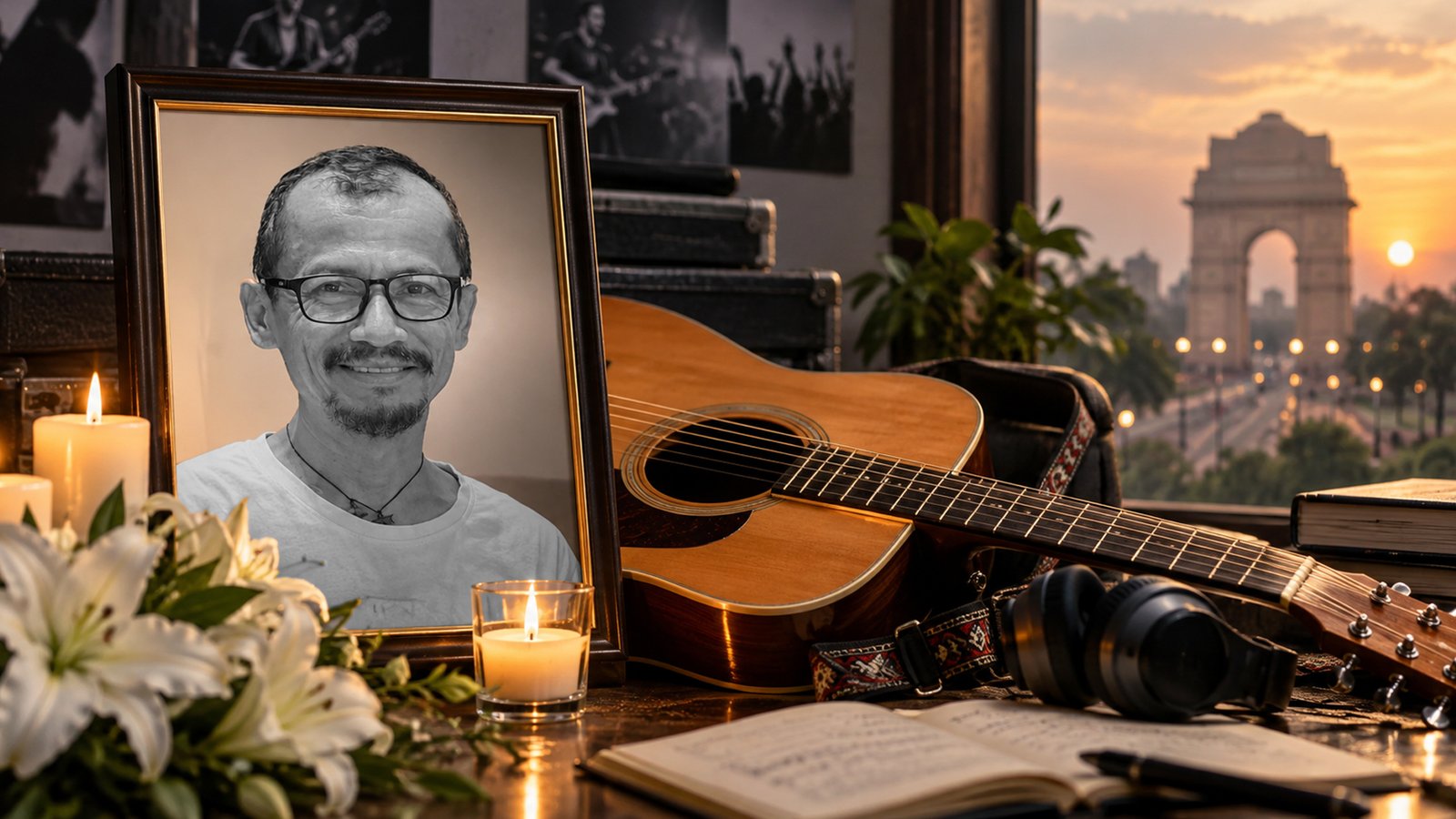
A dispute over noise outside a home in southeast Delhi has ended in the death of a well-known Manipuri musician, leaving his family, friends and members of the Northeast community shocked and angry.
Chongtham Vikram Singh, a 54-year-old guitarist and music teacher, died on Monday after he was allegedly assaulted by a group of men in Kilokari village near Ashram. Seven men have been arrested and a juvenile has also been apprehended in connection with the case.
According to police, the incident took place around 11.30 pm on Sunday when Singh stepped out of his home after noticing a group of people, including food delivery workers and employees of nearby eateries, allegedly making noise outside. Singh reportedly objected to the disturbance, following which an argument broke out.
What happened next turned violent.
Police said Singh was allegedly chased into the building where he lived with his wife and son. The group allegedly assaulted him in the stair lobby, punching and kicking him before leaving the premises. CCTV footage reportedly shows the accused leaving the building shortly after midnight. About 10 minutes later, Singh’s family members were seen taking him to hospital.
Singh was first taken for medical treatment and was later shifted to Holy Family Hospital. He eventually succumbed to his injuries.
Police have registered a case under provisions relating to mob lynching by a group of five or more people. Investigators are examining CCTV footage and statements from witnesses to establish the sequence of events and the precise circumstances that led to the fatal assault.
The arrests have provided some relief to Singh’s family and the Northeast community, but the case has also opened a much larger conversation about safety and discrimination faced by people from the region in metropolitan cities.
Some members of the Northeast community and Singh’s family have alleged that racial prejudice could have been a factor in the attack. Delhi Police, however, have said that no racial motive has been established so far. Investigators are continuing to examine the motive and circumstances of the incident.
That question has become central to the wider public reaction.
Such incidents of racial stereotyping and discrimination are not new for those from the northeast. Singh’s death has therefore revived fears about whether people from the region can feel safe and fully accepted in cities such as Delhi, where thousands have built their homes, careers and families.
Members of the Northeast community gathered outside the police station following the incident, demanding swift and impartial action. Civil society organisations and student groups also condemned the killing and called for a thorough investigation.
A candlelight gathering was held to remember Singh and demand justice. The incident has also drawn political reactions, with leaders questioning the safety of people from the Northeast in the capital and urging authorities to ensure that those responsible face strict action.
Singh’s death has been particularly painful for Manipur’s music community because of his contribution to the state’s Western music scene.
He was regarded as one of the early figures in Manipur’s rock music movement. Singh began his musical journey with Ultra Vires and later became associated with Phoenix, one of the state’s prominent rock bands, as well as Eastern Dark. He eventually moved to Delhi, where he worked as a music teacher and continued sharing his experience with younger musicians.
He was also the eldest son of renowned Manipuri singer Chongtham Kamala, giving him a strong connection to the state’s musical heritage.
Friends and neighbours have remembered him as a familiar and approachable figure who had spent years building a life in Delhi.
Neighbours have described the night of the incident as deeply unsettling. What initially appeared to be a routine neighbourhood argument quickly escalated into violence that left Singh critically injured.
The emergence of CCTV footage has added another layer to the investigation. The recordings reportedly show the accused leaving the building after the assault, followed minutes later by Singh’s family carrying him out for medical treatment.
Police are now working to reconstruct the entire sequence through the footage, witness statements and other evidence. The authorities have also assured Singh’s family and community representatives that the investigation will be pursued according to law.
The case comes at a time when concerns over the treatment of people from the Northeast continue to surface in several Indian cities. Community groups have repeatedly called for greater sensitivity, stronger action against racial discrimination and better protection for people who face harassment because of their appearance or regional identity.
Singh’s death has brought those concerns back into focus.
At the heart of the case, however, remains a family mourning a husband and father, and a music community that has lost one of its own. A man who spent decades playing music and teaching others was allegedly attacked after stepping outside his home to object to a disturbance.
Whether racial prejudice played any role in the violence remains for investigators to establish. What is already clear is that a seemingly ordinary neighbourhood confrontation ended in a death that has left a community demanding answers.
As the investigation continues and the accused face legal proceedings, Singh’s family and supporters are seeking more than arrests. They want the circumstances surrounding his death to be fully established and those responsible to be held accountable.
For Delhi’s Northeast community, the case has also become a painful reminder of a question many have been asking for years: can they live, work and build their lives in the capital without having to fear being treated differently for where they come from?