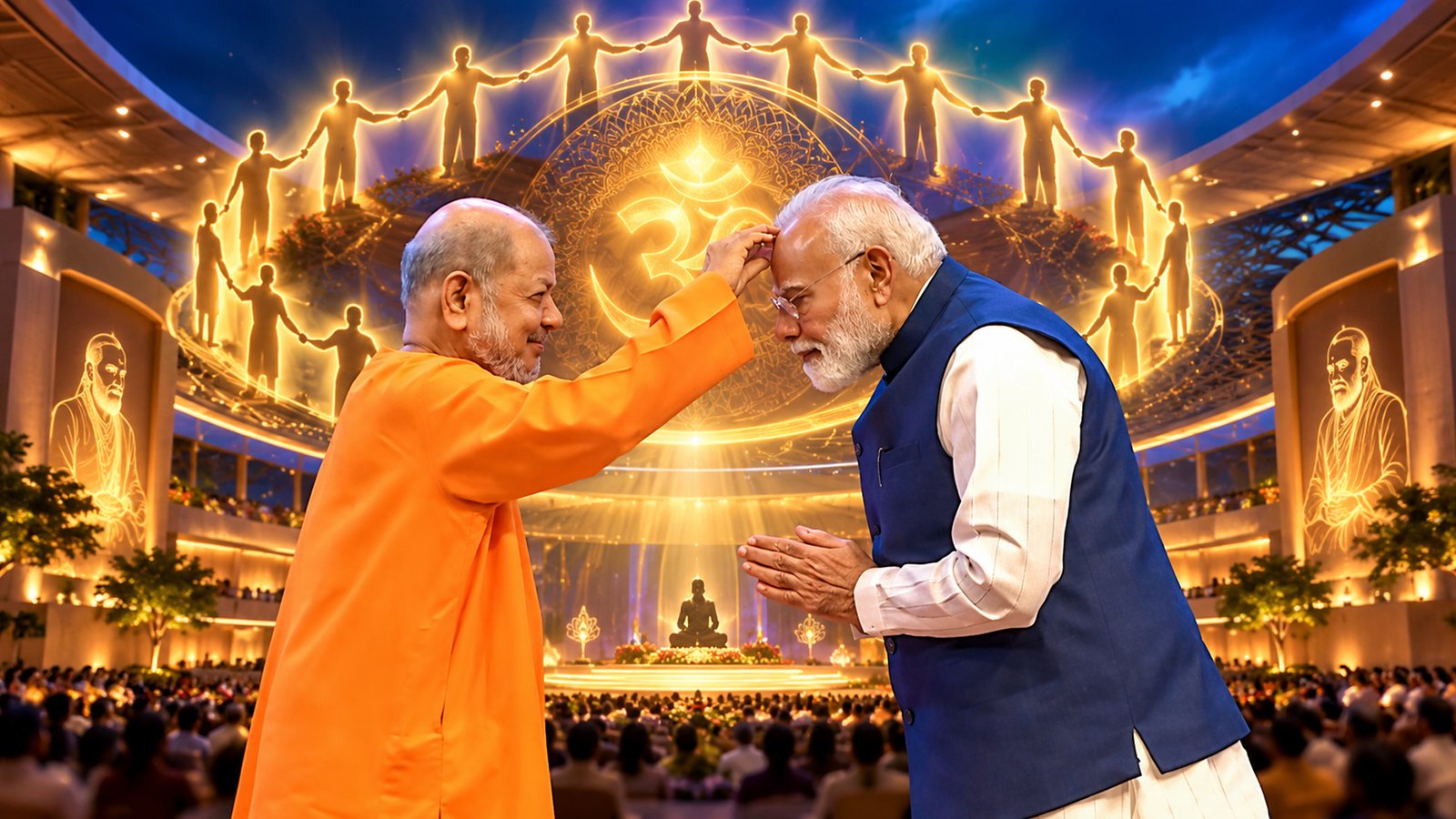
Prime Minister Narendra Modi has called for greater social unity, self-reliance and collective action to address emerging challenges, urging citizens to work towards building a developed India by 2047. He made the remarks while inaugurating the Chinmaya Amrit Mahotsav Global Sammelan at Bharat Mandapam in New Delhi on October 23.
The three-day gathering, running from October 23 to 25, marks 75 years of the Chinmaya Mission and has brought together more than 9,000 participants from India and abroad. Modi said spiritual, cultural and social organisations had an important role to play in addressing changing societal challenges and strengthening the country’s development journey.
His address also highlighted the importance of youth engagement, education, cultural preservation and the responsible use of modern technology in connecting India’s traditional knowledge with younger generations.
PM Modi calls for unity against divisive forces
Addressing the gathering, Modi said changing times had brought new challenges and social problems that required a collective response. He urged organisations and citizens to work together against forces that divide society and to encourage greater awareness and self-reliance.
The Prime Minister stressed that every citizen should be connected with the vision of Viksit Bharat 2047, the government’s goal of transforming India into a developed nation by the centenary of its Independence.
He also emphasised that institutions working in different fields could contribute to a common national objective through cooperation and sustained public engagement.
The message carries particular relevance in an increasingly connected society, where information spreads rapidly through digital platforms. Online communication can help people access knowledge and participate in public discussions, but it also makes responsible information-sharing and constructive dialogue important.
Chinmaya Mission marks 75 years
Founded by Swami Chinmayananda in 1951, the Chinmaya Mission works to make the teachings of Vedanta and the Bhagavad Gita accessible to people across the world. Over the decades, the organisation has expanded its activities to include spiritual education, cultural preservation, youth development and community service.
The anniversary summit marks the culmination of year-long celebrations organised to commemorate the Mission’s 75-year journey.
PM Modi described the organisation as more than an institution, highlighting its philosophy and long-standing contribution to sharing India’s spiritual heritage. He said its work had helped young people carry Indian values to new generations.
The Prime Minister also noted the importance of connecting traditional knowledge with modern education, arguing that India’s cultural heritage could contribute to its broader development goals.
Technology connects traditional knowledge with younger generations
One of the notable aspects of the anniversary celebrations has been the use of modern technology to make spiritual teachings accessible to wider audiences.
During the event, a technology-based tribute involving a Holobot interaction featuring Swami Chinmayananda offered Modi an opportunity to recall his meeting with the spiritual leader in 1993. The experience brought back memories of their conversation and the guidance he received, according to the Prime Minister’s Office.
The moment demonstrated how emerging technologies can be used to present historical figures and preserve memories for new audiences. Such applications also raise broader questions about how technology can support cultural preservation while clearly distinguishing digital recreations from real-life interactions.
The Mission’s wider activities have also used online platforms to bring people together. Under the Chinmaya Gita Samarpanam initiative, more than one lakh participants across the world chanted the 15th chapter of the Bhagavad Gita online.
Digital platforms can help spiritual and educational organisations reach people beyond geographical boundaries. They also provide opportunities to make learning resources available to younger audiences who increasingly rely on online content.
Youth development remains a central focus
PM Modi praised the young volunteers who participated in the Chinmaya Amrit Yatra, an initiative in which 15 members of Chinmaya Yuva Kendra travelled more than 40,000 kilometres across India over nearly 300 days. The journey reached more than one lakh young people.
The Prime Minister said the youth had taken on significant responsibilities during the celebrations and highlighted their role in communicating Indian values to the next generation.
He also referred to the Chinmaya Mission’s educational network, which combines modern learning with Indian cultural and philosophical traditions. The organisation operates more than 100 educational institutions, according to the Prime Minister’s address.
PM Modi highlighted the National Education Policy as part of efforts to integrate Indian knowledge traditions, mother-tongue education, modern science and technology into the country’s education system.
The combination of digital learning, cultural education and youth participation could help institutions engage students in new ways. However, the effectiveness of such initiatives depends on making educational resources accessible and ensuring that technology complements meaningful learning.
Shared vision for India’s future
The Prime Minister pointed to the significance of 2047, when India will mark 100 years of Independence and the Chinmaya Mission will approach its own centenary.
He said the two journeys could move forward together, with the Mission’s experience, global network and service activities contributing to the country’s development.
The gathering has placed the spotlight on the relationship between cultural heritage, education, technology and national progress. While the Mission’s anniversary celebrates its spiritual legacy, the discussions also underline the importance of engaging younger generations in a rapidly changing world.