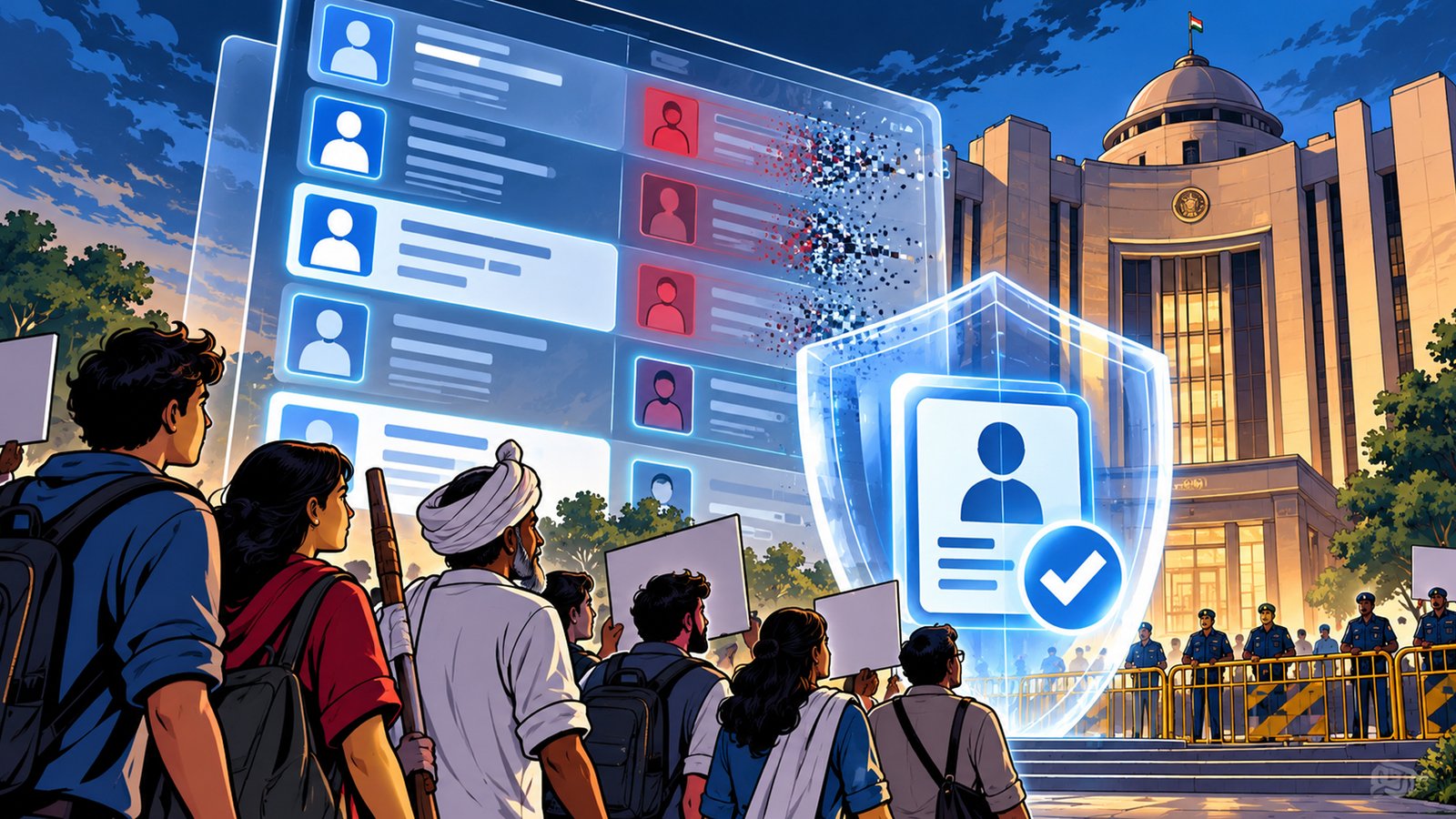
Protests against the Special Intensive Revision (SIR) of electoral rolls intensified in Delhi on October 23, as students, farmers, youth groups and civil society organisations marched towards the Election Commission of India (ECI) headquarters. The demonstrators demanded a halt to the exercise, the restoration of allegedly deleted voter names and the resignation of Chief Election Commissioner Gyanesh Kumar.
The protests have brought renewed attention to electoral transparency, voter registration and the procedures used to update electoral rolls. Protesters argue that eligible citizens must not lose their right to vote because of documentation difficulties or errors during the verification process.
The demonstration was organised under the banner of People Against SIR, a collective supported by student organisations, farmers’ groups and civil society activists. Participants gathered near Gole Dak Khana in central Delhi before attempting to march towards the Election Commission headquarters.
Carrying national flags and placards, protesters raised slogans demanding an end to the SIR exercise. They alleged that the revision could exclude eligible voters and called for greater accountability from the Election Commission.
Police stopped the march, following which some demonstrators staged a sit-in and held what they described as a people’s parliament. More than 100 protesters were reportedly detained during the demonstration. Police had imposed restrictions on public gatherings under Section 163 of the Bharatiya Nagarik Suraksha Sanhita (BNSS).
The allegations raised by protesters have not, by themselves, established that electoral malpractice occurred. However, the demonstration has intensified demands for a transparent review of the revision process.
The movement has expanded beyond Delhi, with organisers announcing demonstrations across 88 cities in 18 states involving 145 organisations. The campaign has called on students, workers, farmers, women and other sections of society to participate in protests scheduled through November 1.
Organisers are using websites and digital communication channels to share information about demonstrations and coordinate activities across locations. These platforms help participating groups circulate updates, connect with supporters and publicise their demands.
The growing use of digital tools in the campaign reflects how online communication can support large-scale public mobilisation. However, campaign announcements and allegations about voter deletions must be distinguished from independently verified electoral data.
The Special Intensive Revision is intended to review electoral rolls and maintain accurate voter records. Reliable electoral lists are essential to ensure that eligible citizens can participate in elections.
However, critics have raised concerns about the possibility of eligible voters being excluded, the difficulties of completing documentation requirements and the need for accessible procedures to correct errors.
Some protesters claimed that individuals who had completed the required formalities were still unable to find their names on electoral rolls. Such allegations have strengthened calls for clearer verification procedures and effective grievance-redressal mechanisms.
From a technology perspective, the controversy highlights the importance of data accuracy, transparency and accountability in managing large public databases. Digital records can make information easier to process and update, but inaccurate entries or inadequate correction procedures can create difficulties for citizens.
A reliable voter registration system must therefore provide clear instructions, accessible verification facilities and a straightforward process for correcting discrepancies. Citizens should be able to understand why a record has been flagged and what steps are available if their registration is affected.
Several organisations, including the All India Students’ Association, Students’ Federation of India, All India Students’ Federation, All India Democratic Women’s Association and Krantikari Yuva Sangathan, supported the Delhi demonstration.
The Samyukt Kisan Morcha also called for protests at district and tehsil headquarters on October 23. Its demands included scrapping the SIR exercise and restoring the names of eligible voters allegedly removed from electoral rolls after a transparent review.
The participation of farmers, students and civil society groups has broadened the campaign, bringing together organisations with different priorities around the common issue of voting rights.
The Election Commission’s handling of the controversy is likely to remain under public scrutiny as the protests continue. Demonstrators are seeking a review of the revision process, the restoration of allegedly deleted voter names and stronger safeguards against wrongful exclusion.
For citizens, the immediate priority is to verify their voter registration details and seek corrections if discrepancies arise. Clear communication, accessible support channels and timely decisions on complaints can help strengthen public confidence in electoral administration.
The controversy also demonstrates that digital systems must be supported by effective public services and accountability. While online platforms can simplify information-sharing and coordination, the credibility of electoral records ultimately depends on accurate data, transparent procedures and meaningful opportunities for correction.
As the anti-SIR movement spreads, the central challenge will be to address concerns about voter exclusion through verifiable evidence and clear explanations. Ensuring that every eligible citizen can exercise the right to vote remains fundamental to a credible and inclusive electoral process.