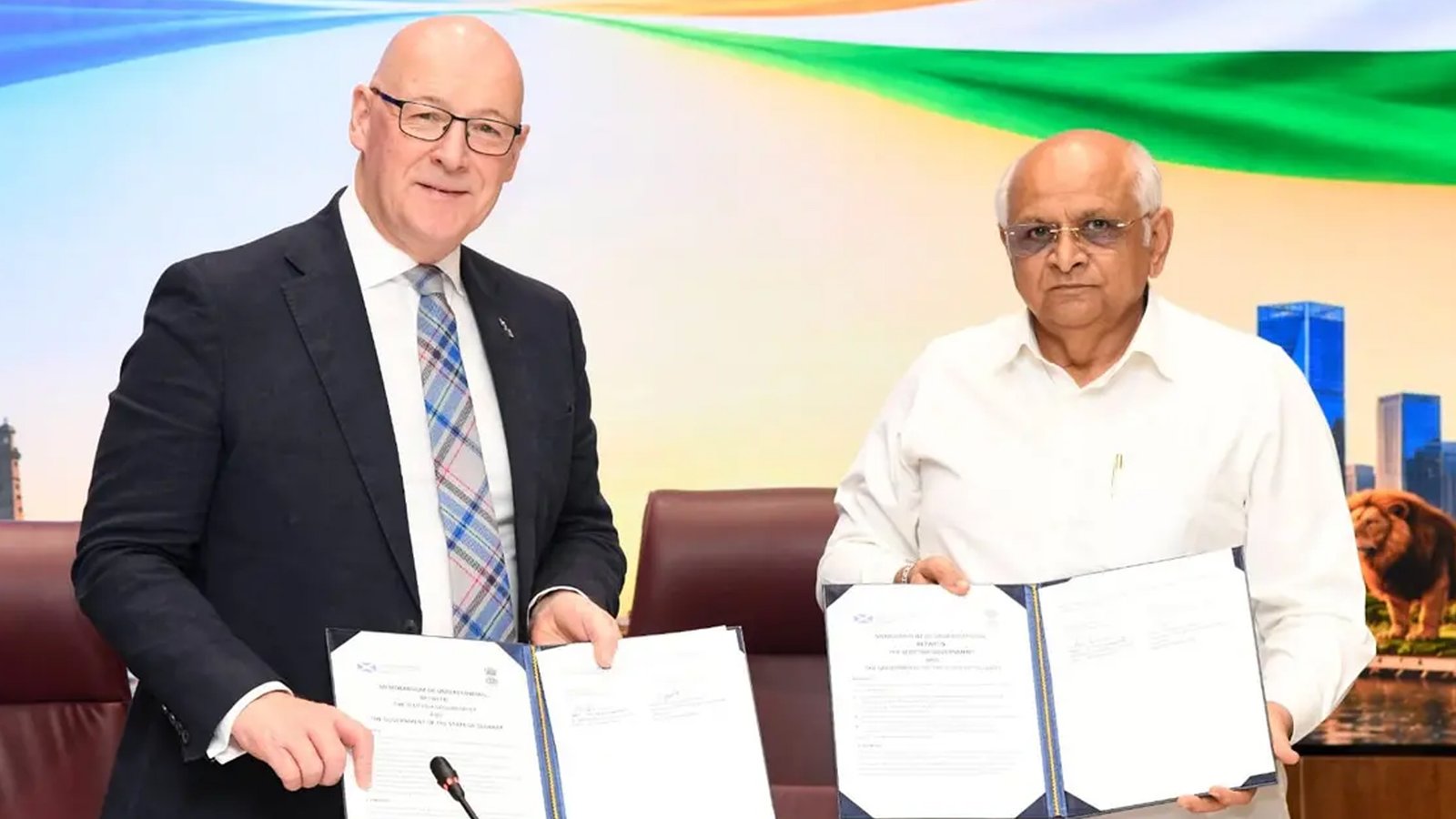
The governments of Gujarat and Scotland signed memorandums of understanding (MoUs) in Gandhinagar on October 23, 2026, to strengthen cooperation in renewable energy, trade, education, research, technology, sports and cultural exchange. The agreements were signed in the presence of Gujarat Chief Minister Bhupendra Patel and Scottish First Minister John Swinney.
The partnership aims to promote knowledge-sharing, encourage investment and establish institutional connections between the two regions. Offshore energy, technological innovation and sustainable development are among the priorities, alongside education, skills development and sports infrastructure.
The agreements offer opportunities to explore international expertise while expanding renewable energy capabilities and strengthening its research ecosystem. Scotland, meanwhile, can share experience in offshore energy and other specialised sectors. However, the MoUs establish a framework for collaboration rather than confirming specific investments or project commitments.
Offshore energy is a significant area of cooperation, given Gujarat’s extensive coastline and potential to explore additional renewable power sources.
Chief Minister Bhupendra Patel highlighted Gujarat’s position in India’s renewable energy sector and its potential to develop offshore energy capabilities. He proposed sending a state delegation to Scotland to study its expertise, technologies and operational practices.
Scotland has experience in offshore wind energy, which generates electricity through turbines installed in marine environments. Developing such projects requires specialised engineering, marine infrastructure, grid connectivity, maintenance capabilities and environmental assessments.
Knowledge-sharing could help Gujarat understand the technical requirements and infrastructure needs associated with offshore energy development. Cooperation could also connect businesses, research institutions and energy specialists.
The engagement is relevant as India explores ways to diversify its renewable energy portfolio. However, the agreements do not confirm offshore wind farm construction in Gujarat or identify specific technology providers.
The MoUs also promote cooperation in sustainable technology, innovation and entrepreneurship. These areas could enable businesses and institutions to exchange knowledge, explore emerging technologies and identify opportunities for collaboration.
The nternational partnership for Gujarat can support technical capabilities and help industries access specialised expertise. Cooperation with Scotland could encourage discussions on clean energy solutions, sustainable industrial practices and emerging technologies.
Stronger connections between companies, researchers and entrepreneurs could facilitate joint research, professional exchanges and commercially relevant solutions.
The agreements also seek to strengthen trade and investment ties, creating opportunities for businesses in both regions to explore mutually beneficial partnerships. Specific projects, funding arrangements and commercial agreements have not been announced.
Education and research constitute another pillar of the Gujarat–Scotland partnership. The agreements envisage stronger links between universities, colleges, research institutions and other educational organisations.
Academic exchanges could enable students, researchers and faculty members to share knowledge and develop professional relationships. Collaborative research may emerge in renewable energy, engineering, sustainability and technological innovation.
Closer engagement between educational institutions and industry could help align research with practical requirements, particularly in sectors requiring specialised technical skills.
Skills development is another potential area of cooperation. Professional exchanges and institutional partnerships could strengthen expertise and improve access to international practices.
Although specific universities, research programmes and exchange schemes have not been identified, the MoUs provide a foundation for developing these partnerships.
The collaboration extends to sports infrastructure and event management. Gujarat’s preparations for the 2030 Commonwealth Games make Scotland’s experience hosting the 2026 edition in Glasgow particularly relevant.
The partnership could facilitate knowledge-sharing on sports facilities, event organisation, infrastructure planning and fitness promotion.
Experience from organising an international sporting event could help Gujarat assess infrastructure requirements and strengthen planning capabilities. Potential cooperation includes professional exchanges and sharing operational best practices.
Scottish First Minister John Swinney said the agreements could create opportunities across culture, sports, renewable energy and life sciences. He also highlighted Scotland’s willingness to share its offshore energy expertise with Gujarat.
The MoUs aim to strengthen economic relations and people-to-people connections between Gujarat and Scotland.
Cooperation in trade, investment and entrepreneurship could help businesses identify partners and explore opportunities in emerging sectors. Cultural exchange, heritage and creative industries are also part of the broader engagement.
Gujarat Chief Secretary M. K. Das said the agreements would connect businesses, institutions and experts while supporting knowledge-sharing, innovation and professional development.
Stronger institutional relationships could provide a foundation for sustained engagement. However, the commercial impact will depend on partnerships established and whether discussions lead to investment or joint projects.
Patel’s proposal to send a Gujarat delegation to Scotland to study offshore energy capabilities is an important next step. The visit could help identify relevant technologies, expertise and practical opportunities.
Further progress will depend on institutional partnerships, technical exchanges and specific initiatives developed under the agreements.
The MoUs do not guarantee immediate investment or commercial outcomes. Their effectiveness will depend on implementation, resources committed by participating institutions and projects undertaken.
If translated into practical initiatives, the collaboration could support Gujarat’s renewable energy ambitions, strengthen research networks and expand cooperation in technology, education and sustainable development.