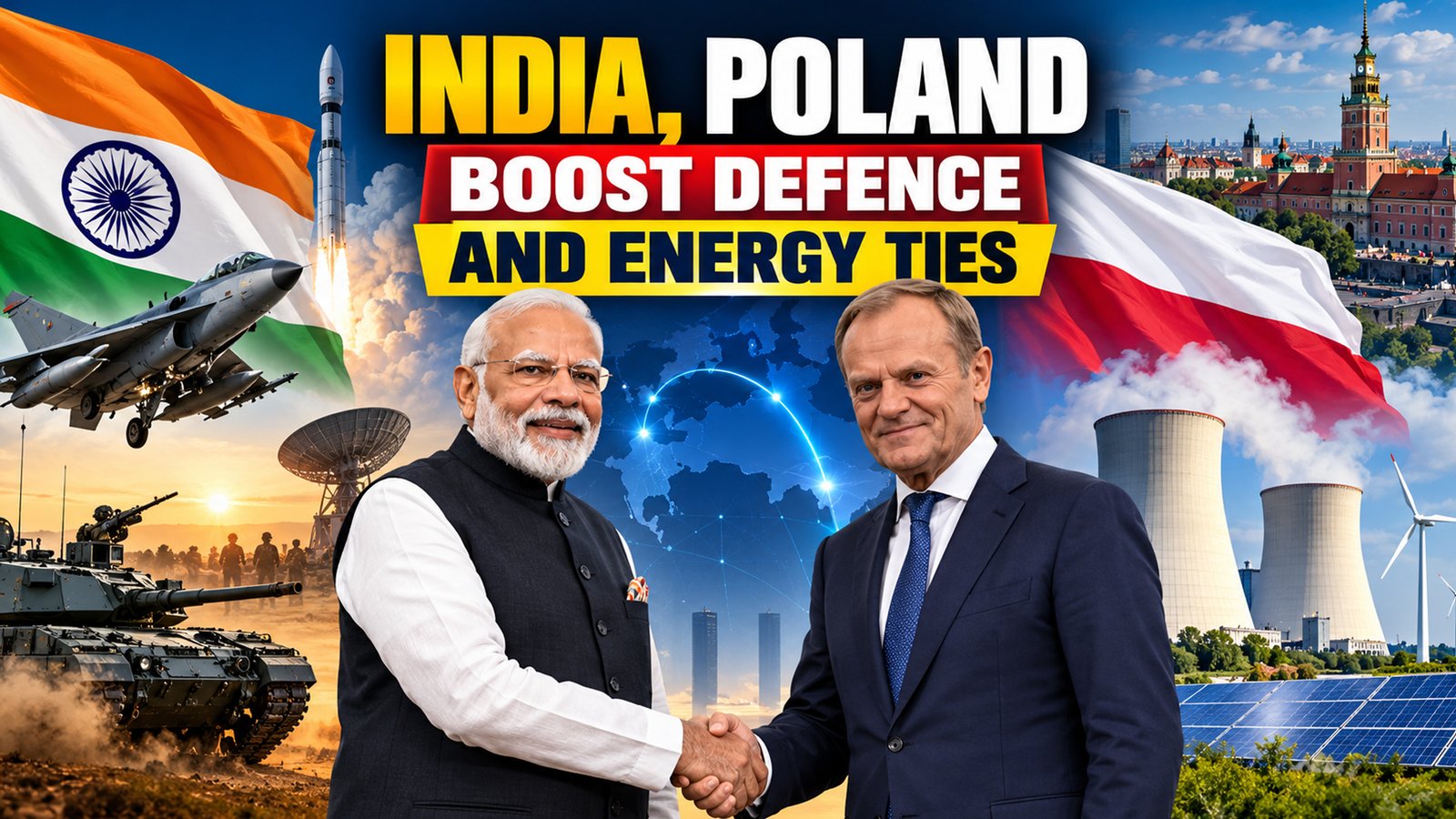
India and Poland are looking to strengthen their strategic partnership, with defence manufacturing, space technology, nuclear energy and investment emerging as key areas of cooperation during talks between Prime Minister Narendra Modi and his Polish counterpart Donald Tusk in New Delhi on Thursday.
The meeting reflects a growing interest on both sides in turning diplomatic ties into practical partnerships that benefit businesses, industries and researchers. While Poland is seeking greater access to the Indian market, New Delhi sees opportunities to attract investment, develop advanced technologies and strengthen economic relations with a key member of the European Union.
PM Modi highlighted the potential to expand cooperation in defence, space and nuclear energy, signalling that both countries want to move beyond political engagement towards closer industrial and technological collaboration.
Defence manufacturing is expected to play an important role in this effort. Poland is keen to expand its presence in India and explore opportunities for supplying equipment, developing technologies jointly and working with Indian manufacturers. For New Delhi, such partnerships could support its push to strengthen domestic defence production and reduce dependence on imported military equipment.
Poland’s Finance and Economy Minister Andrzej Domanski has highlighted the potential for greater cooperation between the two countries’ defence industries. Warsaw is interested in partnerships that go beyond equipment sales to include joint development, research and production. Such arrangements could create opportunities for companies in both countries to share expertise, build manufacturing capabilities and explore international markets.
The two countries have reasons to deepen engagement in this sector. Poland has increased its focus on defence modernisation amid security concerns in Europe, particularly following Russia’s war against Ukraine. India, meanwhile, continues to invest in military capabilities and indigenous defence manufacturing. Their respective priorities could create opportunities for cooperation, although specific projects will depend on further discussions and agreements.
Space technology and nuclear energy are also important parts of the expanding partnership. India has developed considerable capabilities in satellite launches, space applications and scientific research, while Poland has expertise in technology and research. Collaboration in selected areas could encourage knowledge-sharing, engineering partnerships and opportunities for businesses working in advanced technology.
Nuclear energy could provide another avenue for cooperation as countries seek reliable electricity sources while managing their energy transitions. Technical exchanges, research and industrial participation could help identify areas of mutual interest, subject to regulatory requirements and project-specific agreements. Renewable energy and clean technology are also gaining attention as both countries look for ways to encourage investment and develop more sustainable industrial systems.
Trade and investment remain central to the relationship. Poland wants to attract Indian investment and strengthen commercial links with one of the world’s largest markets. Indian companies, in turn, could explore opportunities in Polish manufacturing, technology and energy sectors, while Polish businesses could benefit from India’s expanding industrial base and consumer demand.
Annual bilateral trade has been estimated at around $6 billion in earlier reports, indicating the existing scale of commercial engagement and the potential for further growth. Areas such as machinery, automotive components, information technology, pharmaceuticals and industrial products could provide opportunities for businesses on both sides.
Business engagement is expected to complement the political discussions. The India-Poland Business Forum in New Delhi on October 22 provides a platform for companies to explore partnerships and investment opportunities. Tusk is also scheduled to visit Bengaluru, where he is expected to engage with businesses, including those in information technology and space. Another business forum is planned in the city on October 23.
The current visit builds on the progress made in August 2024, when India and Poland upgraded their relationship to a strategic partnership during Modi’s visit to Warsaw. It was the first visit by an Indian prime minister to Poland in 45 years. The two countries subsequently adopted an action plan for 2024-2028, outlining priorities across trade, investment, defence, technology and people-to-people relations.
Tusk’s visit offers an opportunity to advance that framework while strengthening India’s broader engagement with Europe. The leaders are also expected to exchange views on regional and global developments, including European security and the war in Ukraine.
Defence partnerships will require clarity on technology, production and long-term industrial support, while cooperation in space and energy will depend on investment decisions, technical planning and regulatory approvals.
Stronger commercial ties could generate business opportunities, support employment and improve technology-sharing between the two countries. However, the success of the partnership will depend on how quickly companies and governments can turn shared interests into concrete agreements.
The talks mark another step in India-Poland relations, with defence, space, nuclear energy and investment at the centre of the agenda. Sustained cooperation could help both countries diversify their partnerships, strengthen industrial capabilities and build a more substantial economic relationship in the years ahead.