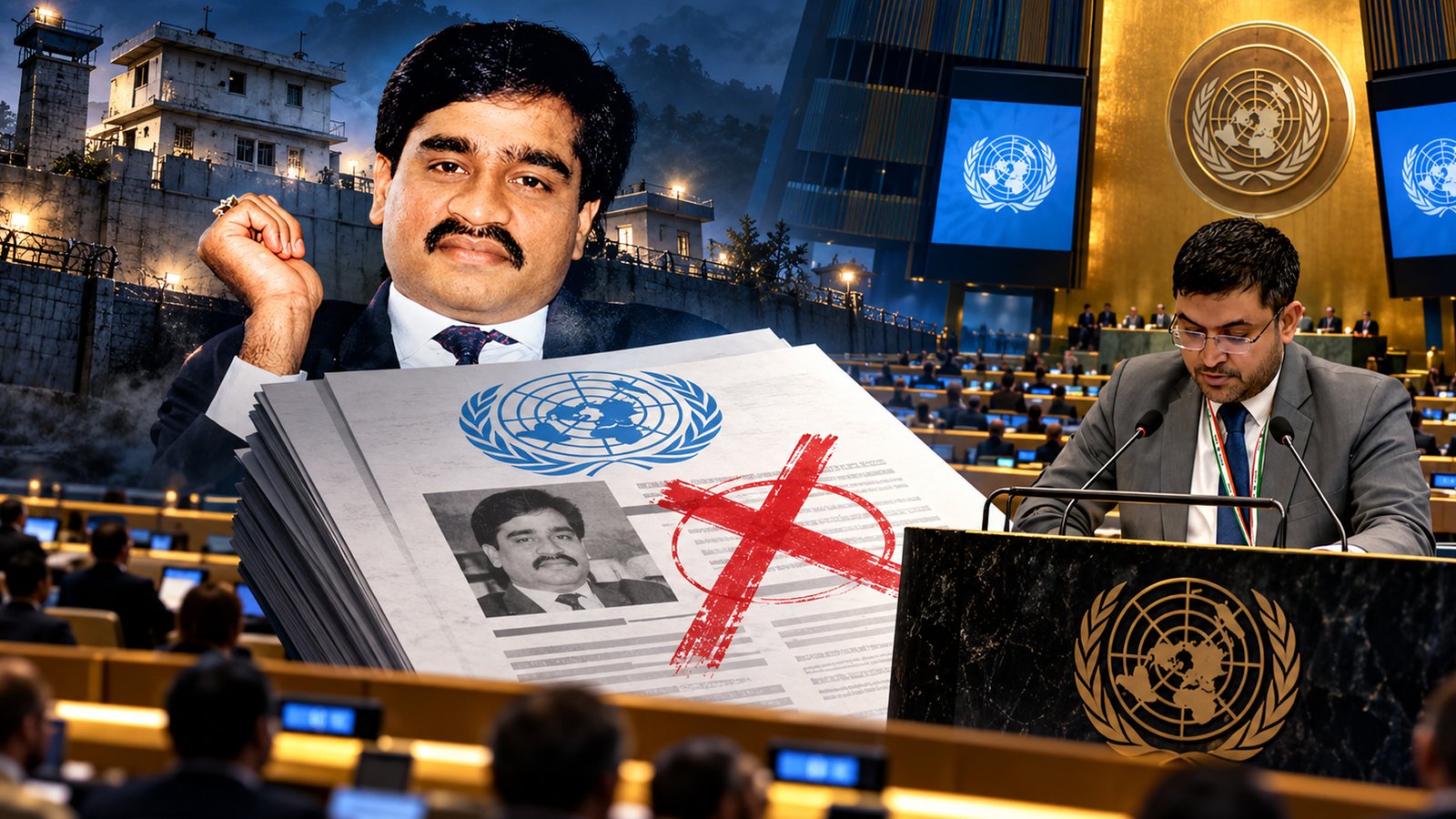
India has strongly objected to a United Nations report describing fugitive gangster Dawood Ibrahim’s criminal network, D-Company, as an “India-based” group, calling the description factually inaccurate and warning that such omissions could undermine the credibility of the global body.
The objection was raised by Raghoo Puri, First Secretary at India’s Permanent Mission to the United Nations, during a meeting of the UN General Assembly’s Third Committee on Wednesday. Puri was responding to a report by Ben Saul, the UN Special Rapporteur on the promotion and protection of human rights and fundamental freedoms while countering terrorism.
India argued that the report failed to provide important context about Dawood Ibrahim’s status as a wanted criminal in India and his alleged presence in Pakistan. New Delhi also questioned the report’s reference to the United Nations Security Council’s 2003 listing of the D-Company leader for links with Al-Qaeda without adequately highlighting the circumstances surrounding the case.
The controversy centres on the report’s description of D-Company as an India-based criminal organisation with terrorist links. According to India, the wording creates a misleading impression because Dawood Ibrahim had fled India long before his 2003 listing under the UN sanctions regime.
Puri said Dawood Ibrahim and his criminal network had been wanted in India in connection with the 1993 Mumbai bombings. He pointed out that the narrative summary accompanying the UN Security Council’s sanctions listing contains information about the case.
India maintained that leaving out this background while describing D-Company as India-based presents an incomplete picture of the organisation and its leader.
Puri expressed concern over what he described as repeated factual inaccuracies in reports issued by UN special mandate holders. He argued that reports containing errors, without adequate accountability, could damage the reputation of the United Nations at a time when its credibility was already facing challenges.
New Delhi’s objection was therefore not limited to the terminology used for D-Company. It also raised broader questions about the accuracy, impartiality and responsibility expected of international human rights experts.
Dawood Ibrahim has long been wanted by Indian authorities in connection with the 1993 serial bomb blasts in Mumbai, which killed more than 250 people and injured many others. India has repeatedly sought action against him and maintained that he is based in Pakistan.
During his intervention at the UN, Puri said Dawood had left India before the 2003 sanctions listing and was subsequently listed for his association with Al-Qaeda and its former leader, Osama bin Laden.
Referring to the UN listing, the Indian diplomat said Dawood remained a wanted criminal in India and was residing in the same country where bin Laden was found and killed. Bin Laden was killed by US forces in Abbottabad, Pakistan, in May 2011.
India’s remarks reiterated its longstanding position that Pakistan is harbouring the fugitive. However, the claim about his current location should be understood as India’s stated position and the information cited in the UN listing, rather than independent confirmation of his whereabouts.
The case has remained a significant issue in India’s counterterrorism efforts and its relations with Pakistan.
The UN Security Council’s sanctions regime targeting Al-Qaeda and associated individuals and entities imposes measures such as asset freezes, travel bans and arms embargoes on listed parties.
Dawood Ibrahim was added to the relevant sanctions list in 2003. India’s argument is that the accompanying narrative summary provides essential information about the reasons for the listing and his links to the case against him in India.
By omitting or inadequately presenting this context, New Delhi said, the report risks confusing the criminal network’s origins with the location from which its leader is believed to operate.
The dispute highlights the importance of accurately distinguishing between a group’s historical roots, its current operational base and the location of individuals associated with it.
India also used the intervention to raise concerns about what it described as bias in international discussions on counterterrorism and human rights.
Puri argued that human rights principles should not be used to justify terrorism or provide protection to those accused of supporting extremist activities. He said terrorism could never be justified and called for greater impartiality in reports prepared by UN experts.
India has repeatedly maintained that counterterrorism efforts and human rights protections should be addressed without selective treatment of countries or politically motivated assessments.
The remarks came amid wider disagreements at the UN General Assembly’s Third Committee, which deals with human rights and social issues. India has called for transparency, accountability and consistency in the work of international human rights mechanisms.
Puri also rejected remarks by Pakistan’s delegation concerning Jammu and Kashmir and Ladakh, reiterating India’s position that both are integral parts of the country.
The exchange underscores the continuing diplomatic tensions between India and Pakistan over terrorism, as well as New Delhi’s concerns about how international organisations describe security-related cases.
The wording used in international reports carries significance for India because it can shape perceptions of the country’s role in counterterrorism and the nature of criminal networks associated with attacks on Indian soil.
The dispute also raises a broader question about the need for UN reports to present complete and verifiable information, particularly when discussing terrorism, sanctions and alleged cross-border criminal activity.
India’s latest objection puts the focus on whether the report’s description will be reviewed or clarified. Any correction would need to address the factual concerns raised by New Delhi while maintaining the independence and credibility of the UN’s reporting mechanisms.