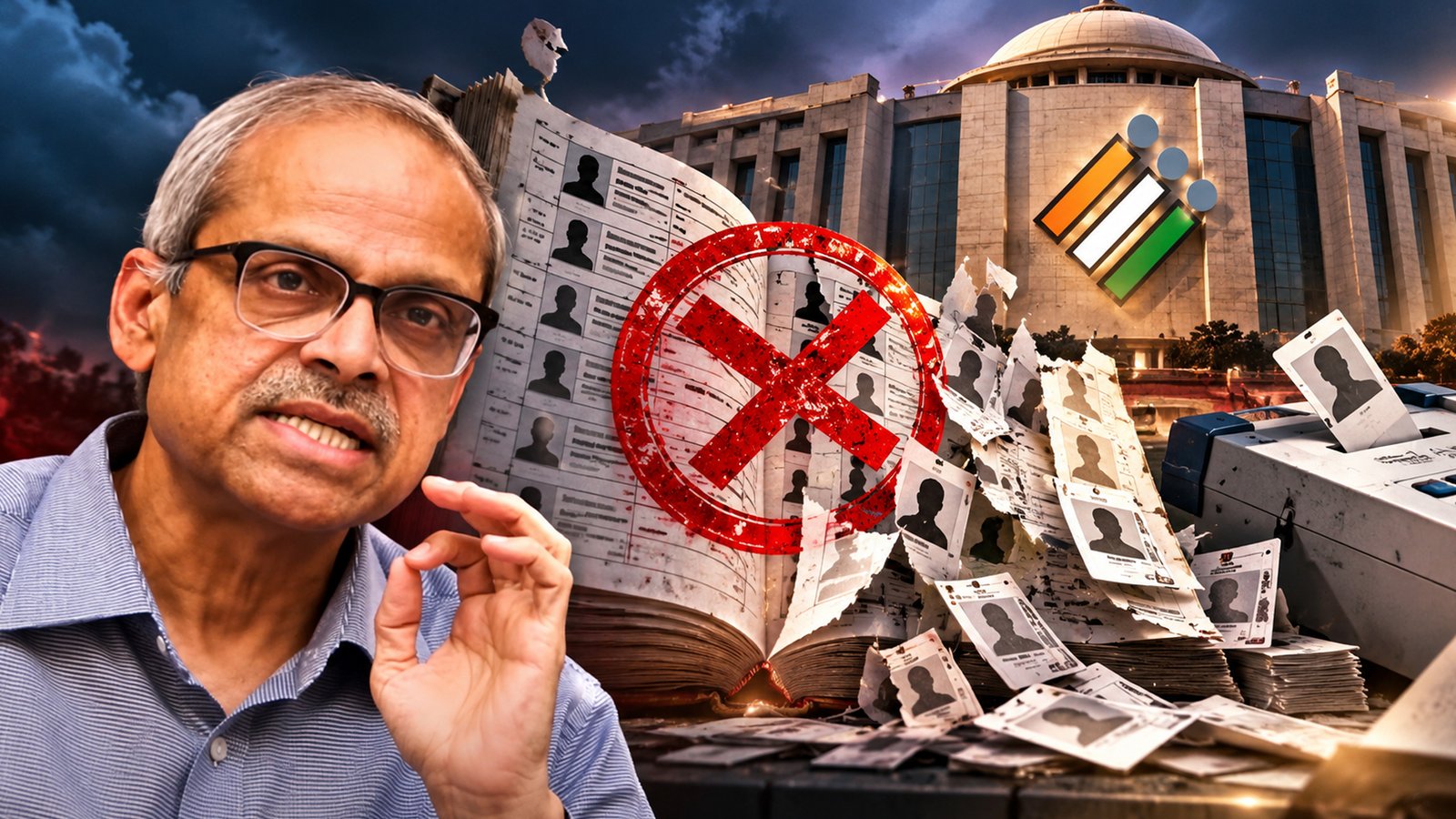
Economist Parakala Prabhakar, actor-activist Prakash Raj and several prominent public figures are set to join a nationwide protest against the Election Commission of India’s Special Intensive Revision (SIR) of electoral rolls on Friday, October 23. Organised by the People Against SIR alliance, the march aims to mobilise citizens against the voter revision exercise and demand the resignation of Chief Election Commissioner Gyanesh Kumar.
The protest, described by organisers as the People’s March to Restore Democracy, is expected to bring together activists, lawyers, student leaders, farmers’ representatives and civil society groups. The alliance has called on people to organise demonstrations in their neighbourhoods under the slogan, “Har haath mein Tiranga, Har gali mein Jantar Mantar”, which translates to a tricolour in every hand and a Jantar Mantar in every street.
Prabhakar announced his participation in the march through a post on social media, urging people to join the campaign. His involvement has drawn attention to the protest, particularly because he is the husband of Union Finance Minister Nirmala Sitharaman. Prabhakar, an economist and author, has frequently criticised the government’s economic policies and expressed concerns about democratic institutions.
He is expected to share the platform with Cockroach Janta Party (CJP) founder Abhijeet Dipke, Prakash Raj, senior advocate Prashant Bhushan, farmer leader Rakesh Tikait, All India Students’ Association president Neha Bora and author Tushar Gandhi. Former Jawaharlal Nehru University Students’ Union president Aishe Ghosh and other activists have also been invited. However, the participation of political parties from the INDIA bloc had not been confirmed in reports available on Thursday.
The People Against SIR alliance was formed on October 14 and brings together organisations representing students, farmers, workers, women, Dalits, Adivasis, minorities, persons with disabilities and other groups. Its campaign centres on concerns that the electoral roll revision could result in eligible voters being excluded from electoral lists.
The alliance has demanded that the SIR exercise be scrapped and that names deleted from electoral rolls be restored where voters are eligible. It has also called for the removal and prosecution of Chief Election Commissioner Gyanesh Kumar, alleging that the electoral process has been compromised. These are the organisers’ allegations, which remain contested.
The Election Commission’s stated purpose of electoral roll revision is to update voter lists and improve their accuracy. The dispute centres on how the exercise is conducted, whether eligible voters risk losing their place on the rolls and what safeguards are available to ensure that no genuine voter is wrongly excluded.
The planned march comes amid growing tensions over the SIR process and recent demonstrations against the Chief Election Commissioner. The controversy has also drawn attention to the availability of designated spaces for peaceful protests in the national capital.
Jantar Mantar, traditionally associated with public demonstrations in Delhi, was recently denotified as a designated protest site by the Delhi Police. The move has become another point of contention for activists seeking to raise concerns about the electoral revision exercise. Organisers of the October 23 campaign have said they want people to create local spaces for peaceful protest rather than limiting demonstrations to a single location.
The route announced for the march in Delhi is from Bangla Sahib Gurdwara in Connaught Place towards the Election Commission’s office near Patel Chowk. Organisers have said that if the march is blocked by police, participants may hold a “People’s Parliament” before dispersing after singing the national anthem. The final arrangements and any police restrictions remain important factors to watch.
The alliance has also raised wider electoral reform demands, including changes to the law governing the appointment and service conditions of election commissioners, a more transparent appointment process and a return to paper ballots. Its members argue that public confidence in elections depends on the perceived independence of the Election Commission and the ability of citizens to participate without fear of exclusion.
Prabhakar has previously criticised the SIR exercise, describing it as a “bloodless political genocide of citizenship”. He also joined a protest organised by the CJP at Bengaluru’s Freedom Park on October 8, alongside Prakash Raj and other public figures.
His participation in the latest mobilisation adds to the public debate surrounding the electoral roll revision. Prabhakar’s criticism of the government has often focused on economic policy, unemployment and what he sees as the weakening of democratic institutions. His presence at the march is likely to bring further attention to the campaign and its demands.
For the organisers, the immediate challenge is to turn public concern into a coordinated nationwide mobilisation. They have urged citizens to participate in peaceful demonstrations and have appealed to opposition parties to support the campaign. Whether the march draws broad participation and prompts a response from the Election Commission will be closely watched.
The October 23 protest is expected to place voter rights, electoral transparency and the accountability of constitutional institutions at the centre of public discussion.