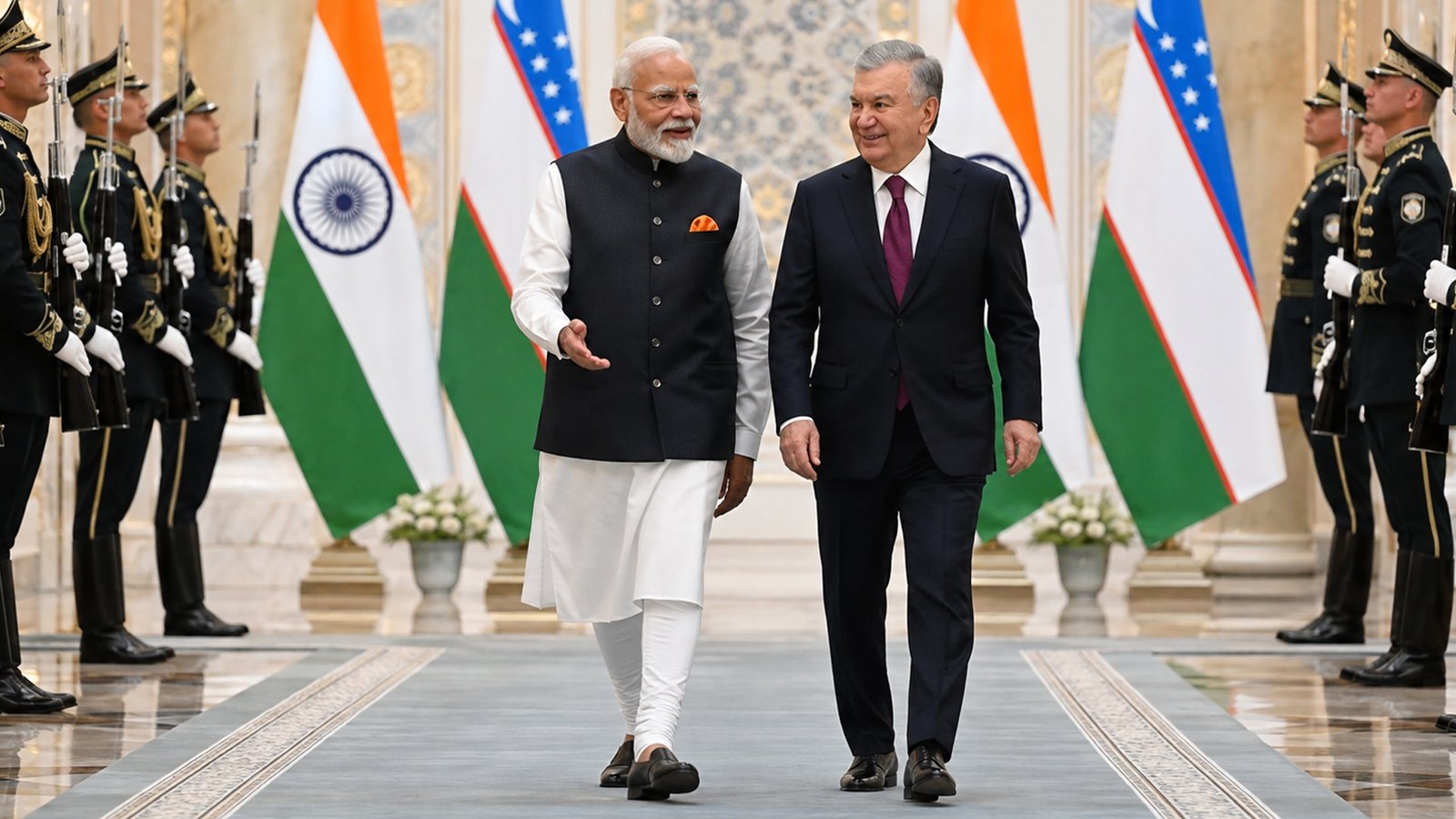
India and Uzbekistan have elevated their bilateral relationship to a Comprehensive Strategic Partnership, marking a significant expansion of cooperation between the two countries across trade, defence, energy, technology, connectivity and people-to-people ties.
The decision was announced during Prime Minister Narendra Modi’s state visit to Uzbekistan from August 29 to 30, at the invitation of President Shavkat Mirziyoyev. The two leaders held detailed discussions in Tashkent on bilateral, regional and international issues and agreed on a broad roadmap aimed at giving greater momentum to the relationship.
The upgrade comes as India and Uzbekistan mark 15 years of their Strategic Partnership. The two sides said the new framework would focus on concrete outcomes and strengthen cooperation in areas including trade and investment, transport connectivity, digital technologies, artificial intelligence, space, cybersecurity, energy, critical minerals, healthcare, pharmaceuticals, agriculture and education.
A key economic goal is to raise India-Uzbekistan bilateral trade to $5 billion by 2030. The two countries will work to diversify traded goods, remove non-tariff barriers and improve market access. A Joint Working Group will address trade and investment hurdles, while both sides will explore e-commerce, digitalisation of trade procedures and platforms to help small and medium enterprises.
Electrical goods, engineering products, automobiles and pharmaceuticals have been identified as areas with strong potential for greater business cooperation. India and Uzbekistan will also explore investment opportunities, regulatory cooperation and a mechanism to address investor concerns. The two countries are considering follow-up steps on a proposed preferential trade agreement after completing a joint feasibility study.
Energy and critical minerals emerged as another important pillar. India and Uzbekistan agreed to explore cooperation in geology, mining, mineral processing and the development of value-added products involving critical and strategic minerals. They also agreed to expand cooperation in peaceful nuclear energy, renewable energy and energy infrastructure.
A major development was the agreement to establish a long-term arrangement for uranium supplies from Uzbekistan to India. Indian officials said discussions had been positive and that the two countries were close to finalising an agreement. The move adds a strategic energy dimension to India’s engagement with resource-rich Central Asia.
Defence and security cooperation also received considerable attention. The two sides agreed to deepen exchanges between their defence and security agencies, including capacity-building, joint activities and cooperation in the defence industrial sector. They welcomed the work of the Joint Working Group on Military Cooperation and the successful Dustlik joint military exercise, the latest edition of which was held in Uzbekistan’s Namangan region in April 2026.
India and Uzbekistan also reaffirmed a zero-tolerance approach towards terrorism, including cross-border terrorism. They agreed to strengthen intelligence sharing and law-enforcement cooperation and work jointly against terrorism financing, violent extremism, organised crime, illicit drug trafficking and cyber threats.
Connectivity is another area where the two countries want to move from agreements to implementation. India and Uzbekistan will work on multimodal transport routes and logistics corridors to facilitate movement of goods and reduce transportation costs. They will also exchange expertise in road construction and explore cooperation in modernising road infrastructure and developing energy-efficient public transport.
The digital economy is set to become an increasingly important part of the relationship. The leaders highlighted the success of Tashkent’s first IT Park, established in 2019 with support based on the Indian model. The two sides will expand links among technology parks, startups, companies and educational institutions and cooperate on artificial intelligence, digital transformation and space technology. They also agreed to exchange expertise in developing safe and trustworthy AI systems.
Healthcare and pharmaceuticals will receive a further push. India and Uzbekistan plan to strengthen cooperation in public health, biomedical research and medical innovation. The Tashkent Pharma Park is expected to serve as a platform for joint projects, technology transfer, local manufacturing and skill development. The two countries also expressed support for establishing medical centres, laboratories, research institutions and pharmaceutical manufacturing facilities in Uzbekistan with Indian participation.
Education and skill development remain another important link. More than 2,700 Uzbek nationals have participated in India’s ITEC programme, while more than 400 Uzbek students have received ICCR scholarships, including under AYUSH. India has also announced the Lal Bahadur Shastri Scholarship for Hindi language studies in Uzbekistan.
The partnership also carries a strong cultural dimension. India and Uzbekistan signed a Cultural Exchange Programme for 2026-2030 and agreed to cooperate in preserving historical and cultural heritage. A Letter of Intent covers the conservation and restoration of the ancient Buddhist sites of Fayaz Tepa and Karatepa. Cooperation will also extend to sports such as badminton, archery and chess, while yoga and traditional medicine will receive further support.
India will provide $1 million under its grant-in-aid framework for greening and ecological rehabilitation efforts in the Aral Sea region, reflecting the two countries’ shared environmental priorities.
At the international level, Uzbekistan reaffirmed its support for India’s candidature for permanent membership of the UN Security Council. Both countries agreed to strengthen coordination on issues concerning the Global South and deepen cooperation within the Shanghai Cooperation Organisation. Uzbekistan also congratulated India on its BRICS chairship in 2026, while India expressed support for Uzbekistan’s upcoming chairship of the Non-Aligned Movement for 2027-2030.
During the visit, President Mirziyoyev conferred Uzbekistan’s highest state honour for foreign leaders, the Order of Oliy Darajali Do’stlik, on Modi. The Prime Minister dedicated the honour to the centuries-old friendship and shared heritage of the two countries, saying the recognition belonged to India’s 1.4 billion people.
The visit ended with both leaders stressing that the upgraded partnership should translate into tangible results. A new Foreign Ministers-led coordination mechanism will oversee implementation of bilateral agreements and priority projects, while the existing inter-governmental mechanisms will be strengthened.
This expanded relationship with Uzbekistan strengthens India’s economic, energy and strategic engagement with Central Asia. For Uzbekistan, closer ties with India offer opportunities in investment, technology, healthcare, pharmaceuticals and infrastructure. The new Comprehensive Strategic Partnership therefore places the relationship on a wider platform, combining longstanding cultural ties with new economic and strategic priorities.