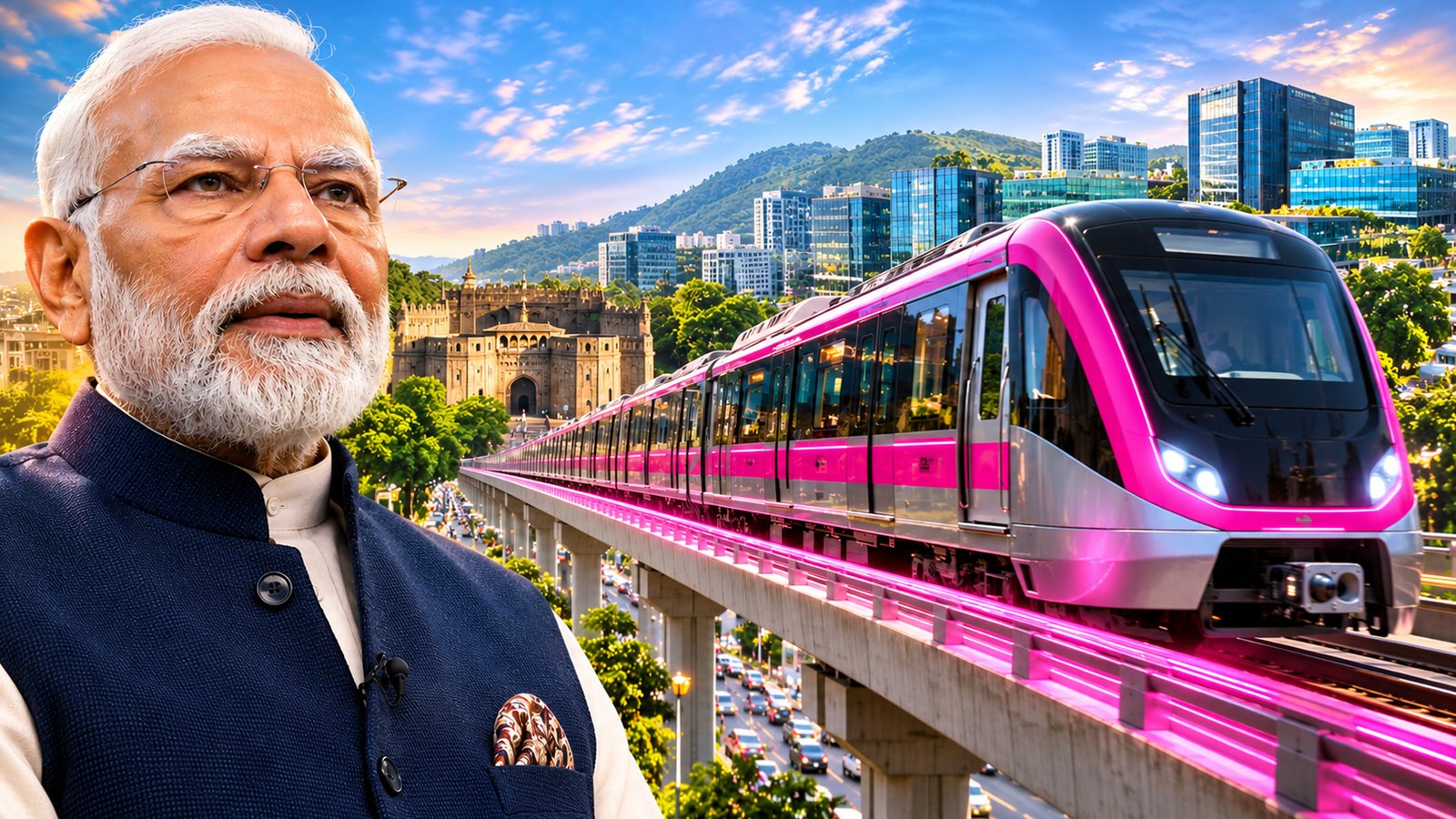
Pune’s long-awaited Metro Line 3, connecting the city’s major information technology hub in Hinjawadi with Shivajinagar, has been inaugurated by Prime Minister Narendra Modi. The new corridor, also known as the Pink Line, is expected to improve daily travel for thousands of commuters and provide relief from the heavy traffic that has affected the route for years.
Modi virtually inaugurated the 23.203-kilometre elevated corridor on November 3, 2026. Built at an estimated cost of ₹8,313 crore, the line connects Maan in the western part of Pune with the District Court Metro station at Shivajinagar. Passenger services are scheduled to begin at 6 am on November 4.
The project is particularly significant for employees working at the Rajiv Gandhi Infotech Park in Hinjawadi, one of Pune’s largest employment centres. A large number of IT professionals travel between Hinjawadi and different parts of the city every day, often spending considerable time on congested roads. The new Metro connection is expected to offer them a faster and more predictable alternative to road transport.
The corridor passes through important residential, commercial and administrative areas, including Hinjawadi, Wakad, Baner, Balewadi, Aundh and Shivajinagar. By connecting these locations, the Metro is expected to strengthen public transport and reduce dependence on private vehicles. Authorities believe the service will also help ease congestion along major roads leading to the IT park.
One of the most distinctive features of Pune Metro Line 3 is its all-women train operations team. Around 100 women drivers will operate trains along the entire corridor, making it a first-of-its-kind initiative in the country. The decision gives the project a wider significance, placing women in key operational roles in the public transport sector.
The corridor also includes a focus on sustainable energy. Around 30% of its electricity requirements are expected to be met through solar power. The initiative is aimed at reducing dependence on conventional energy sources while supporting cleaner urban transport.
The new line has 23 stations, of which 17 will initially be opened to passengers. The remaining six stations are expected to become operational in phases. Work on two of these stations is expected to be completed by the end of November 2026, while the remaining four are scheduled for completion by January 2027.
Some stations will also have limited access arrangements during the initial phase. At seven of the 17 operational stations, only one staircase will be available to commuters. The other ten stations will have both staircases operational. Passengers may therefore need to check station access arrangements while planning their journeys.
The Metro will operate at intervals of around six minutes during peak hours and 12 minutes during non-peak hours, according to the announced schedule. The first train from Maan will depart at 6 am, while the last service from the station towards Shivajinagar is scheduled for 10.30 pm. From Shivajinagar, the first train will also start at 6 am, with the last service towards Maan scheduled for 11.40 pm.
An important advantage of the Pink Line will be its connection with Pune’s existing Metro network. At the District Court station in Shivajinagar, passengers will be able to interchange with Line 1, which operates between Pimpri-Chinchwad and Swargate, and Line 2, which connects Vanaz with Ramwadi. A common ticketing application is also expected to make travel across the two Metro networks more convenient.
The project has been developed by the Pune Metropolitan Region Development Authority (PMRDA) under the public-private partnership model. Pune IT City Metro Rail Limited, a joint venture involving Tata and Siemens, is responsible for implementing the corridor. It is among the country’s major Metro projects developed under the Design, Build, Finance, Operate and Transfer framework in line with the National Metro Rail Policy, 2017.
Alongside the inauguration of Line 3, the Prime Minister laid the foundation stone for four additional Metro corridors under Pune Metro Phase II. The proposed expansion is estimated to cost around ₹13,500 crore and is intended to improve connectivity across several residential, commercial and employment centres.
The Phase II plan includes Line 2A between Vanaz and Chandani Chowk and Line 2B between Ramwadi and Vitthalwadi, together covering approximately 12.75 kilometres. Line 4 will connect Kharadi with Khadakwasla over 25.52 kilometres, while Line 4A will link Nal Stop with Manik Baug over 6.12 kilometres.
The proposed routes are expected to improve access to areas such as Kharadi, Magarpatta, Hadapsar, Swargate, Pune Cantonment, Warje and Nanded City. They are also planned to connect with existing Metro services and intercity bus facilities, creating a wider public transport network.
The inauguration of Line 3 marks an important step in Pune’s efforts to expand its urban transport infrastructure. With the new corridor connecting a major IT hub to central Pune, commuters will have another option for daily travel. The success of the project, however, will depend on how effectively the service meets passenger demand, improves last-mile connectivity and encourages more residents to use public transport.