The Supreme Court will hear a challenge to the Election Commission of India’s (ECI) insistence that voters left out of Delhi’s draft electoral rolls during the Special Intensive Revision (SIR) submit Form 6 to seek inclusion in the final list. The issue was brought before Chief Justice of India Surya Kant on Wednesday, November 4, after the poll panel issued a fresh clarification allowing previously registered voters to use the form.
Advocate Prashant Bhushan, appearing for petitioners Anjali Bharadwaj and Amrita Johri, told the Chief Justice that the Election Commission’s November 3 clarification appeared to go against the Supreme Court’s observations during its October 28 hearing. The petitioners have challenged the procedure followed during the Delhi SIR, arguing that existing voters should not be treated as first-time applicants simply because their names are missing from the draft list.
Responding to Bhushan’s submission, Chief Justice Surya Kant said the matter was pending before the court and that people need not be apprehensive. He asked the petitioners to file an application placing the latest ECI clarification before the bench. The court said it would hear the issue on November 19 and indicated that it could ask the Commission to extend the deadline further, if necessary.
The latest disagreement follows a series of questions raised by the Supreme Court over the use of Form 6 for voters who were already registered in the 2026 electoral roll. Form 6 is ordinarily used by individuals seeking registration as new voters. It requires applicants to declare that their names are being included in the electoral roll for the first time.
The petitioners argue that this creates a problem for people whose names were present in the earlier voter list but were left out during the SIR exercise. They say such electors should not be required to make a declaration that does not reflect their previous registration.
During the October 28 hearing, the Supreme Court questioned why voters who had appeared in the earlier electoral roll were being asked to apply through Form 6 instead of being allowed to submit enumeration forms or Form 8, which is used for changes in electoral details, including address changes.
The bench, comprising Chief Justice Surya Kant and Justices Joymalya Bagchi and V Mohana, also pointed to the possibility that some voters may have temporarily moved out of Delhi for work or other reasons and therefore failed to receive or submit their enumeration forms. Their absence, the court observed, should not automatically mean that they had permanently shifted or should be treated as new voters.
The court suggested that the Election Commission create a separate category for people who could not submit enumeration forms during the exercise. It also asked the poll body to publish the details of excluded voters and reach out to them through local election officials. The Commission’s counsel told the bench that the suggestions would be examined and that remedial steps could be considered.
The controversy is significant because of the scale of voter exclusion in Delhi. Before the SIR began, the national capital had around 1.45 crore registered electors. However, the draft electoral roll published on August 31 contained approximately 97.53 lakh names. As many as 47.56 lakh electors were left out after their enumeration forms were not received.
These voters were placed under categories such as Absent, Shifted, Dead or Duplicate, commonly referred to as ASDD. The petitioners have questioned the process and argued that people who were already registered should be given a practical opportunity to establish their eligibility and restore their names.
On November 3, the Election Commission issued a clarification to Chief Electoral Officers across States and Union Territories. It said previously enrolled voters whose names were missing from the draft SIR rolls could submit Form 6 to seek inclusion in the final electoral roll.
The Commission also addressed concerns that submitting the form could amount to making a false declaration and expose applicants to prosecution under Section 31 of the Representation of the People Act, 1950. It clarified that an Electoral Registration Officer could not initiate action merely because an applicant had been registered in an earlier electoral roll.
However, this protection is subject to conditions. The applicant should not already be enrolled in another Parliamentary or Assembly constituency, and the declaration must comply with the law. The ECI cited an October 14 Delhi High Court order in the case of Nilotpal Datta and another versus the Election Commission of India while explaining its position.
The poll panel has also directed election officials to publicise the clarification widely through different media platforms and in local languages so that affected voters are aware of the procedure.
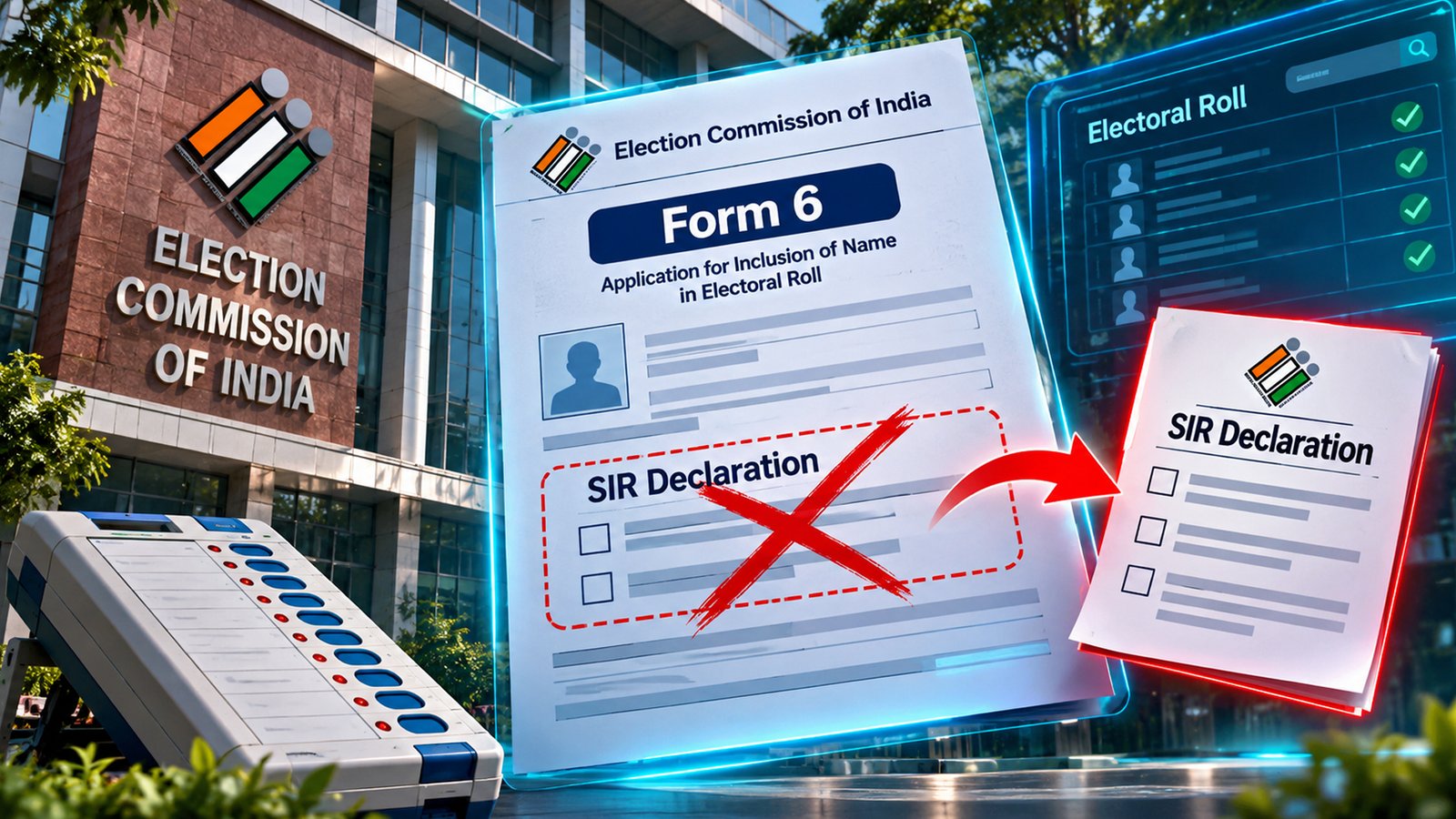
Separately, the Election Commission has made another change concerning Form 6 on its ECINet portal. It has removed the SIR-related declaration from the online version of the statutory voter enrolment form and placed it in a separate document. The declaration had asked applicants whether their names, or those of their parents or grandparents, appeared in the electoral roll during the previous intensive revision.
The change follows objections raised by Election Commissioners Sukhbir Singh Sandhu and Vivek Joshi, who had questioned the insertion of the declaration into Form 6 without a formal amendment to the prescribed rules. The Commission informed the Supreme Court that its Electoral Rolls Division had decided on October 21 to separate the two documents.
The two developments concern different aspects of the SIR process: one relates to the format of the online voter application, while the other concerns how previously registered voters can seek inclusion after being left out of the draft list.
With the Supreme Court scheduled to take up the petitioners’ latest application on November 19, the Election Commission’s approach to excluded voters remains under judicial scrutiny. The next hearing is expected to examine the concerns raised over Form 6 and the practical steps needed to ensure that eligible electors are not left out of the final voter list.