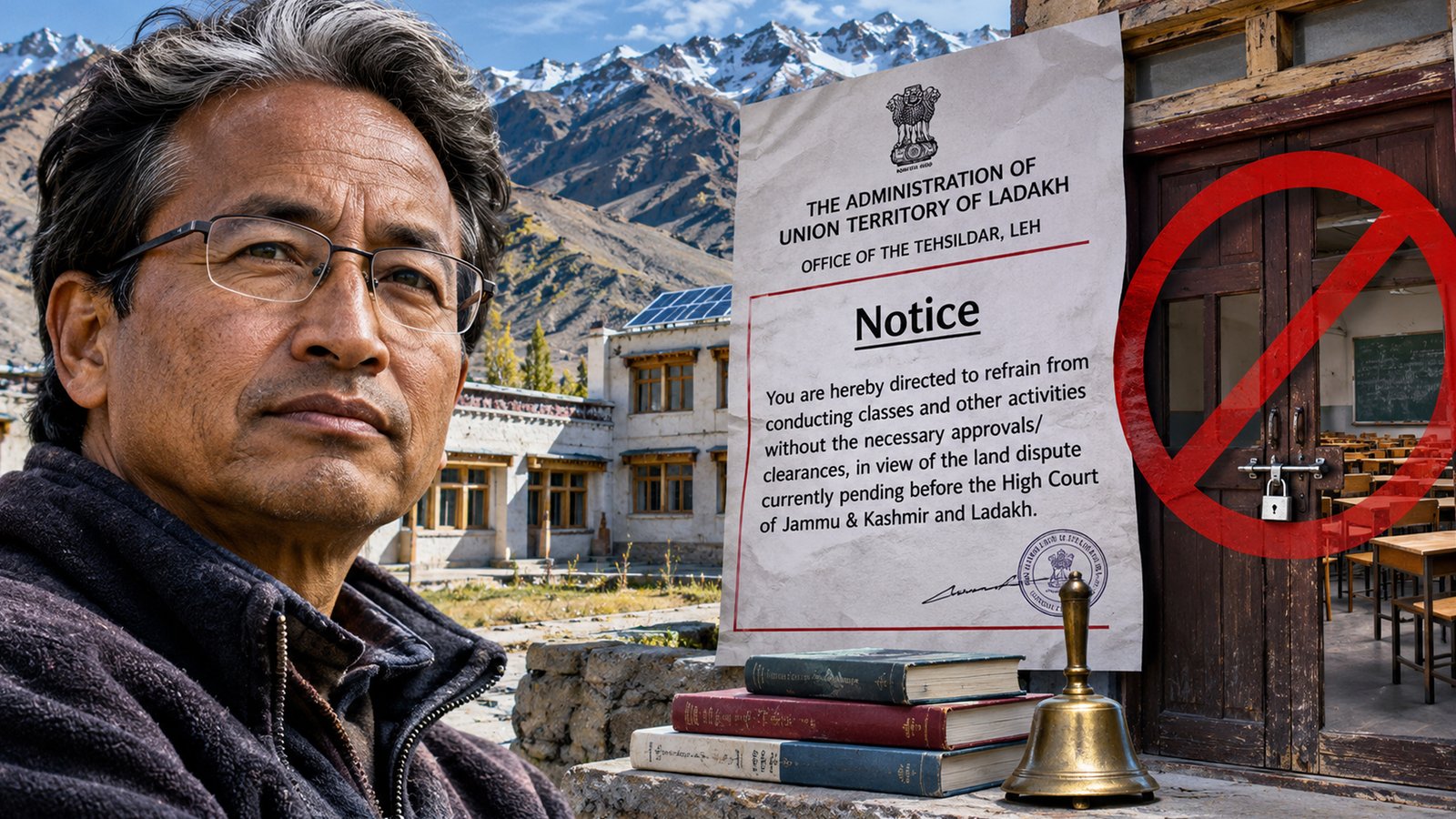
The Ladakh administration has directed the management of Desert Flower School in Leh, associated with activist and educationist Sonam Wangchuk, to stop all activities until further orders from the High Court. The notice, issued to Wangchuk’s wife, Gitanjali J Angmo, cites the absence of necessary administrative approvals and an ongoing legal dispute over land allotted to the Himalayan Institute of Alternatives (HIAL).
The directive has brought the school’s operations under scrutiny, with the administration asking the management not to proceed with classes or other activities until the court delivers its final decision or issues further directions. It has also instructed the institute to maintain the status quo and avoid taking any steps that could affect the ongoing legal proceedings.
The notice was issued on November 1 by the Office of the Tehsildar in Leh. It followed reports that Desert Flower School, located in Phyang, had started conducting classes without obtaining the required permissions and clearances from the concerned authorities.
Angmo, who heads HIAL as its chief executive officer, had written to the Leh Deputy Commissioner on September 22 seeking a No Objection Certificate (NOC) or clearance for the proposed members of the school’s managing committee. However, the administration said it had received information that the institution had begun its activities before the necessary approvals were granted.
The authorities referred to the pending case concerning HIAL’s land allotment and advised the school management against taking further steps until the legal dispute was resolved. The notice effectively places the school’s activities on hold while the matter remains before the High Court of Jammu and Kashmir and Ladakh.
The latest development is connected to a wider dispute between HIAL and the Ladakh administration over land allotted to the institute in Phyang. The institute was established by Wangchuk with the aim of promoting alternative education, innovation and sustainable development suited to the environmental and social conditions of the Himalayan region.
In May 2018, the administration allotted 1,076 kanals and one marla of land at Phyang Thang to HIAL under a proposed 40-year lease. The land was intended for setting up an alternative university that would focus on research, education and solutions to challenges faced by mountain communities.
However, the administration cancelled the land allotment in August 2025, arguing that the institute had failed to fulfil the conditions attached to the original decision. HIAL challenged the cancellation before the High Court, questioning the grounds on which the land was taken back.
The dispute took another turn in September 2026, when the High Court passed an interim order restraining the administration from creating third-party rights over the disputed land. The order provided temporary protection while the court examined the petition, but did not overturn the administration’s decision to cancel the allotment.
The administration has maintained that HIAL failed to complete the necessary formalities within the stipulated period. In an affidavit submitted before the court in October, the Leh Deputy Commissioner argued that the allotment had lapsed because the institute did not deposit the mandatory premium ground rent or complete the required lease formalities.
The administration also questioned whether the land had been used for the purpose for which it was originally allotted. It maintained that the proposed university had not been established and argued that the conditions attached to the allotment had not been fulfilled.
According to the administration’s position, the allotment had lapsed in May 2019, as the required conditions were not met within the first year. HIAL, however, has disputed this claim, maintaining that delays on the part of the authorities prevented the institute from completing the lease process.
Angmo has said that HIAL made efforts to complete the formalities soon after receiving the land. She has pointed out that the institute applied for execution of the lease deed on May 20, 2018, just 15 days after the allotment was made.
She also said HIAL followed up with the administration in March 2020 but was informed that the lease could not be executed because the authorities had not finalised their land lease policy. According to her, an official communication issued in February 2021 acknowledged that administrative delays had affected the process and allowed construction activities to continue.
Wangchuk has also maintained that the institute repeatedly approached the authorities to resolve the matter. He has alleged that the action against HIAL is linked to his activism and his demands concerning Ladakh’s political rights, environmental protection and constitutional safeguards.
The administration, however, has rejected the allegations and maintained that its decision was based on the institute’s failure to meet the conditions of the original land allotment.
Angmo has reportedly described the latest notice as unjustified, arguing that the delay in securing the necessary clearance was not caused by the institute. She has also said that a response had been sent to the authorities.
The latest directive has added to the uncertainty surrounding HIAL’s educational plans in Ladakh. While the institute continues to challenge the cancellation of its land allotment, the school has now been asked to suspend its activities until further directions.
The High Court’s eventual decision on the land dispute is likely to have significant implications for HIAL’s plans in Phyang, including its proposed university and associated educational initiatives.