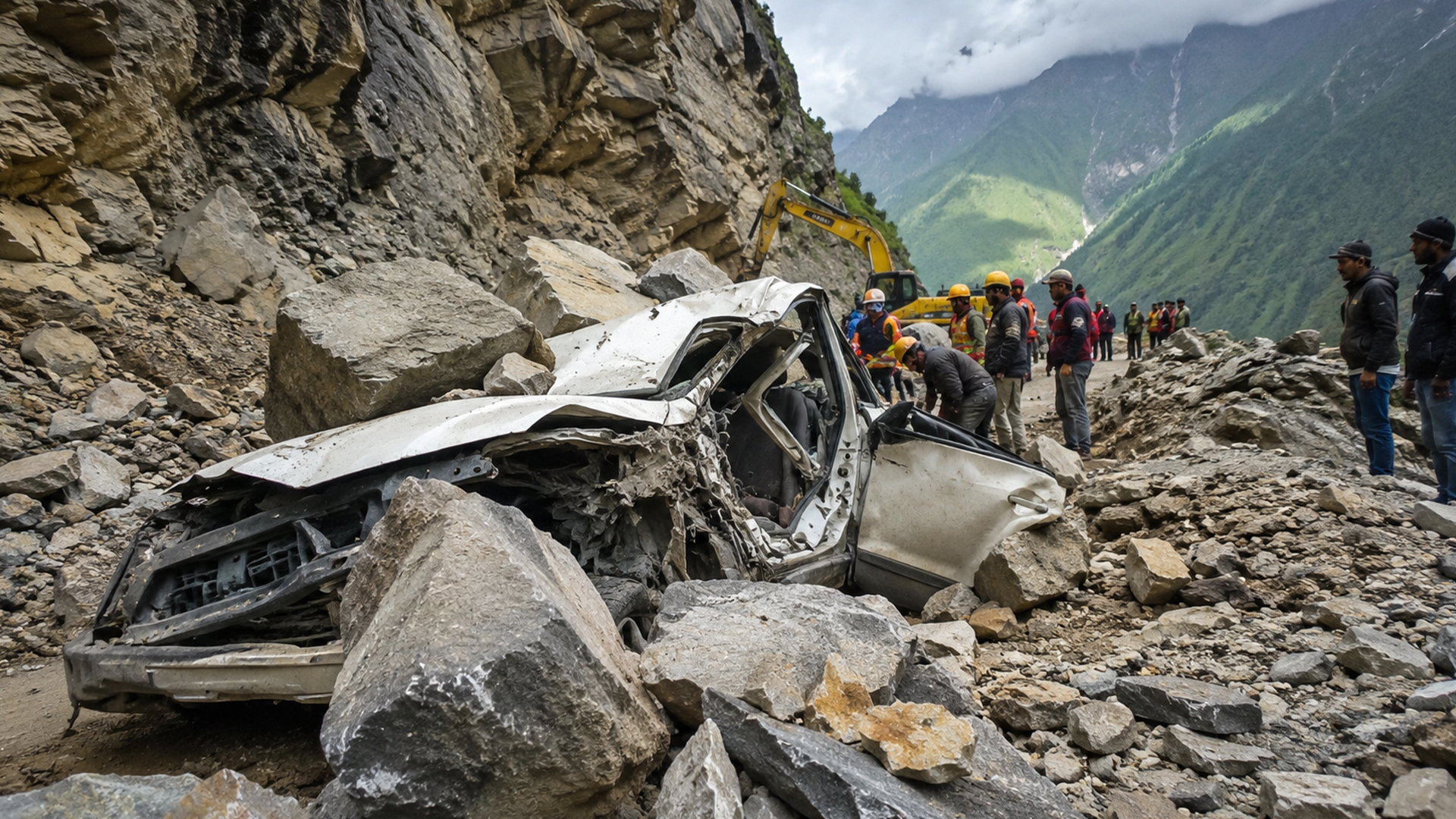
A journey home through the breathtaking mountains of Himachal Pradesh ended in unimaginable tragedy on Friday when a massive rockfall crushed a passenger taxi in Lahaul-Spiti district, killing 13 people, including a six-month-old infant. Two others survived after narrowly escaping the vehicle moments before giant boulders came crashing down, turning an ordinary trip into one of the state’s deadliest monsoon road disasters this year.
The accident occurred near Kadu Nala on the Udaipur-Killar road, a narrow and landslide-prone stretch that connects remote tribal areas with the rest of the state. The Tata Sumo was carrying 15 passengers from Kullu to the Pangi Valley when a section of the steep mountainside suddenly gave way. Without warning, enormous rocks tumbled onto the moving vehicle, crushing it within seconds.
Officials said there was virtually no time for those inside to react. While two passengers managed to jump out just before the impact, the remaining occupants were trapped as the taxi was flattened under the weight of the falling boulders.
The force of the impact left the vehicle mangled beyond recognition. Parts of the taxi later caught fire, making rescue efforts even more difficult. Images from the scene showed the vehicle buried beneath rocks and debris, highlighting the devastating power of the rockfall.
Rescue teams, police personnel, Border Roads Organisation (BRO) workers, local residents and emergency officials rushed to the accident site soon after receiving information. Heavy machinery was deployed to remove massive rocks blocking the road while rescue workers carefully searched the wreckage for survivors.
Despite their efforts, authorities confirmed that 13 people, including the driver and a six-month-old infant, had lost their lives. The two injured survivors were rescued and taken to a nearby hospital, where they are receiving treatment. Officials said their condition is stable.
According to the district administration, the victims were travelling to the remote Pangi Valley, one of Himachal Pradesh’s most isolated regions. For many of them, it was a routine journey through familiar mountain roads. But the unpredictable nature of the Himalayan terrain, especially during the monsoon, turned that journey into a heartbreaking disaster.
Officials revealed that the passengers had already faced delays before the tragedy struck. The Udaipur-Killar road had been closed on Thursday because of another landslide, forcing the travellers to halt overnight in Tindi village. After road clearance operations were completed, authorities reopened the route on Friday morning. Believing it was safe to proceed, the passengers resumed their journey—only to encounter another sudden rockfall a short distance later.
Deputy Commissioner Kiran Bhadana said rescue operations continued for several hours as teams worked to recover the bodies and clear the debris. Authorities also began the process of identifying the victims and informing their families, many of whom were waiting for their loved ones to arrive in Pangi Valley.
Himachal Pradesh Chief Minister Sukhvinder Singh Sukhu expressed profound grief over the loss of lives and described the incident as deeply distressing. He directed the district administration to personally supervise rescue and relief operations and ensure that the injured received the best possible medical treatment. He also assured that every possible assistance would be provided to the families of those who lost their lives.
Leader of Opposition Jairam Thakur also conveyed his condolences, calling the accident heartbreaking and expressing sorrow over the deaths of entire families, including an infant.
The tragedy has once again drawn attention to the dangers of travelling on mountain roads during the monsoon season. Heavy rainfall often loosens rocks and destabilises steep slopes, increasing the risk of landslides and rockfalls without warning. Roads in districts such as Lahaul-Spiti, Kinnaur, Chamba and Pangi are particularly vulnerable because they pass through rugged Himalayan terrain where falling rocks are a constant hazard.
The India Meteorological Department (IMD) has forecast more rain across Himachal Pradesh over the coming days and has warned of continued risks of landslides, flash floods and road blockages in several districts. Authorities have urged residents and tourists to avoid unnecessary travel through vulnerable stretches, especially during periods of heavy rainfall.
Road restoration teams continue to monitor key mountain routes, but officials admit that despite regular inspections and clearance work, sudden rockfalls remain difficult to predict. The incident near Kadu Nala occurred despite the road having been reopened only hours earlier after being declared safe for traffic.
For families waiting at the other end of the journey, Friday’s tragedy has left behind unbearable grief. Loved ones who had set out expecting a routine drive through the mountains never reached home. Instead, relatives were left receiving devastating phone calls and travelling to identify victims of a disaster that unfolded in mere seconds.
The accident is a painful reminder of the fragile balance between life and nature in the Himalayas. As rescue teams completed their operations and authorities began investigating the circumstances surrounding the tragedy, fresh questions emerged about improving safety on vulnerable mountain roads. Experts have called for stronger real-time monitoring of landslide-prone zones, better early warning systems, and stricter travel advisories during extreme weather.
Also Read: Scientists find a ‘little brain’ inside the heart