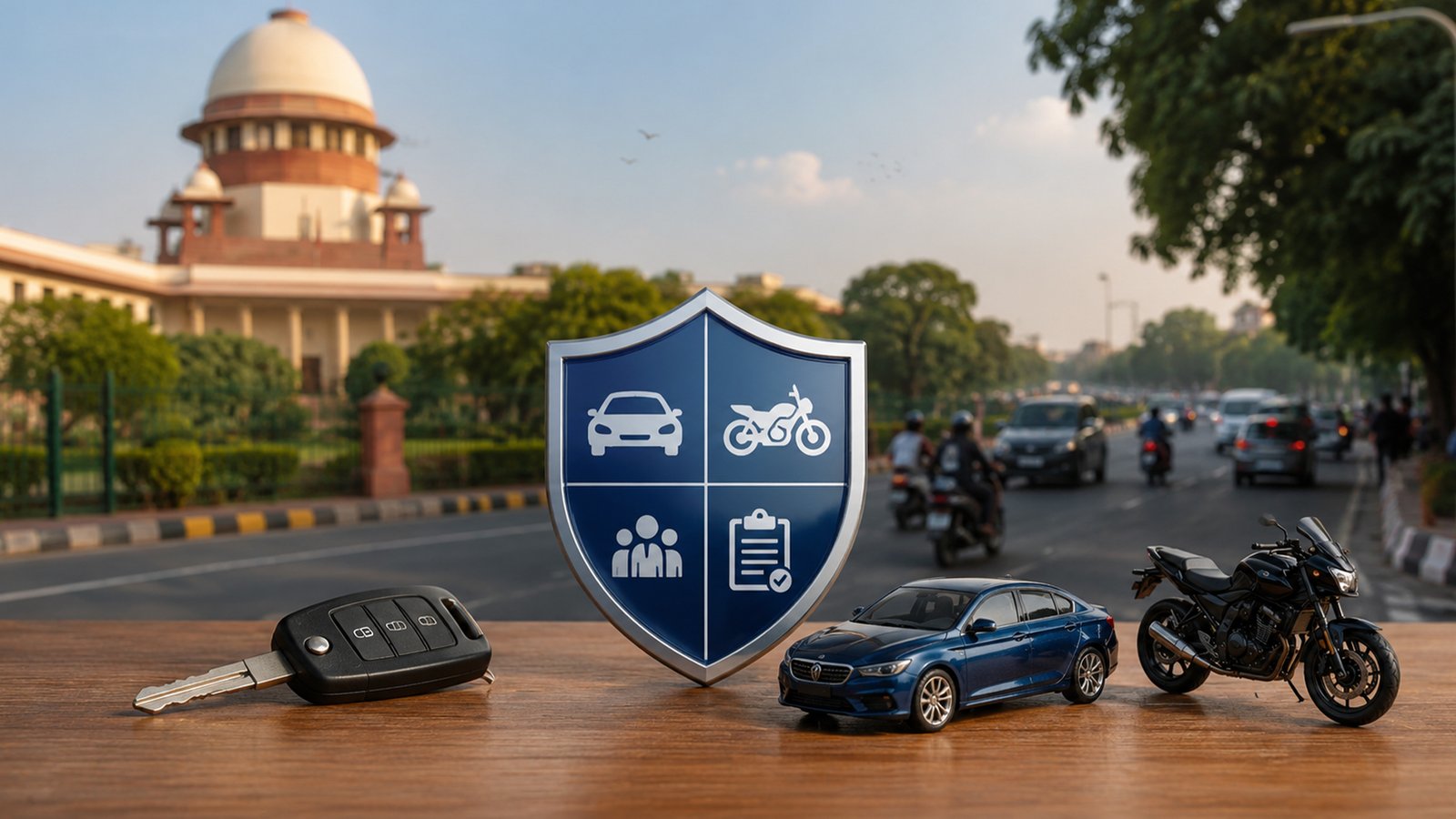
The Supreme Court has extended the mandatory third-party insurance period for newly purchased vehicles by one year, directing that new private cars must have four years of third-party cover while new two-wheelers must carry six years of coverage.
The decision seeks to improve motor insurance compliance across India and ensure that victims of road accidents are not left without financial protection when an uninsured vehicle is involved. The court has also asked the Insurance Regulatory and Development Authority of India (IRDAI) to take necessary steps to implement the revised insurance periods.
Under the existing rules, introduced after a 2018 Supreme Court order, buyers of new private cars were required to take three years of third-party insurance, while buyers of new two-wheelers had to purchase five years of cover. The latest direction adds one year to both periods.
Third-party insurance is mandatory under the Motor Vehicles Act and is designed to protect people other than the vehicle owner in case of an accident. It covers the policyholder’s legal liability for death, injury or property damage caused to a third party. It is different from own-damage insurance, which protects the insured vehicle against risks such as accidents, theft and certain natural disasters.
For people buying a new car or two-wheeler, the immediate impact will be a longer period of mandatory third-party protection at the time of purchase. The insurance component of the initial vehicle cost could also rise because buyers will have to pay for an additional year of third-party coverage.
The Supreme Court’s move comes amid serious concerns about the number of uninsured vehicles on Indian roads. Data cited during the proceedings showed that a large share of the country’s vehicle fleet does not have valid insurance. The court has repeatedly stressed that compulsory third-party insurance is intended not only to regulate vehicle owners but also to protect accident victims.
When an uninsured vehicle causes a serious accident, victims and their families can face difficulties in recovering compensation. The absence of valid insurance can lead to additional legal and financial complications, particularly when victims are already dealing with medical expenses, loss of income or the death of a family member.
The court has therefore linked insurance compliance with road safety and the larger objective of ensuring timely compensation for victims.
Alongside the extension of insurance cover, the Supreme Court is also looking at stronger ways to identify uninsured vehicles. It has asked authorities to explore technology-based enforcement, including systems that can automatically detect vehicles without valid insurance and generate electronic challans.
The court has also proposed a pilot project based on the “no insurance, no fuel” concept. Under the proposed system, vehicles without valid third-party insurance could potentially be prevented from purchasing fuel at petrol pumps. The proposal is still at the pilot stage and does not mean that petrol pumps across the country have begun refusing fuel to uninsured vehicles.
The proposed mechanism would require coordination between IRDAI, the Ministry of Road Transport and Highways and other authorities. If eventually implemented, insurance status could be checked digitally before fuel is dispensed, giving motorists a strong incentive to renew policies on time.
The court is also examining the use of technology to improve insurance verification. Linking vehicle registration databases, insurance records and automatic number plate recognition systems could allow authorities to identify uninsured vehicles more efficiently. Such measures could reduce dependence on physical traffic checks and make enforcement more consistent.
The latest order is particularly important because extending the mandatory insurance period for new vehicles alone will not address the wider problem of uninsured vehicles. Older cars, motorcycles and scooters can also become uninsured when owners fail to renew their policies after the initial coverage expires.
The court has additionally suggested that buyers should be offered a broader insurance package covering different risks. This could include third-party liability, personal accident protection and cover for damage to the vehicle, giving consumers a clearer understanding of the protection available when purchasing a vehicle.
However, motorists should distinguish between mandatory third-party insurance and comprehensive motor insurance. The extended four-year or six-year requirement applies to third-party coverage and does not automatically mean that the vehicle itself will remain protected against every type of damage for the same period.
The exact premium structure and implementation process will depend on the directions issued by IRDAI and the insurance industry following the Supreme Court’s order.
For new vehicle buyers, the change means longer mandatory third-party insurance from the date of purchase. For the broader motor insurance sector, the ruling signals a stronger push towards digital monitoring, stricter enforcement and wider insurance coverage.