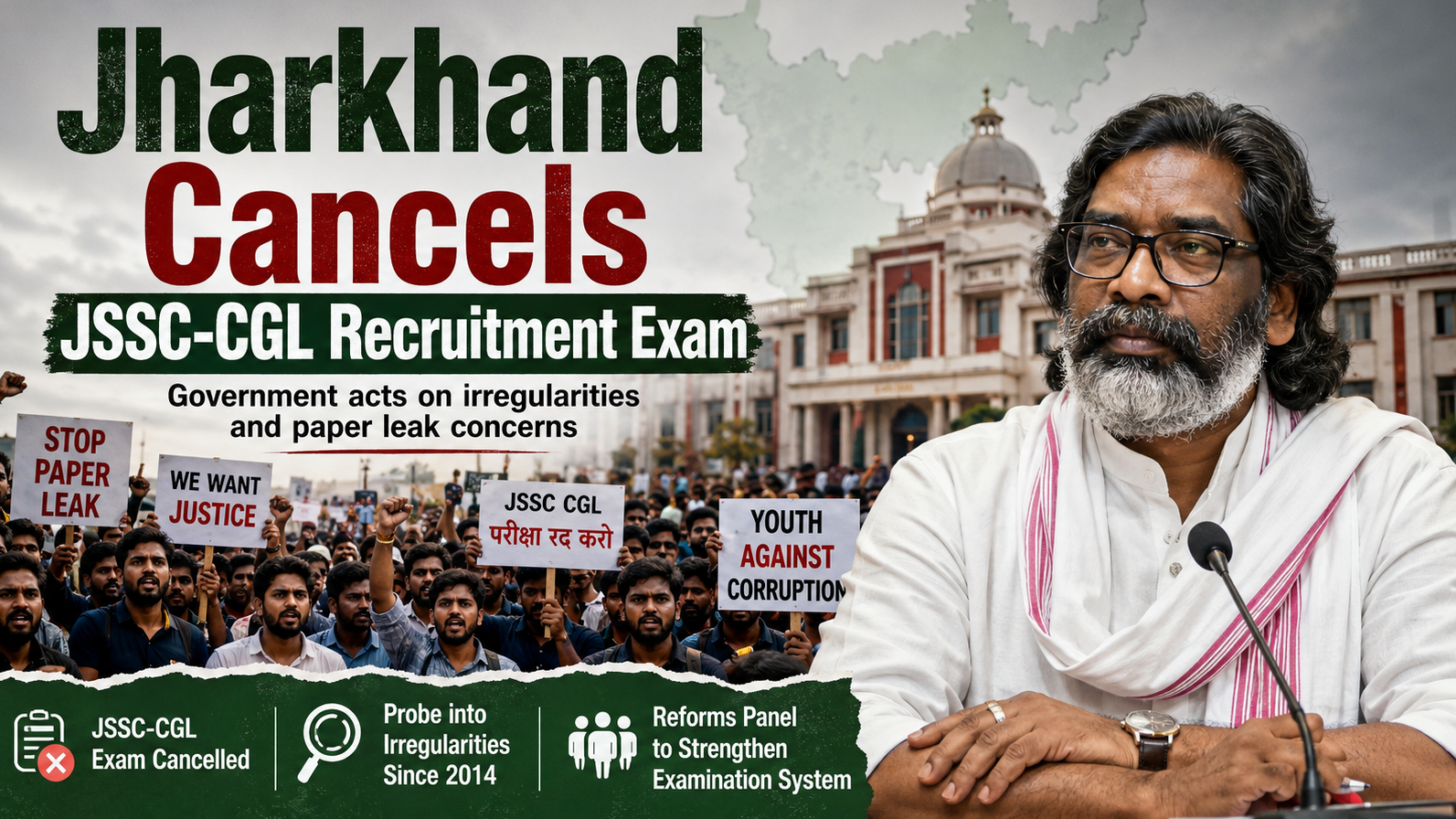
he Jharkhand government has cancelled the 2024 Jharkhand Staff Selection Commission-Combined Graduate Level (JSSC-CGL) examination and all recruitment tests conducted by an outsourced agency, bringing a major development to a student agitation that has continued for 24 days. The decision came after weeks of protests over alleged irregularities in government recruitment examinations and mounting pressure from student leaders.
Chief Minister Hemant Soren announced the decision after a Cabinet meeting on August 17. The government said examinations conducted by TSR Data Processing Pvt Ltd (TDPL), along with their results and recruitment, would be cancelled. It also ordered a comprehensive investigation into examinations and recruitment processes handled through the agency since 2014.
The move was welcomed by student leader Devendra Nath Mahto, who had been on a hunger strike for 16 days. Mahto ended his fast at Sadar Hospital in Ranchi after the government accepted the key demand to cancel the disputed examinations. He described the decision as a major victory for students and thanked the government for taking action.
The protest, however, has not ended completely. While the cancellation of the JSSC-CGL examination has provided relief to students, sections of the protesting group have said they want further assurances on the investigation and recruitment process. Student leaders have also continued to demand accountability over alleged irregularities and greater transparency in future government examinations.
The agitation had gained momentum in Ranchi as students raised concerns about the integrity of competitive examinations conducted for government jobs. The JSSC-CGL examination was at the centre of the dispute, with protesters demanding that the test be cancelled and that alleged irregularities be investigated.
For thousands of candidates preparing for government recruitment, the issue has carried significant stakes. The JSSC-CGL examination is an important route to state government employment, and its cancellation means that candidates who had invested considerable time and money in preparation will have to wait for clarity on what happens next.
The decision has also created uncertainty for candidates who had already cleared the examination. According to reports, around 2,000 candidates who qualified the JSSC-CGL could be affected by the cancellation. Their future will depend on the government’s next steps, including whether the examination is conducted afresh and how the authorities deal with candidates who had already progressed through the selection process.
The government has sought to frame the decision as part of a broader effort to restore confidence in the recruitment system. By extending the cancellation to all examinations conducted by TDPL since 2014, the administration has widened the scope of the action beyond the JSSC-CGL controversy.
The probe into the recruitment process will now be closely watched. The government has indicated that irregularities in examinations and recruitment conducted through the agency will be examined and that those responsible, if wrongdoing is established, will face action. The investigation is expected to determine whether the concerns raised by students were isolated incidents or part of wider problems in the recruitment system.
The student movement has also highlighted a broader concern among young people seeking government jobs: the need for recruitment examinations to be conducted in a transparent and credible manner. The issue is part of the wider national developments affecting students and public recruitment in India. Competitive examinations can determine the career prospects of thousands of candidates, making allegations of paper leaks, malpractice or procedural lapses particularly sensitive.
Mahto’s hunger strike had become one of the most visible aspects of the agitation. His health had come under scrutiny during the fast, adding urgency to negotiations between the government and protesters. His decision to end the strike followed the government’s announcement on the examination cancellations.
However, Mahto has indicated that the larger campaign for corruption-free recruitment may continue. On Tuesday, he said the next phase of the movement would focus on ensuring that future examinations are conducted without paper leaks or other irregularities. This suggests that the government’s latest decision may mark the end of one phase of the protest rather than the complete resolution of the dispute.
The developments also come after earlier rounds of talks between student representatives and the state government failed to produce an agreement. Protesters had been pressing for action on several issues linked to recruitment examinations, while the government faced growing pressure to respond to the allegations.
With the JSSC-CGL cancellation now officially announced, attention is likely to shift to the investigation and the government’s plan for conducting fresh examinations. Students will also be looking for clarity on whether the new recruitment process will provide adequate safeguards against malpractice and whether candidates affected by the cancellation will receive clear timelines.