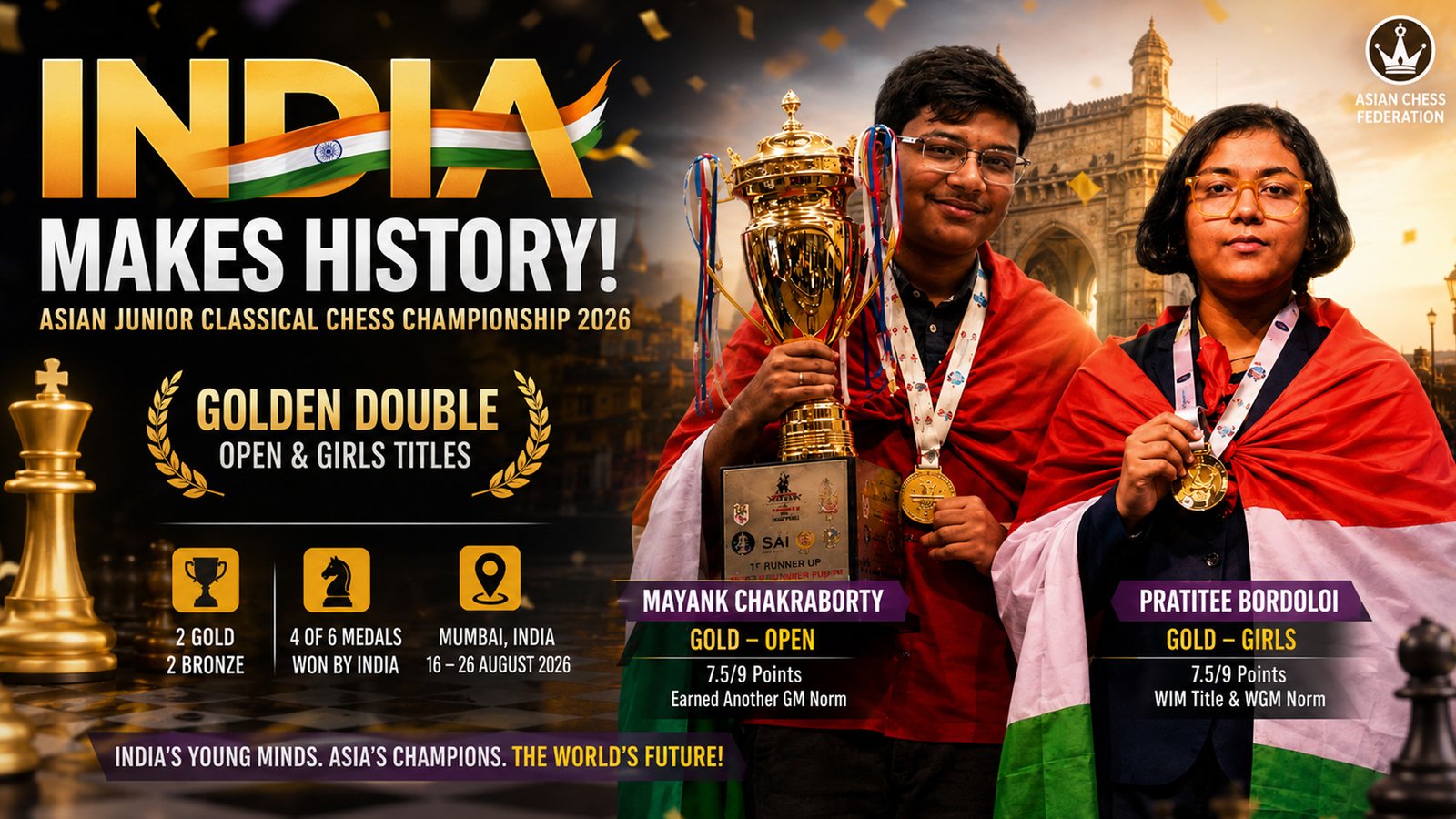
India produced a memorable performance at the Asian Junior Classical Chess Championship in Mumbai, with Mayank Chakraborty and Pratitee Bordoloi winning the Open and Girls titles respectively.
The two Indian youngsters finished the nine-round tournament with 7.5 points each, giving the host nation a golden double at the championship held at the ITC Maratha Sheraton. Their victories also added important international norms to an already impressive list of achievements in junior chess.
Top seed Mayank Chakraborty lived up to expectations in the Open section. The 17-year-old from Assam finished with 7.5 points to take the gold medal, ahead of Russia’s Artem Pingin, who scored seven points for silver. India’s Daksh Goyal completed the podium with 6.5 points and secured the bronze medal.
Mayank had already made history earlier this year by becoming India’s 94th Grandmaster and the first player from Assam and the Northeast to achieve the title. The Asian Junior crown now gives him another significant milestone at a time when he is establishing himself among India’s promising young players.
His success in Mumbai was also important because the tournament was not simply about collecting medals. Mayank secured another Grandmaster norm during his title-winning campaign, further strengthening his credentials on the international circuit.
Pratitee Bordoloi completed India’s golden double by winning the Girls title. The top-seeded Indian scored 7.5 points from nine rounds to finish ahead of Kazakhstan’s Mariya Kholyavko, who took silver after scoring seven points. India’s Nivedita V C claimed the bronze medal with 6.5 points.
Pratitee’s victory was equally significant. She also earned a Woman Grandmaster norm, adding an important achievement to her growing chess career. Her consistent performance throughout the tournament helped her take control of the Girls section before converting that advantage into the championship title.
The final result reflected the depth of Indian junior chess. India finished with four medals in the two main sections, collecting two golds and two bronzes. Mayank and Pratitee took the top honours, while Daksh Goyal and Nivedita V C added bronze medals.
The championship had already begun with strong expectations around the two Indian top seeds. In the earlier rounds, both players maintained their positions near the top of the standings. By the seventh round, Pratitee had moved into the sole lead in the Girls section after defeating WCM Aadya Gowda. Mayank, meanwhile, remained firmly in contention in the Open competition.
The pressure increased in the eighth and penultimate round. Both players secured victories, moving within touching distance of the titles before the final round. Their ability to maintain concentration through nine rounds proved decisive, particularly in a classical chess tournament where games can stretch for several hours and small mistakes can change the result.
Mayank’s path to the Open title was particularly noteworthy because the field included several strong international junior players. Russia’s Artem Pingin remained close behind, but the Indian top seed managed to finish half a point clear of the next-best Indian and one of his main international challengers.
Pratitee’s 7.5 points placed her half a point ahead of Kholyavko, while Nivedita finished another half point behind. The close standings underline how competitive the Girls championship was and how important every point became during the nine-round event.
The tournament was organised by the Maharashtra Chess Association on behalf of the All India Chess Federation and the Asian Chess Federation. Mumbai hosted players competing for the Asian Junior Open and Girls Classical Chess titles, bringing together some of the continent’s strongest young players.
The event also highlighted India’s expanding pool of young chess talent. While established names such as Viswanathan Anand and the current generation of Indian Grandmasters have helped put the country firmly on the global chess map, performances by players such as Mayank and Pratitee point to another generation coming through.
Mayank’s journey is particularly significant for the Northeast. His rise has helped bring greater attention to chess in Assam and neighbouring states. Becoming the first Grandmaster from the region earlier this year was already a landmark moment. Winning the Asian Junior title only months later adds another chapter to that story.
Pratitee’s achievement, meanwhile, strengthens India’s growing presence in women’s and girls’ chess. Her Woman Grandmaster norm gives her another target to build on as she continues competing at higher levels.
The Asian Junior Classical Chess Championship also offered opportunities beyond the main medals. Several participants earned FIDE titles and norms during the competition, underlining the importance of the event as a stepping stone for young players hoping to progress in international chess.
Mayank and Pratitee’s victories also showed two different sides of success in junior chess: the ability to handle the pressure of being favourites and the discipline needed to deliver across a long classical tournament.
With 7.5 points apiece, two gold medals and major FIDE norms, the pair gave India a result that went beyond a routine home victory. The Asian Junior Classical Chess Championship has produced another strong indication that India’s next generation of chess talent is ready to make its mark on the international stage.