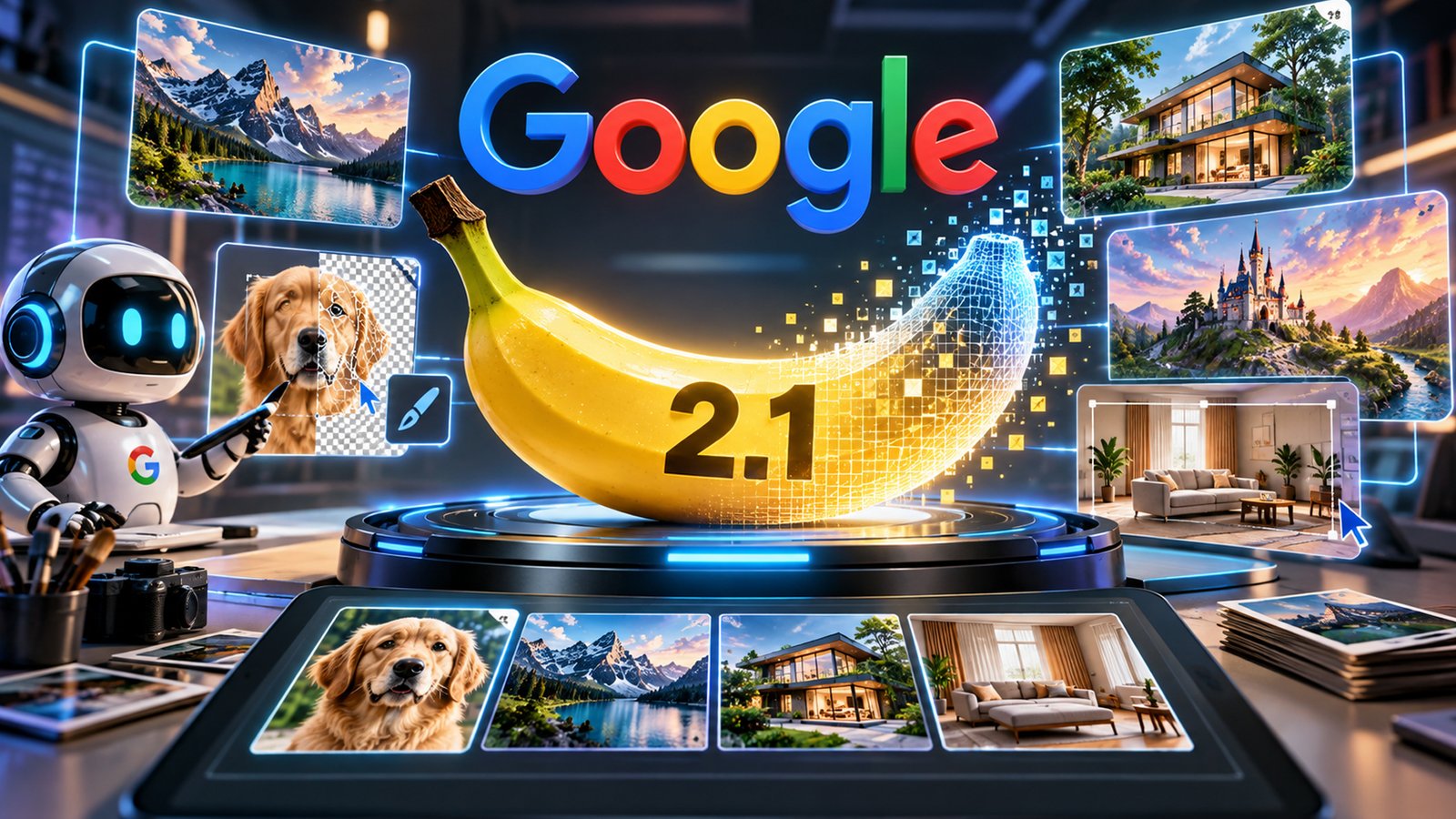
Google has launched Nano Banana 2.1, its latest artificial intelligence model for image generation and editing, bringing better visual quality and stronger editing capabilities at a significantly lower cost.
The new model became generally available on October 6 and is positioned as an updated, more efficient version of Nano Banana 2. Google says it is designed to handle everyday image-generation tasks faster while improving how accurately it follows prompts and preserves details during repeated edits.
The biggest attraction for developers could be the price. Google has nearly halved the image-output cost compared with Nano Banana 2. Standard API pricing for Nano Banana 2.1 is $0.0336 for a 1K image, $0.0504 for a 2K image and $0.0756 for a 4K image. The previous Nano Banana 2 was priced at roughly twice those levels for comparable output.
That difference could become meaningful for businesses generating thousands or millions of images. E-commerce companies, advertising agencies, gaming studios, publishers and social media teams increasingly use generative AI to create product visuals, campaign material, thumbnails and other digital content. Lower image-generation costs can make it easier to use AI throughout those workflows rather than only for occasional experiments.
Nano Banana 2.1 also focuses on one of the more frustrating problems with AI image generation: keeping important details consistent when an image is edited repeatedly.
Google says the model improves multi-turn character consistency, allowing people or characters to remain more stable across successive edits. It can also combine up to 14 reference images, with Google highlighting support for maintaining the appearance of up to four characters and the fidelity of up to 10 objects.
That could be particularly useful for creative professionals working on advertising campaigns, fashion imagery or branded content. A designer could provide several reference images and ask the model to change the background, clothing, lighting or composition without completely changing the subject.
Text rendering has received an upgrade as well. Nano Banana 2.1 is designed to produce more accurate text and infographic layouts, addressing a long-standing weakness of AI-generated visuals. This matters because posters, advertisements, presentations and social media graphics often depend on readable text rather than images alone.
The model also supports image generation at 1K, 2K and 4K resolutions. Google says it has fixed tiling artefacts that could appear in extremely wide or tall images at 2K and 4K resolutions. Such improvements could make the model more useful for banners, panoramic graphics and other unusual formats.
Another notable feature is Google Search grounding. Nano Banana 2.1 can use Google Web and Image Search as visual context, allowing generated images to be informed by current information and reference material. Google also supports video-to-image generation with the model, opening possibilities for creating thumbnails, posters or new artwork based on video content.
The model is available through several parts of Google’s AI ecosystem, including Gemini, Google AI Studio and the Gemini API. Developers can access it using the model identifier gemini-nano-banana-2.1. Google has positioned it as the main high-efficiency image model for new projects, alongside Nano Banana Pro for more demanding visual tasks and Nano Banana 2 Lite for situations where speed and cost are the biggest priorities.
The launch also highlights how quickly competition in generative AI is moving beyond text-based chatbots. Image generation has become an increasingly important battleground, with companies competing on realism, editing control, speed, consistency and cost.
Lower prices could be especially important as companies move from experimenting with AI to using it at scale. Creating one marketing image with an AI tool may not seem expensive, but the economics change when a business needs thousands of variations for different products, languages, markets and advertising formats.
Nano Banana 2.1 is therefore less about simply making another AI-generated picture and more about making image generation a practical production tool. Better editing, improved text rendering, reference-image support and lower API costs could make it attractive to developers building AI-powered creative applications.
Google’s latest release also shows where generative AI is heading. Users increasingly want more than a beautiful first image; they want to control what changes, preserve what works and make multiple revisions without losing the original subject.
With Nano Banana 2.1, Google is betting that better control combined with lower costs will make AI image generation more useful for everyday creators as well as businesses building large-scale visual workflows.