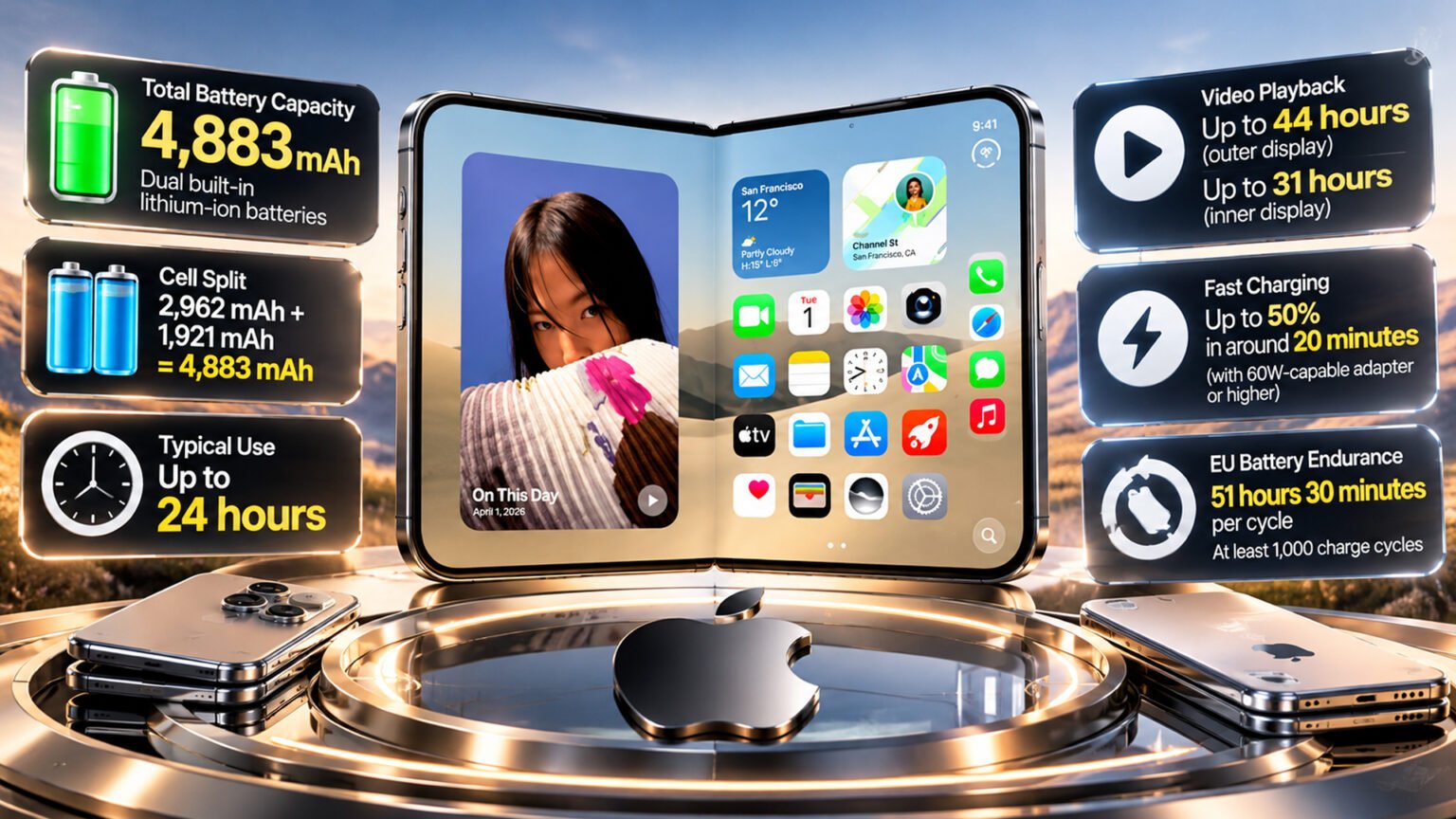
Apple has revealed the battery capacity of its first foldable smartphone, the iPhone Duo, just days before the device reaches stores. The phone packs a 4,883mAh battery, according to a European Union energy label published by the company. The disclosure offers a clearer picture of the hardware powering Apple’s new foldable phone and gives buyers more information as they decide whether to make the switch.
The battery details appeared in the European Product Registry for Energy Labelling (EPREL), a database used to provide standardised information about electronic devices. The listing identifies the iPhone Duo by its model number, A3720, and confirms that its battery uses two separate cells with a combined capacity of 4,883mAh.
Apple has divided the battery into two units, reportedly rated at 2,962mAh and 1,921mAh. This arrangement helps accommodate the phone’s book-style folding design, which needs to fit a large screen and other components into a relatively compact body.
The capacity figure had been anticipated following earlier reports, but the regulatory disclosure now provides confirmation. It also helps put the iPhone Duo’s battery in context alongside other recent iPhones.
The iPhone 18 Pro has a 4,288mAh battery in its eSIM-only version, while the iPhone 18 Pro Max has a larger 5,567mAh battery. The iPhone Duo therefore sits between the two in terms of total battery capacity. However, battery size alone does not determine how long a phone lasts. Display size, brightness, processor efficiency, software and the way people use their devices all influence battery performance.
This distinction is particularly important for the iPhone Duo because it has two displays. The device features a 5.4-inch outer screen for everyday tasks and a larger 7.6-inch folding display that opens up for viewing videos, gaming and multitasking. Using the larger screen more frequently may affect battery consumption differently from relying mainly on the outer display.
Apple has advertised all-day battery life for the iPhone Duo. According to the company’s technical specifications, the device supports up to 44 hours of locally stored video playback when using the outer display. That figure falls to up to 31 hours when using the inner screen. For streamed video, Apple’s estimates are up to 37 hours on the outer display and 26 hours on the inner display.
These are manufacturer-rated figures, not a guarantee of the battery life every user will experience. Real-world performance can vary with network conditions, screen brightness, applications and other settings.
The European energy label also lists battery endurance of 51 hours and 30 minutes per charge cycle under its standardised testing method. This measurement should not be treated as directly equivalent to Apple’s video-playback estimates, as the tests use different conditions.
The listing provides additional information about durability and long-term battery performance. It rates the iPhone Duo’s battery for at least 1,000 full charge cycles before its capacity falls below the specified threshold under the stated testing conditions. The EU label also gives the device an energy-efficiency rating of A, a drop-resistance rating of B and a repairability rating of C.
Charging is another key part of the package. Apple says the iPhone Duo can reach around 50% charge in approximately 20 minutes when connected to a compatible 60W or higher power adapter using a USB-C cable. A compatible MagSafe charger paired with a 35W or higher adapter can deliver a similar charge level in around 30 minutes. The required adapters and charging accessories are sold separately.
Beyond the battery, the iPhone Duo represents Apple’s entry into the foldable smartphone market. It is powered by the A20 Pro chip and runs iOS 27, with software designed to adapt to the phone’s changing screen size. Apple says the inner display offers a larger workspace for multitasking, while the outer screen keeps routine tasks accessible without opening the device.
The company has priced the iPhone Duo from ₹2,99,900 in India for the 256GB model. Higher-storage versions are also available. Pre-orders began on October 16, and the phone is scheduled to reach customers and stores from October 23, 2026.
The timing of the battery disclosure matters because buyers considering a premium foldable phone often weigh battery life against the benefits of a larger display. A two-cell design allows Apple to distribute the battery across the device, but the final experience will depend on how efficiently the hardware and software work together.
The 4,883mAh figure gives buyers a useful specification to compare, but it does not settle the question of everyday endurance. Independent testing after the phone becomes widely available should provide a clearer picture of how it performs during calls, browsing, video streaming and heavy multitasking.
Apple’s regulatory filing confirms the iPhone Duo’s battery capacity and provides more detail about its endurance rating. With sales due to begin shortly, real-world reviews will be crucial in showing whether the company’s first foldable can deliver dependable battery life alongside its large screen and premium price.