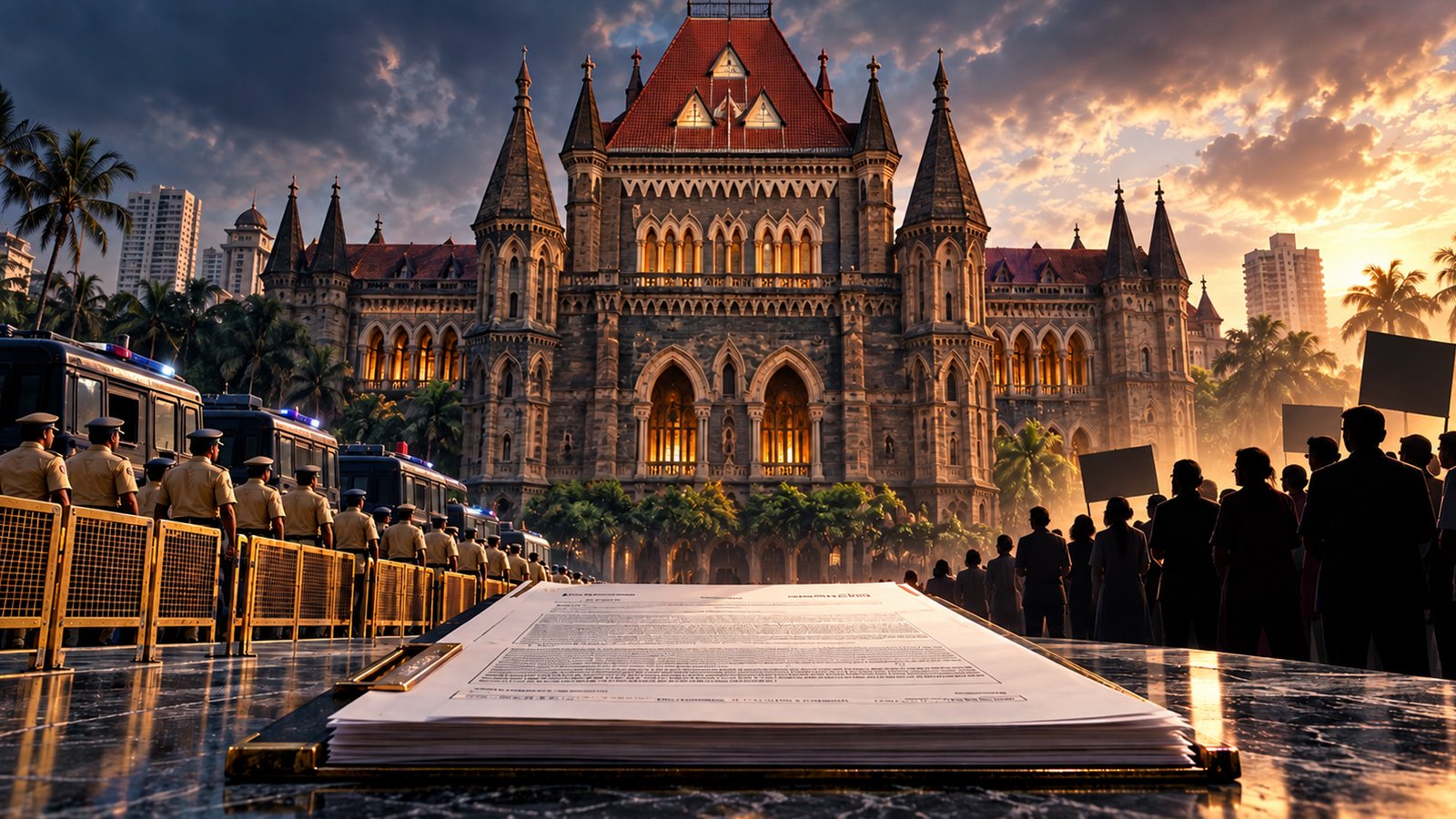
The Bombay High Court has sought a response from the Maharashtra government over allegations that Mumbai Police unlawfully detained hundreds of people during protests demanding the resignation of Chief Election Commissioner Gyanesh Kumar. The court said citizens have the right to demonstrate peacefully but stressed that protests must not disrupt public order or cause unnecessary hardship to others.
A division bench of Chief Justice Mahesh Chandra Tripathi and Justice Advait Sethna was hearing a public interest litigation filed by advocate and activist Sagar Kantilal Devre. The petition questions the legality of police action during anti-CEC demonstrations held in Mumbai on October 10 and 11.
The protests were organised amid wider criticism of the Election Commission and allegations of irregularities in the electoral process. Demonstrators have demanded Kumar’s resignation, raising concerns about the revision of electoral rolls and the treatment of voters. The Election Commission has maintained that eligible voters whose names are removed can re-enrol in accordance with the rules.
During the hearing on October 19, the bench asked the Maharashtra government to respond to the allegations of unlawful detention and police excesses. The court has scheduled the next hearing for November 19, when it is expected to consider the submissions from the parties.
Court says protests must remain peaceful
The bench underlined that the right to agitate is an important part of democratic life, but it must be exercised peacefully. The judges indicated that the court would consider the facts of the case before issuing any broad directions governing police action during demonstrations.
The court observed that the background and conduct of people participating in protests, along with the inconvenience caused to the public, could be relevant when assessing the circumstances. It also indicated that peaceful citizens should not automatically be treated as offenders simply because they are present near a protest.
At the same time, the bench made clear that the right to demonstrate does not remove the responsibility to maintain public order. Police may need to act when a gathering blocks roads or creates a law-and-order problem, but allegations of unlawful detention must be examined.
The court indicated that it would intervene if illegal detention was established. However, it did not rule at this stage that the detentions described in the petition were unlawful.
Petition claims more than 900 people were detained
Devre’s petition alleges that more than 600 people were detained on October 10 and over 300 on October 11. The incidents were reported at several locations in Mumbai, including August Kranti Maidan, Nana Chowk, Hutatma Chowk and Shivaji Park.
According to the petition, those affected included students, women, senior citizens, passers-by and people who were recording the demonstrations. It also raised concerns about individuals who allegedly had no direct involvement in the protests.
One allegation involved a senior citizen who reportedly had a pacemaker. Another concerned a woman who was allegedly recording the proceedings when police intervened. The petition further claimed that some people were taken from their homes despite not participating in the demonstrations.
It also referred to an alleged incident in which a young man suffered a panic attack while at Tardeo police station.
The petitioner has challenged what he describes as indiscriminate police action. The plea seeks judicial intervention to protect peaceful demonstrators and others who may be affected by police measures during public gatherings.
These allegations are yet to be established. The High Court has sought the state’s response before deciding whether further action or directions are necessary.
State disputes allegations of illegal detention
Maharashtra Advocate General Milind Sathe disputed the claims concerning the protest at August Kranti Maidan. He told the court that no one had been illegally detained at the site.
The state also submitted that some demonstrators had allegedly blocked roads near Nana Chowk without permission. According to the government’s account, police went to the area and dispersed the crowd to restore the movement of traffic rather than detaining people unlawfully.
The submissions place the police action at the centre of the dispute. The petitioners have alleged that the operation affected people who were not participating in unlawful activity, while the state has maintained that police were responding to concerns about road obstruction and public order.
The court will consider these competing accounts as the case progresses. Its assessment will depend on the explanations and material placed before it by the government and the petitioners.
Shivaji Park residents raise separate concerns
The proceedings also brought attention to complaints from residents of the Shivaji Park area, where demonstrations were held. Lawyers representing some residents filed applications seeking to intervene in the case.
They argued that the gatherings had caused inconvenience in the neighbourhood and referred to an earlier High Court order restricting protests at the location.
The bench indicated that the concerns of local residents would also need consideration. The issue highlights the challenge of protecting the right to peaceful assembly while ensuring that demonstrations do not unreasonably affect people living and working nearby.
November 19 hearing to bring further clarity
The Maharashtra government is expected to submit its response before the next hearing. The petitioners will then have an opportunity to address the state’s arguments, allowing the court to examine the claims from both sides.
The case could have wider implications for police handling of demonstrations and the safeguards available to citizens who allege unlawful detention. It also raises questions about how authorities should respond when protests take place at restricted locations or affect public movement.