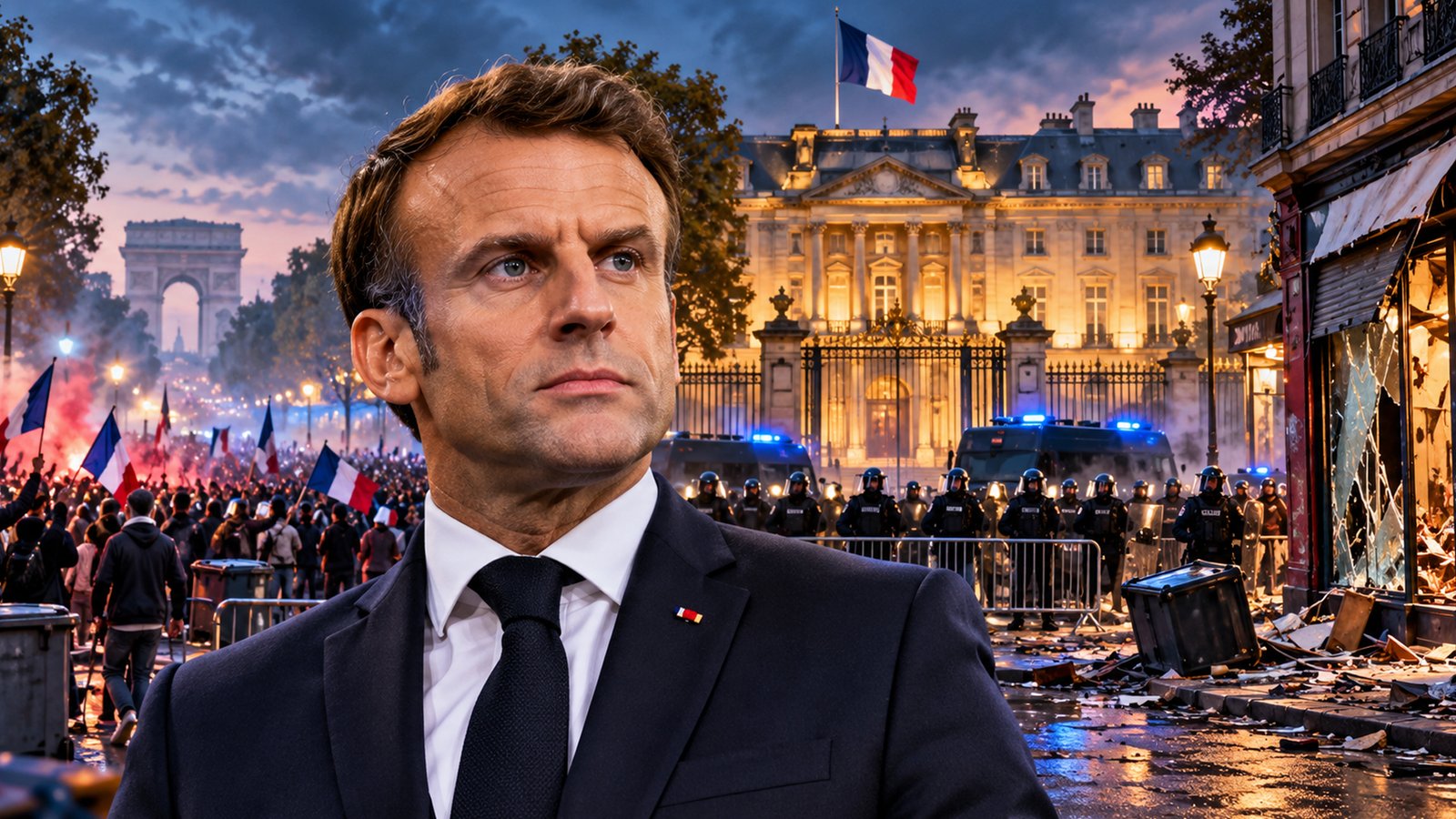
France is facing a major political and security crisis after nationwide protests over the cost of living, poor public services and school conditions escalated into violent clashes, looting and arson. Around 2,400 people were arrested over the weekend, while hundreds of shops and public buildings were damaged. President Emmanuel Macron has promised accountability and ordered a review of the security failures that allowed the violence to spread.
The unrest reached its peak on Saturday, October 17, when demonstrations across the country turned violent after weeks of protests led by students and groups demanding better public services. Paris, Marseille, Lyon, Bordeaux and other cities witnessed clashes between protesters and police, looting of businesses and attacks on government buildings.
One of the most serious incidents occurred in Limoges, central France, where a fire destroyed the city’s historic 19th-century town hall. In Marseille, masked groups stormed the city hall and a police station, while buildings and shops were attacked in other urban centres. In Lyon, a tourist office was set ablaze.
The scale of the destruction has intensified criticism of the government’s handling of the protests. Local officials questioned whether security forces had been adequately prepared, particularly after large crowds gathered across the country. Some mayors described the scenes as unprecedented, with residents left frightened by burning barricades, damaged streets and looted shops.
Macron addressed the nation on Sunday, condemning what he called uncontrolled violence and insisting that those responsible must face the consequences. He said the government needed to distinguish between people exercising their right to protest and those who destroyed property or looted businesses. He also promised transparency about the shortcomings in the security response.
The president’s government faced further pressure on Monday after Interior Minister Laurent Nuñez offered to resign. Macron rejected the offer and asked him to remain in office to maintain the chain of command within the police and security services. The president also directed Nuñez to develop new approaches to prevent further looting and investigate failures in planning and intelligence.
Nuñez acknowledged that police had lost control in some major cities. He said around 60,000 police officers and other security personnel had been deployed on Saturday, but their numbers and preparations proved insufficient in certain areas. Nearly 1,000 police officers and gendarmes were reported injured during the unrest, including several who suffered serious injuries.
Prime Minister Sébastien Lecornu has called for targeted curfews in selected cities to prevent further violence. Authorities are also examining footage and gathering evidence to identify those involved in arson, attacks on public buildings and looting. The government has urged local officials to take measures suited to conditions in their areas.
The demonstrations were initially driven by concerns about overcrowded classrooms, shortages of teachers, inadequate school facilities and declining public services. Rising living costs have added to public frustration, with many households struggling to manage expenses amid economic uncertainty.
Although hundreds of thousands of people joined the nationwide demonstrations, much of the protest activity was peaceful. The violence involved groups that clashed with police or took advantage of the disorder to loot shops and damage property. The distinction has become central to the political debate, with the government insisting that legitimate grievances cannot justify criminal acts.
The damage has also created financial concerns for businesses. Retail representatives estimated that around 1,500 businesses had been damaged, with losses running into hundreds of millions of euros. Shopkeepers in affected cities face the immediate cost of repairs, lost stock and disrupted trade, while local authorities must assess damage to public infrastructure.
The unrest has spread beyond the streets into financial markets. Investors have become increasingly concerned about France’s political stability and its ability to manage public finances. French government bond yields rose on Monday, while the CAC 40 stock market index declined. The euro also weakened against major currencies as uncertainty weighed on sentiment.
The timing adds to the pressure on Macron, whose presidency is approaching its final months before the next presidential election in 2027. His government is already facing difficult decisions over the national budget, public spending and efforts to reduce France’s deficit. Any prolonged unrest could make those decisions harder to implement.
Political leaders have traded accusations over the causes of the violence and the government’s response. The authorities are under pressure to restore order without deepening public anger over education, living costs and deteriorating services.