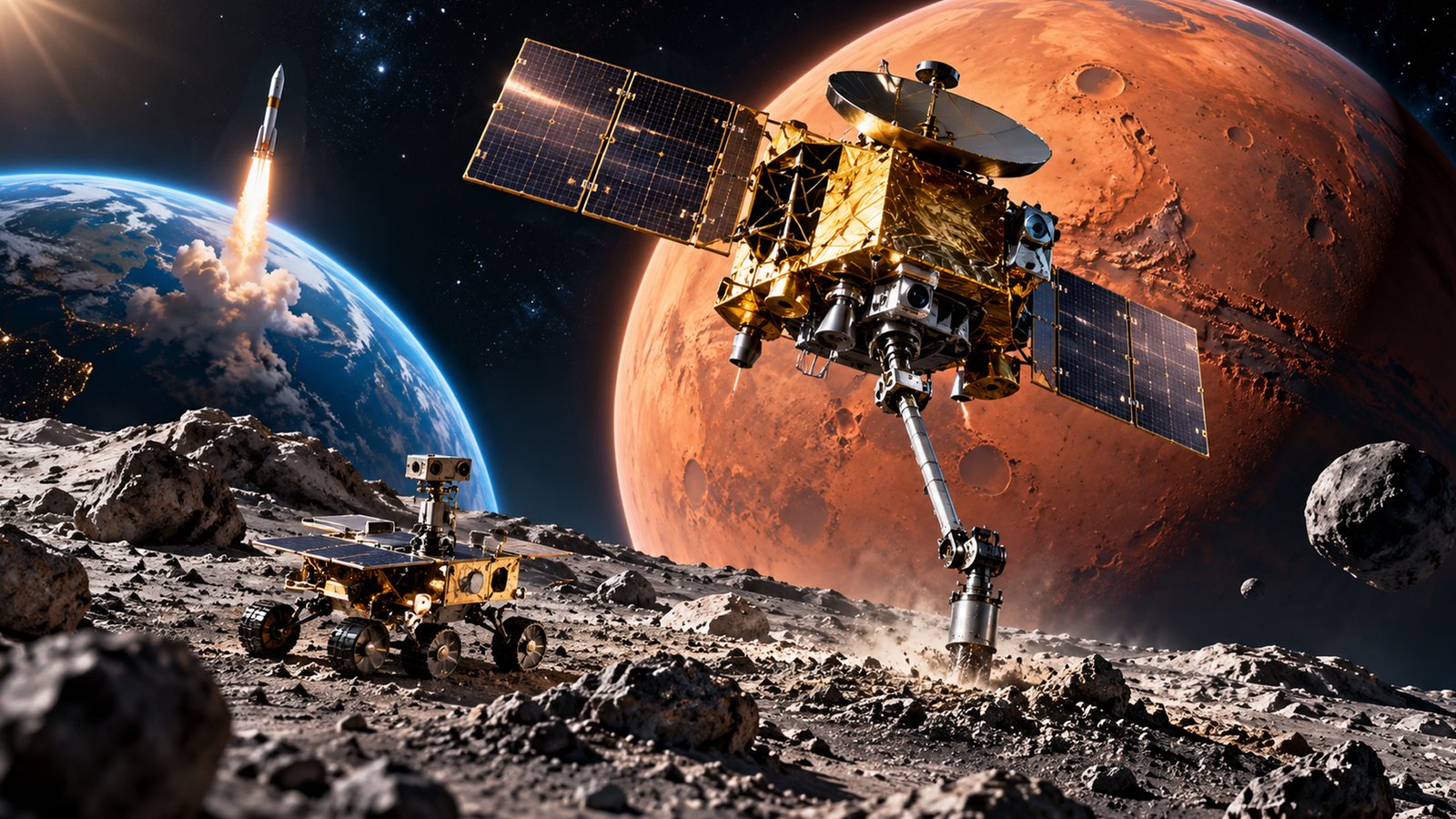
Japan is preparing for a major step in space exploration, with a mission designed to bring material from one of Mars’s moons back to Earth for the first time. The Martian Moons eXploration mission, known as MMX, is scheduled to launch on October 20, carrying a spacecraft that will study Phobos, collect samples and return them to scientists in 2031.
Led by the Japan Aerospace Exploration Agency (JAXA), the five-year mission aims to uncover how Mars’s two moons, Phobos and Deimos, formed. It could also provide new clues about the evolution of Mars and the early history of the solar system.
The spacecraft is scheduled to lift off aboard Japan’s H3 rocket from the Tanegashima Space Center. The launch is planned for 4.41 am Japan Standard Time on October 20, which is 1.11 am Indian Standard Time on the same date.
Unlike missions that study distant objects through photographs and remote measurements, MMX is designed to bring physical samples home. Scientists will be able to examine the material in laboratories on Earth using instruments that are too large or complex to send into space.
Phobos is the mission’s primary target. It is the larger of Mars’s two moons, although it is small compared with Earth’s Moon. Irregular in shape and heavily marked by craters, Phobos measures about 27 kilometres across at its widest point and orbits Mars roughly 6,000 kilometres above the planet.
Despite decades of Mars exploration, the origins of Phobos and Deimos remain uncertain. One leading theory suggests that the moons formed from debris thrown into space when a large object struck Mars. Another proposes that they are asteroids captured by the planet’s gravity.
Scientists hope the samples from Phobos will help settle this debate. Since the moon orbits close to Mars, its surface may contain material from the planet that was blasted into space by ancient impacts. Researchers estimate that material originating from Mars could make up a small fraction of the collected samples.
The mission will travel for about a year before reaching the Martian region around August 2027. It is then expected to spend approximately three years studying Phobos, mapping its surface and preparing for sample collection.
A small rover named Idefix, developed jointly by France and Germany, will play an important role. It is expected to explore the moon’s surface, examine the terrain and help identify a suitable landing area for the main spacecraft. Operating in Phobos’s extremely weak gravity will be a major challenge, making careful surface assessment essential.
The MMX spacecraft will attempt to collect at least 10 grams of material through two sampling operations. It will use different techniques to gather surface dust and material from below the surface, helping scientists examine samples from different depths.
The spacecraft carries 13 instruments and includes contributions from several international partners. NASA is providing a sampling device, while the European Space Agency is contributing deep-space communication equipment. The mission also involves the French space agency CNES and the German Aerospace Center, DLR.
After completing its work around Phobos, the spacecraft will also observe Deimos, Mars’s smaller moon. These observations could help scientists understand whether both moons share a common origin and how they have changed over time.
The return journey is expected to begin in 2030, with the samples scheduled to reach Earth in 2031. A dedicated return capsule will separate from the spacecraft and enter Earth’s atmosphere before landing in Australia’s Woomera region. The material will then be recovered and sent for scientific analysis.
The findings could have implications beyond understanding the moons themselves. Studying their composition may help researchers investigate how water and organic materials moved through the early solar system and how conditions favourable to life developed on rocky planets. The mission is not designed to prove that life exists or once existed on Mars, but its samples could provide useful evidence about the planet’s history.
MMX also builds on Japan’s experience with its Hayabusa and Hayabusa2 asteroid sample-return missions. Bringing material back from the Martian system, however, involves a much longer journey and the additional challenge of operating around a moon with extremely low gravity.
If successful, the mission will mark a significant milestone in planetary science. By bringing pieces of Phobos into laboratories on Earth, Japan hopes to turn one of Mars’s enduring mysteries into a question scientists can examine directly. The results could reshape understanding of the Red Planet’s moons and help prepare for future missions to the Martian system.