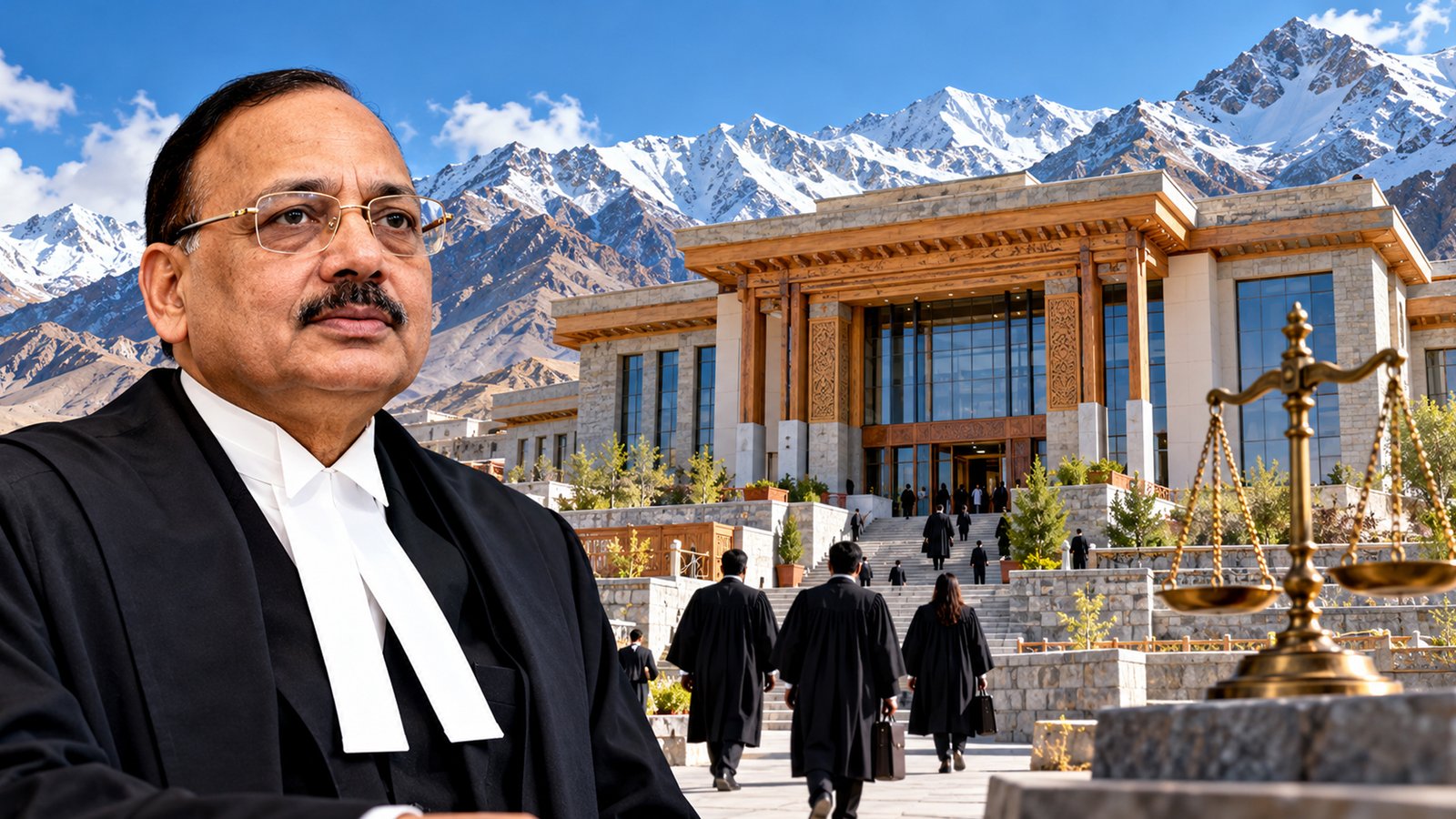
Chief Justice of India (CJI) Surya Kant has inaugurated the first permanent bench of the High Court of Jammu and Kashmir and Ladakh in Leh, marking a major step towards improving access to justice in the remote Union Territory.
The new Ladakh Bench was inaugurated at Melongthang in Leh on October 18. It is expected to reduce the time, travel expenses and difficulties faced by residents who have had to travel to Jammu or Srinagar to pursue cases before the High Court.
The bench will begin functioning on October 21, with 75 cases initially identified for hearing. It will operate two days a week, with judges taking turns to conduct proceedings.
Located at an altitude of around 3,500 metres above sea level, the Ladakh Bench is also being described as the highest-situated High Court bench in India.
The inauguration fulfils a long-standing demand for a permanent High Court presence in Ladakh, where difficult terrain, extreme weather and long distances have often made access to legal services challenging.
For many residents of Ladakh, pursuing a High Court case has involved more than preparing legal documents and appearing before judges. Travel to Jammu or Srinagar can require considerable time and money, particularly for people living in remote villages.
Harsh winters and difficult road conditions can add to these challenges. The absence of a permanent High Court bench within the Union Territory has therefore been a longstanding concern for litigants and members of the local legal community.
The new bench is expected to bring judicial proceedings closer to residents of Leh, Kargil and other parts of Ladakh. It could make it easier for litigants and lawyers to attend hearings while reducing the costs associated with repeated travel and accommodation.
Addressing the inauguration, CJI Surya Kant highlighted the importance of bringing the justice system closer to people living in geographically isolated areas.
Justice Pushpendra Singh Bhati, Chief Justice of the High Court of Jammu and Kashmir and Ladakh, described the new bench as the fulfilment of a decades-long aspiration for accessible, inclusive and equitable justice.
He stressed that geographical isolation should not prevent people from obtaining timely legal remedies.
The establishment of the bench also reflects efforts by the judiciary, the Union government and the Ladakh administration to strengthen judicial infrastructure in the region.
The new Ladakh Bench will function as an information technology-enabled, paperless court. Digital facilities are expected to play an important role in helping lawyers and litigants overcome the challenges posed by distance.
During the inauguration, four initiatives were launched: a Green Wall, an e-filing portal, a Document Management System (DMS) for the Ladakh Bench and an online recruitment portal for the High Court.
The e-filing facility will allow lawyers and litigants to submit cases electronically, reducing the need for physical visits to court offices for filing-related work.
The Document Management System will support the digital storage and management of judicial records, helping improve access to case documents and the efficiency of court administration.
The online recruitment portal is intended to make recruitment processes for the High Court and district judiciary more accessible and transparent.
These initiatives are particularly relevant in Ladakh, where long distances between settlements can make even routine administrative tasks difficult. Their effectiveness will depend on reliable digital infrastructure, connectivity and the ability of lawyers and litigants to use the services.
The court has also indicated that virtual access to the Supreme Court will be made available to lawyers from Leh and Kargil. Once the required video-conferencing facilities are in place, the arrangement is expected to reduce the need for people to travel to New Delhi for proceedings involving Ladakh cases.
The inauguration was attended by Supreme Court judges Justice M. M. Sundresh, Justice P. S. Narasimha and Justice Arun Palli, along with Attorney General R. Venkataramani and Ladakh Lieutenant Governor Vinai Kumar Saxena.
Members of the High Court, senior officials and representatives of the Leh and Kargil Bar Associations also attended the ceremony.
Local lawyers have welcomed the permanent bench as an important development for the region. Its presence is expected to strengthen the legal community and could encourage more young people in Ladakh to consider law as a career.
The High Court’s full court also adopted a resolution calling for better access to education and safe, affordable residential facilities for girl students, particularly those from remote areas. It highlighted the difficulties students face because of long travel distances and inadequate accommodation.
The resolution called for coordinated efforts by educational institutions, legal services authorities and other stakeholders to improve educational opportunities.
The immediate focus will be on the commencement of hearings on October 21 and the gradual development of the bench’s operations. The initial list of 75 cases marks the beginning of its judicial work, while the two-day weekly schedule will determine how proceedings are organised in the early stages.
The longer-term impact will depend on the court’s capacity, the availability of judges and staff, and the smooth functioning of digital services.
For residents of Ladakh, however, the opening of a permanent High Court bench represents an important change. It brings a key constitutional institution closer to people who have long faced geographical and financial barriers in pursuing legal cases.
The move is not just about establishing a new court facility. It is about making access to justice more practical for people living in one of India’s most remote regions.