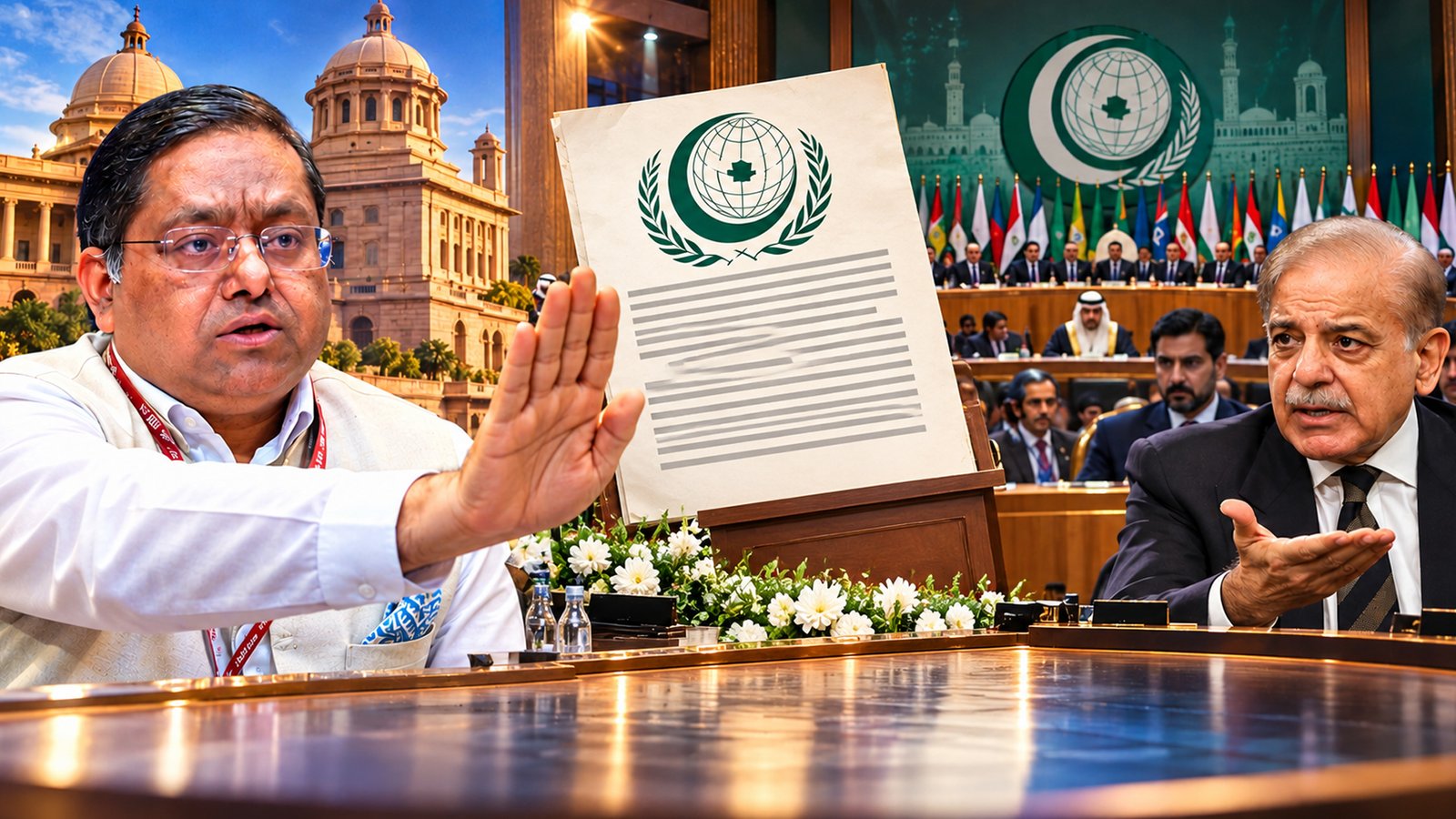
India has strongly rejected references to the country in resolutions adopted at a meeting of the Organisation of Islamic Cooperation (OIC), accusing Pakistan of using the international platform to push an anti-India agenda. New Delhi described the remarks as “malicious, biased and false” and questioned the credibility of the grouping for repeatedly raising issues that India considers its internal matters.
The Ministry of External Affairs (MEA) issued its response on October 19, following the OIC Council of Foreign Ministers’ meeting held in Baghdad, Iraq, on October 17 and 18. The resolutions included references to Jammu and Kashmir and concerns relating to religious minorities in India.
In its statement, the MEA said the references had been orchestrated by Pakistan and expressed disappointment that the OIC had once again allowed itself to be used to advance what it called Islamabad’s “bigoted agenda”.
India maintained that the organisation had no standing to comment on matters strictly internal to the country. It reiterated that the Union Territories of Jammu and Kashmir and Ladakh were integral and inalienable parts of India, adding that politically motivated statements could not change this position.
The latest exchange reflects the continuing diplomatic tensions between India and Pakistan over Jammu and Kashmir. The region has remained a major point of disagreement between the two countries for decades, with both sides making competing claims. India has consistently opposed attempts by international organisations to intervene in what it describes as its domestic affairs.
The OIC, a grouping of 57 member states, has repeatedly expressed concern over Jammu and Kashmir through statements and resolutions. Pakistan has sought support from the organisation on the issue, while India has criticised these interventions as one-sided and politically motivated.
The MEA also referred to developments in Pakistan-occupied Jammu and Kashmir (PoJK), accusing Pakistan of repression and violence against civilians. The ministry said reports of protests and alleged abuses in the region raised serious concerns, and argued that international attention should focus on the situation there rather than on what it described as unfounded allegations against India.
India stated that the outstanding issues concerning Jammu and Kashmir were Pakistan’s withdrawal from territories under its occupation and an end to its support for cross-border terrorism. New Delhi has repeatedly made these demands in its diplomatic exchanges with Islamabad.
The Indian government has also defended its decisions on Jammu and Kashmir, including the 2019 removal of the region’s special constitutional status under Article 370 and its subsequent reorganisation into two Union Territories. India has described these measures as internal constitutional changes intended to strengthen governance, development and integration.
The OIC resolutions also referred to concerns about religious minorities and allegations of Islamophobia in India. New Delhi rejected these references, arguing that they presented a distorted picture of the country and attempted to divert attention from Pakistan’s own record on minority rights.
The MEA accused Pakistan of facing serious challenges involving minority persecution, sectarian violence, political instability and governance. These remarks formed part of India’s broader argument that Pakistan was using the OIC to raise allegations against India while avoiding scrutiny of its own domestic problems.
India also questioned the OIC’s impartiality, saying its repeated endorsement of claims promoted by Pakistan raised serious doubts about the organisation’s credibility and integrity. The ministry urged member countries to consider whether the grouping was fulfilling its purpose as a forum for cooperation or allowing bilateral disputes to dominate its proceedings.
The OIC has historically addressed issues concerning Muslim communities across the world, including conflicts, discrimination and political disputes. Its positions on Jammu and Kashmir have frequently drawn criticism from India, which argues that the organisation should not take sides in disputes involving its members and non-member countries.
The latest statement does not indicate any change in India’s position on Kashmir or its relations with the OIC. Instead, it reinforces New Delhi’s long-standing policy of rejecting international commentary on the region and opposing what it views as Pakistan-backed diplomatic campaigns.
The dispute also comes against the backdrop of strained India-Pakistan relations, with cross-border terrorism remaining a central concern for New Delhi. India has repeatedly called on Pakistan to take action against militant groups operating from its territory, while Islamabad has denied supporting terrorism and continued to raise the Kashmir issue at international forums.
The response to the Baghdad meeting is likely to keep the issue in focus at a time when both countries remain sharply divided over security and territorial questions. Any further statements from the OIC or its member states could prompt additional diplomatic exchanges.
India will continue to challenge international resolutions that it believes misrepresent its position on Jammu and Kashmir or its treatment of minorities. By questioning the OIC’s credibility and accusing Pakistan of steering its agenda, New Delhi has sought to make clear that such statements will not alter its position on sovereignty and territorial integrity.