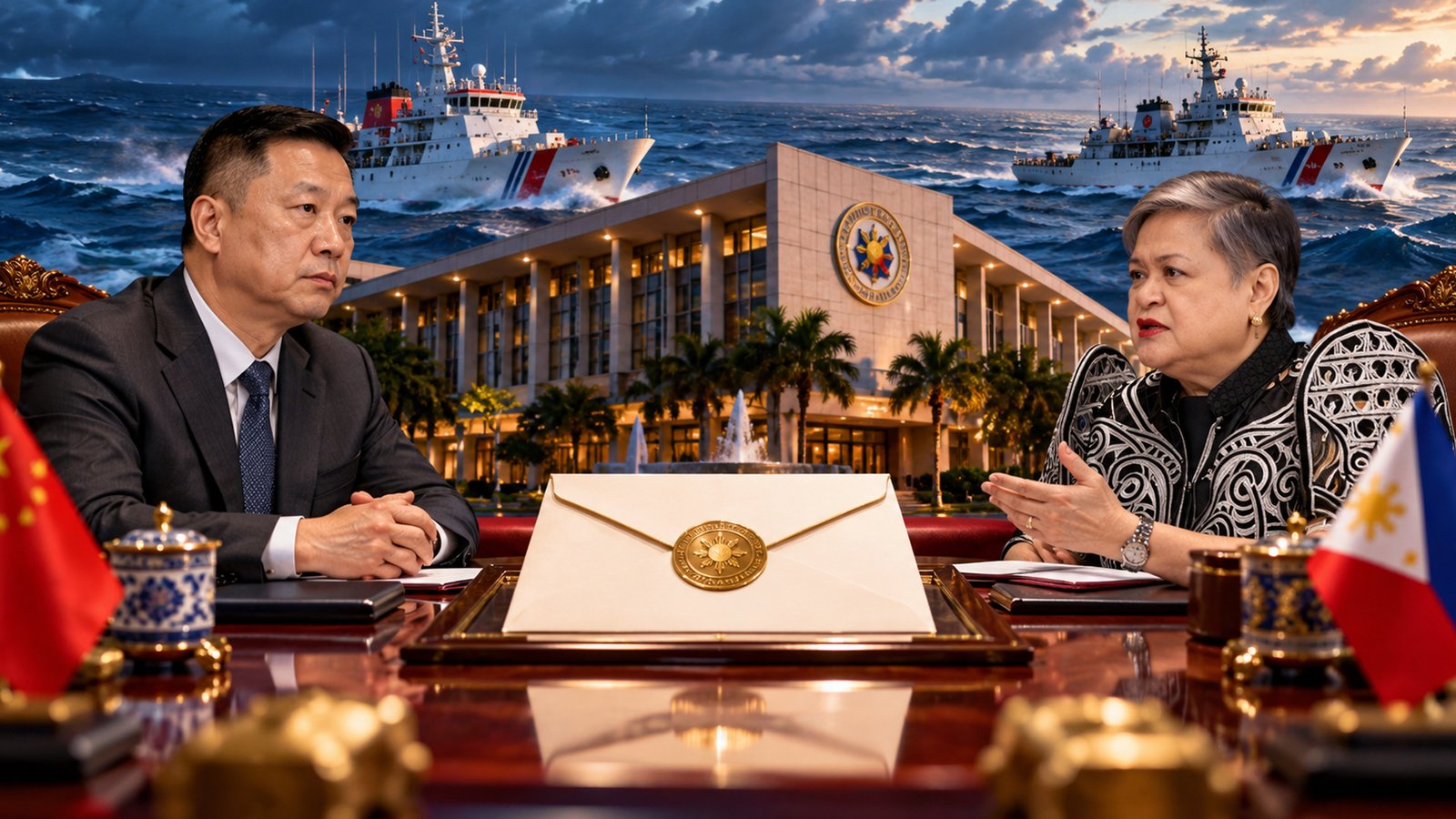
The Philippines has summoned Chinese Ambassador Jing Quan after his remarks suggesting that China could easily win a confrontation with the Philippines sparked anger in Manila. The Philippine government described the comments as provocative and unacceptable, warning that they could worsen already strained relations between the two countries.
The diplomatic protest took place on October 19, after Philippine Foreign Secretary Ma. Theresa Lazaro met Jing to convey Manila’s strong objection to his public statement. The controversy has added to tensions between the neighbours over competing territorial claims and repeated confrontations in the South China Sea.
The dispute began after Jing told reporters on October 15 that China could easily win if it chose to use force, while insisting that Beijing preferred peace. His comments came in response to criticism from Philippine Defence Secretary Gilberto Teodoro Jr., who had described China as a troublemaker in the region.
The Chinese ambassador rejected that characterisation and argued that accusations against Beijing were creating hostility between the two countries. However, his remarks triggered a strong response from Philippine officials, including President Ferdinand Marcos Jr., who said the statement sounded like a threat.
In a statement following the meeting, the Philippine Department of Foreign Affairs said Lazaro had expressed the country’s serious concern and strong objection to Jing’s comments.
The department described the statement as provocative and unacceptable, saying it did not help build mutual understanding or cooperation. It also stressed that foreign diplomats must exercise caution when making public statements, particularly when relations between their host country and their own government are sensitive.
Manila argued that the ambassador’s words could be interpreted as a threat to use force. The government also maintained that it would not accept attempts to intimidate Philippine officials and lawmakers who speak about China’s actions.
The foreign ministry indicated that the Philippines reserved the right to take further diplomatic action if necessary. The move to summon the ambassador is a formal way for a government to register its displeasure with another country’s representative without immediately severing diplomatic relations.
The controversy has also prompted calls from some Philippine lawmakers for Jing to be expelled from the country. However, no expulsion had been announced as of October 20.
Jing made the remarks while responding to questions from reporters following a forum in Quezon City. He was asked about Teodoro’s criticism of China’s behaviour in the region.
The ambassador dismissed the description of China as a troublemaker and argued that accusations against Beijing were encouraging hostility. He said the Philippines should appreciate having China as a neighbour.
Jing then said China could easily win if it decided to use force, but added that Beijing would not choose that path because it valued peace.
His comments were intended to underline China’s stated preference for peaceful relations. However, Philippine officials interpreted the reference to military strength as an inappropriate warning, particularly given the repeated maritime disputes between the two countries.
The Chinese Embassy has defended Jing’s position, arguing that his remarks were taken out of context and that Manila’s reaction exaggerated their meaning. Beijing has also urged the Philippines to avoid statements that could further damage bilateral relations.
The diplomatic row comes against the backdrop of a long-running territorial dispute in the South China Sea, one of the world’s most important maritime trade routes.
China claims sovereignty over much of the waterway, while the Philippines, Vietnam, Malaysia, Brunei and Taiwan have overlapping claims in different areas. The Philippines refers to parts of the sea within its exclusive economic zone as the West Philippine Sea.
The two countries have repeatedly accused each other of provocative actions at sea. Disagreements have involved coast guard vessels, fishing activities, military patrols and access to disputed features.
The Philippines has accused Chinese vessels of acting aggressively in waters it considers part of its exclusive economic zone. China, meanwhile, maintains that its coast guard and other forces are protecting Chinese territory and maritime interests.
An international arbitral tribunal ruled in 2016 that China’s expansive claims had no legal basis under the United Nations Convention on the Law of the Sea. Beijing rejected the ruling, and the disagreement remains unresolved.
The continuing stand-offs have raised concerns about the risk of an incident escalating into a wider confrontation. The South China Sea is also a major route for international shipping, making stability in the region important for global trade.
The Philippines has strengthened its defence cooperation with the United States and other security partners amid concerns about China’s activities. Joint military exercises and expanded security arrangements are intended to improve coordination and support Manila’s ability to protect its maritime interests.
China has criticised these activities, arguing that military cooperation with outside powers increases tensions in the region. Beijing has also conducted its own military activities in disputed waters.
The Philippine government has left open the possibility of further diplomatic measures, while China has urged Manila to interpret the ambassador’s remarks in context.