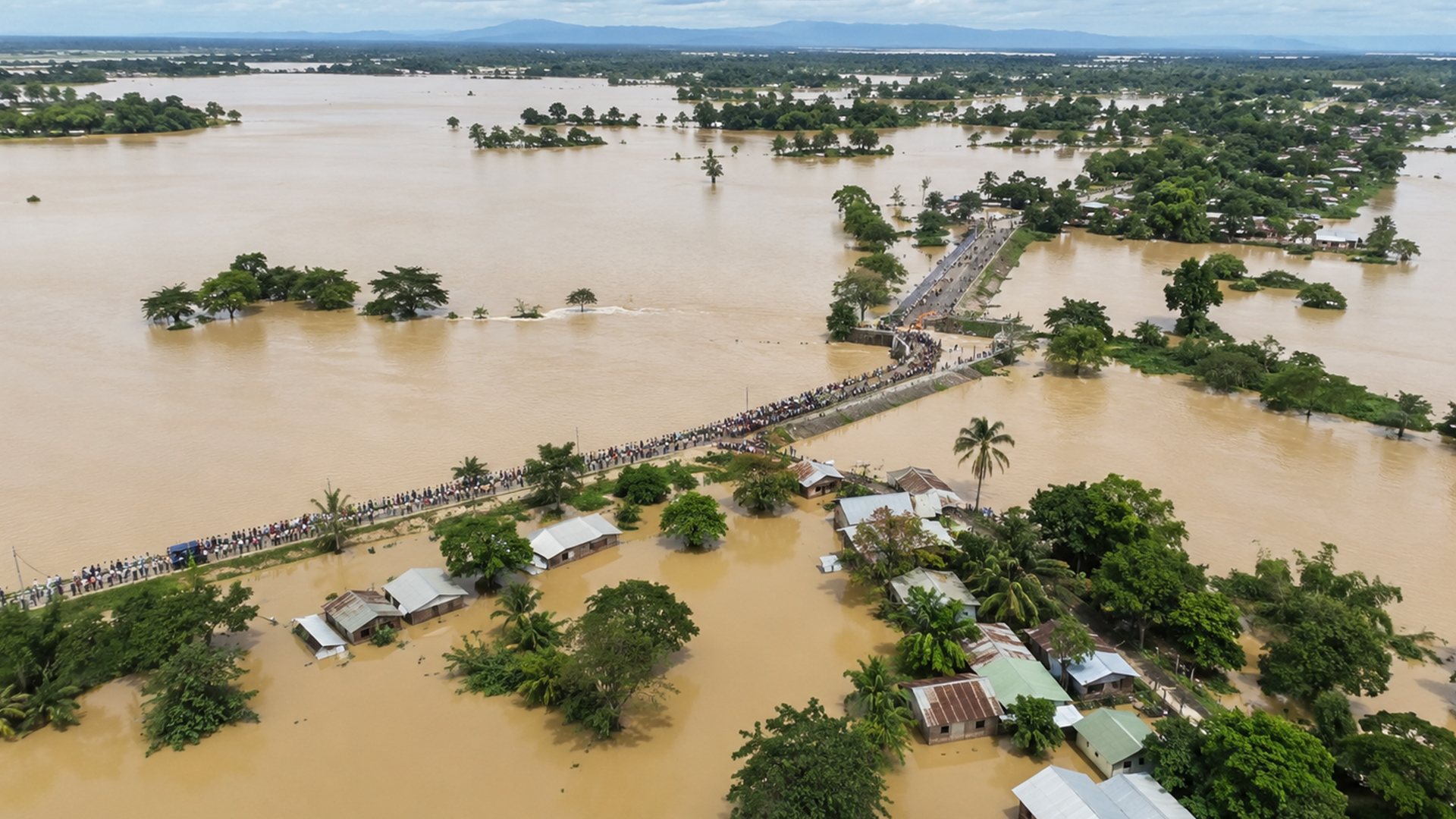
Assam’s flood crisis continues to take a heavy toll, with the death count rising to 78 even as floodwaters begin to recede in several parts of the state. Three more people died in the latest incidents, including two in Sivasagar and one in Golaghat, according to the latest flood bulletin. More than three lakh people remain affected across seven districts, keeping rescue and relief operations on high alert.
The latest figures mark a grim development in Assam’s ongoing monsoon flood crisis. While the overall flood situation has improved in some areas, the impact on families, homes, agriculture and basic services remains severe. Many residents are still unable to return home because of damaged houses, mud-covered roads and disrupted essential services.
The situation has changed significantly in just a few days. On Tuesday, seven fresh deaths had pushed the Assam flood death toll to 75, while around 3.32 lakh people were affected across seven districts. At that time, 622 villages were reported to be under the impact of severe flooding. Nearly 45,342 hectares of crop area had also been submerged.
The floods have damaged more than just farmland. Houses, cattle sheds, schools and anganwadi centres have also suffered damage in several affected areas. For families who depend on farming and livestock, the destruction has created a second crisis: rebuilding their livelihoods after the immediate flood threat passes.
The human cost has been particularly visible in Upper Assam. Sivasagar has emerged among the worst-hit districts, with several villages and settlements facing severe flooding. In one particularly distressing incident, Hiloni Nepali Khuti in Sivasagar was reportedly devastated within a short period after the Dikhow River swelled rapidly. Around 200 Gorkha families lived in the village, highlighting how quickly rising water can turn a familiar home into a disaster zone.
Despite the difficult conditions, multiple agencies continue to work on the ground. The Army, Air Force, National Disaster Response Force (NDRF), State Disaster Response Force (SDRF), Fire and Emergency Services and local volunteers have been involved in rescue and relief operations. Their work has focused on evacuating people, delivering essential supplies and helping communities cut off by floodwaters.
The Assam government has also announced a wider relief and rehabilitation package for families affected by the floods. Chief Minister Himanta Biswa Sarma said families of people who died in flood-related incidents would receive the statutory Rs 4 lakh ex-gratia payment without the requirement of a post-mortem. Families of people missing for more than 30 days will also be eligible for the compensation, subject to the prescribed legal process.
In addition to the statutory compensation, the state government has announced another Rs 5 lakh from the Chief Minister’s Relief Fund for families of those killed in the floods. This takes the total announced assistance for families of flood victims to Rs 9 lakh.
For households struggling to meet immediate needs, the government has also announced cash support. More than one lakh severely flood-affected families will receive Rs 15,000 each. The assistance is intended to help families purchase essential items and manage expenses while normal life remains disrupted.
Education has also become a concern as flooding has damaged schools and destroyed important documents. The government has announced book grants of Rs 1,000 for Higher Secondary students, Rs 3,000 for undergraduate students and Rs 5,000 for postgraduate students in severely affected districts. School students will receive free textbooks, while assistance will also be provided for uniforms.
Students who lost their Class 10 and Class 12 certificates or mark sheets in the floods will be able to obtain duplicate documents without paying a fee. The measures are aimed at ensuring that the disaster does not create long-term academic problems for children and young people.
However, the immediate danger has not completely passed. The India Meteorological Department has issued fresh warnings of heavy to very heavy rainfall in Assam and neighbouring northeastern states. Forecasts indicate that more rain could arrive over the next few days, raising concerns that already vulnerable areas could face renewed flooding.
The continuing rain threat is particularly worrying for communities that have only recently seen floodwaters recede. Roads remain damaged or covered in mud, electricity supplies have been disrupted in several areas and some families are still unable to safely return to their homes. Nearly 13,000 households were reported to be without electricity in flood-affected parts of Assam on Thursday.
For Assam, the challenge is therefore shifting from emergency rescue to a difficult recovery phase. Even where water levels are falling, the damage left behind is extensive. Farmers have lost crops, families are assessing damage to homes, and communities are waiting for roads, electricity and other essential services to return to normal.
The latest Assam flood situation shows that a fall in water levels does not immediately mean the crisis is over. With 78 deaths recorded so far, more than three lakh people still affected and another spell of heavy rainfall possible, relief agencies and local authorities face a race against time.
For thousands of families, the priority now is simple: safe shelter, food, clean water, electricity and a way to rebuild what the floods have taken away. The coming days will determine whether Assam can move steadily from rescue and relief towards recovery, or whether fresh rainfall will deepen an already painful monsoon disaster.