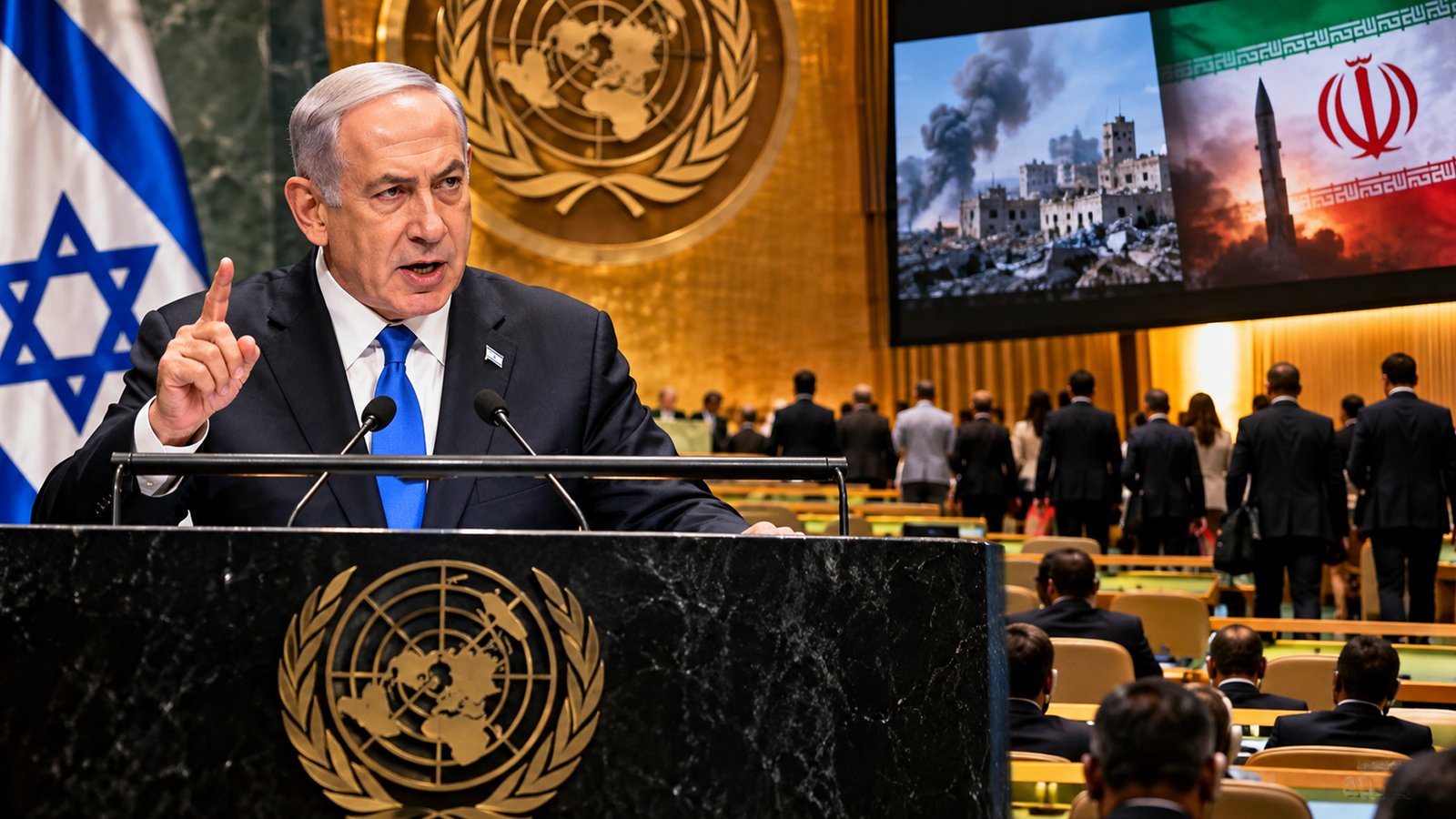
Israeli Prime Minister Benjamin Netanyahu faced a mass walkout by diplomats as he began his address to the United Nations General Assembly in New York on Thursday, with the Gaza war, Palestinian statehood and Israel’s wider conflict with Iran dominating one of the most closely watched speeches of the UN session.
Delegates from several countries left the General Assembly hall as Netanyahu approached the podium. The protest came after months of international criticism over Israel’s military campaign in Gaza and amid growing debate over the future of the Palestinian territories.
Netanyahu responded by accusing those who left of abandoning the truth. He defended Israel’s military actions and rejected allegations that the country had committed genocide in Gaza, calling the accusation a lie and saying Israel had taken steps to protect civilians.
He also defended Israel’s military campaign against Iran, saying the decision to attack Iranian nuclear facilities was necessary to prevent a larger threat. Netanyahu said Israel and the United States had acted together and praised US President Donald Trump for his support.
The speech also turned sharply towards New York Mayor Zohran Mamdani, who has criticised Israel’s conduct in Gaza and described Netanyahu as a war criminal. Netanyahu accused Mamdani of antisemitism and said Jews in New York no longer felt safe. Mamdani has rejected Netanyahu’s accusations and has continued to criticise the Israeli government’s actions in Gaza.
The confrontation highlighted how the Gaza conflict has increasingly become part of political debates well beyond the Middle East. Netanyahu used his UN address not only to defend Israel’s military position but also to challenge critics in the United States and Europe.
The response inside the UN chamber was mixed. Some delegates walked out, while others remained and applauded Netanyahu. Pro-Palestinian demonstrators also gathered outside the UN headquarters, with New York police detaining several protesters.
Earlier in the day, Palestinian Authority President Mahmoud Abbas addressed the General Assembly through a prerecorded video. He could not travel to New York after the US administration denied him a visa for the second consecutive year.
Abbas used his address to describe the situation facing Palestinians in Gaza and the occupied West Bank as one of the most dangerous periods in their history. He accused Israel of killing, destruction, displacement and settlement expansion, while calling for international action to protect Palestinians and preserve the possibility of a two-state solution.
Abbas also rejected the idea that Palestinians would leave their homeland. He said Palestinians would remain on their land and reiterated his support for a Palestinian state existing alongside Israel. He also said the Palestinian Authority had completed reforms relating to governance, public finances, transparency and accountability.
The contrasting speeches reflected the deep divide surrounding the Israel-Palestine conflict. Netanyahu focused on Israel’s security, the October 7 attack, Iran and what he described as international efforts to undermine Israel. Abbas focused on the humanitarian situation in Gaza, Israeli settlements in the West Bank and Palestinian statehood.
The humanitarian cost of the Gaza war remains at the centre of the international debate. Netanyahu rejected allegations of genocide and said Israel had taken measures to protect civilians. Palestinian officials and critics of Israel have continued to accuse Israel of unlawful military conduct and excessive civilian harm. International investigations and governments remain divided over the legal and political characterisation of Israel’s actions.
The UN gathering also comes against the backdrop of a wider Middle East crisis. Netanyahu devoted part of his speech to Iran, arguing that Israeli and US military action had prevented a greater threat. The conflict has added another layer to already strained international relations and has placed pressure on governments trying to balance regional security concerns with calls for diplomacy.
The speeches also brought renewed attention to the future of Gaza. Abbas said a US-backed plan for ending the war and rebuilding the territory had not progressed as expected. He argued that Gaza’s reconstruction should ultimately be connected to a broader Palestinian political settlement.
The UN session has therefore become a stage for competing visions of what comes next. Israel is stressing security and its right to defend itself, while the Palestinian Authority is calling for an independent state and international pressure to end the occupation and protect Palestinian rights.
The sharp exchanges in New York showed how difficult it remains to bridge those positions. The walkout during Netanyahu’s speech, the competing accounts of the Gaza war and Abbas’s renewed call for a two-state solution all underscored the unresolved political divide.