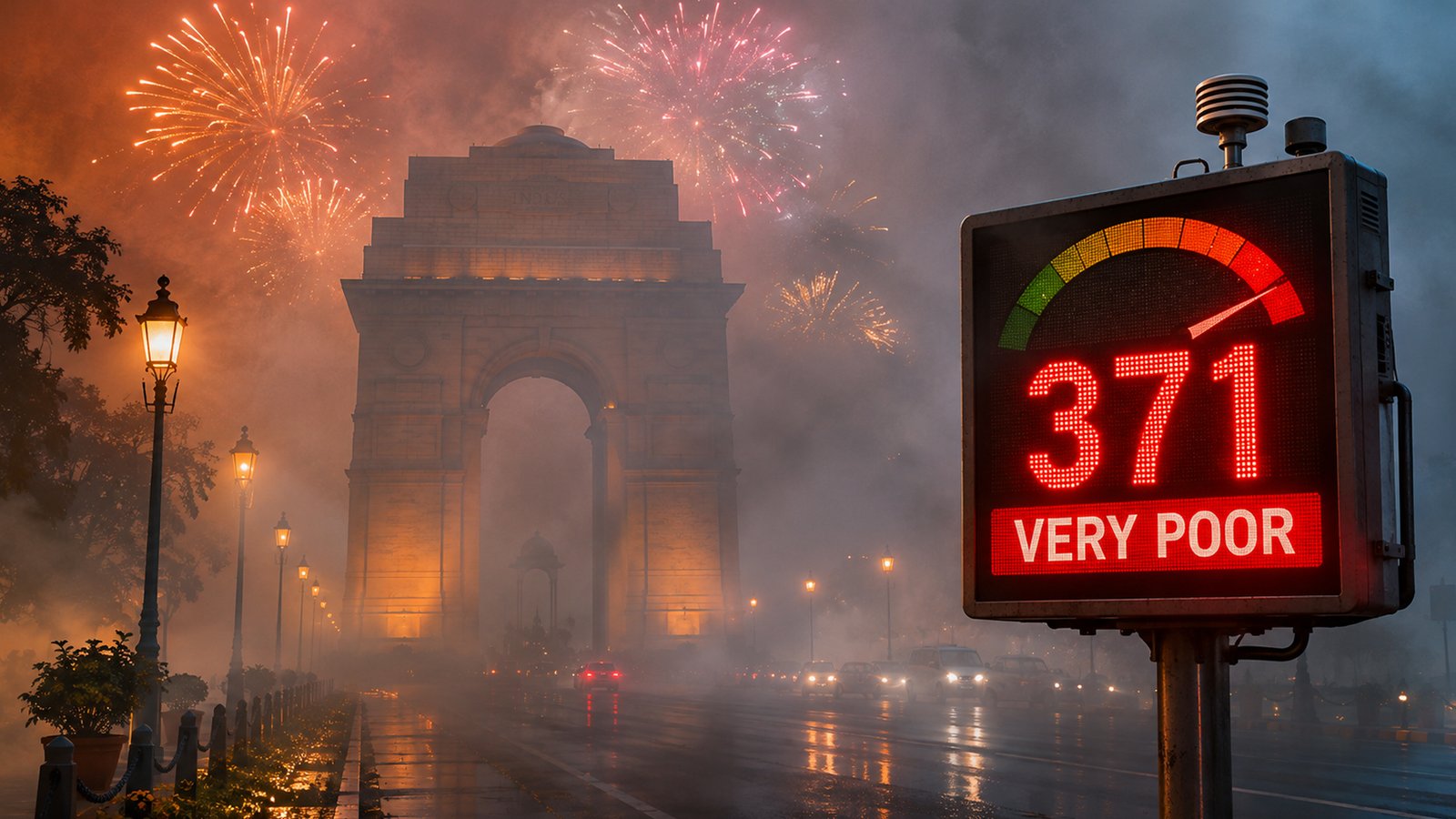
Delhi continued to battle severe air pollution on Monday, November 9, as the impact of Diwali celebrations pushed pollution levels higher across several parts of the national capital. A thick layer of smog covered residential neighbourhoods and major roads, reducing visibility and raising concerns about the health risks associated with prolonged exposure to polluted air.
The city’s Air Quality Index (AQI) crossed the 400 mark in the early hours, entering the severe category at several monitoring stations. According to Central Pollution Control Board (CPCB) data, the ITO monitoring station recorded an AQI of 406 at around 4.20 am. Several other locations also reported readings above 400, indicating a significant deterioration in air quality following Diwali celebrations.
Jahangirpuri recorded an AQI of 433, while Chandni Chowk registered 418 and Mundka reported 417. Burari Crossing recorded 441, Vivek Vihar stood at 437 and Delhi Technological University registered 434. Rohini and North Campus also experienced severe pollution levels.
Although the city’s overall AQI fluctuated during the morning, several neighbourhoods continued to experience unhealthy air conditions. The thick haze also affected visibility, making morning travel uncomfortable for commuters.
The post-Diwali pollution spike has once again highlighted Delhi’s continuing struggle with deteriorating air quality, particularly during the winter months when weather conditions often prevent pollutants from dispersing.
Delhi’s air quality was already in the very poor category before Diwali celebrations began. The city’s average AQI stood at 376 on Sunday, November 8, compared with 369 on Saturday, indicating that pollution levels had increased even before the festival’s main celebrations.
The situation worsened as residents began bursting firecrackers during the evening. Monitoring data showed a sharp increase in fine particulate matter concentrations across several parts of the city.
Average PM2.5 concentrations across 39 monitoring stations increased from approximately 190 micrograms per cubic metre at 7.45 pm to 259 micrograms per cubic metre around 8 pm. This was more than four times the prescribed national 24-hour standard of 60 micrograms per cubic metre.
At around 7 pm on Diwali night, Delhi’s AQI stood at 371. Of the 59 monitoring stations reporting data, 19 were already in the severe category, while 33 recorded very poor air quality.
By 10 pm, the number of stations reporting severe pollution had increased to 20. Sonia Vihar recorded the highest AQI at 463, followed by Jahangirpuri at 450.
Residents in several neighbourhoods complained about the smell of burnt firecrackers, smoke and reduced visibility. The pollution remained suspended over residential areas and roads, creating uncomfortable conditions even after the celebrations ended.
PM2.5 particles are particularly dangerous because of their extremely small size. They can penetrate deep into the lungs and enter the bloodstream, increasing the risk of respiratory and cardiovascular problems.
Ahead of Diwali, the Supreme Court had permitted the sale and use of certified green firecrackers in Delhi-NCR during specified hours on November 7 and 8.
The permitted timings were between 6 am and 7 am and 8 pm and 10 pm. The decision allowed regulated celebrations while attempting to limit the environmental impact of firecracker emissions.
However, reports of fireworks from different neighbourhoods indicated that restrictions were not uniformly followed. The increase in pollution levels has also raised questions about the effectiveness of existing regulations and their enforcement.
The Supreme Court had directed that a complete ban on firecrackers would come into effect again from November 9.
Green firecrackers are designed to reduce emissions compared with conventional fireworks. However, their use does not eliminate pollution, particularly when large quantities are burst within a short period.
The latest readings demonstrate how quickly air quality can deteriorate when firecracker emissions combine with existing pollution sources.
Firecracker emissions are only one part of Delhi’s air pollution problem. Vehicular exhaust, industrial emissions, construction dust and agricultural stubble burning in neighbouring states continue to contribute to the city’s deteriorating air quality.
Weather conditions also play an important role. During winter, low wind speeds and unfavourable atmospheric conditions restrict the movement of pollutants, allowing harmful particles to accumulate close to the ground.
The Air Quality Early Warning System had forecast a further deterioration in Delhi’s air quality from November 9, with severe conditions likely to continue over the following days.
The transport sector was estimated to contribute around 19% of the city’s pollution on Sunday, while stubble burning accounted for approximately 3.5%.
These figures underline the need to address multiple pollution sources rather than focusing only on firecracker emissions during Diwali.
The Commission for Air Quality Management (CAQM) had invoked Stage III of the Graded Response Action Plan (GRAP) across Delhi-NCR on November 6, anticipating a deterioration in air quality.
The restrictions include tighter controls on construction and demolition activities, measures to reduce road dust and additional steps to control vehicular emissions.
Certain non-essential construction activities are prohibited under Stage III restrictions. Authorities have also been directed to strengthen pollution-control measures to prevent further deterioration.
Under the CPCB’s classification, an AQI between 0 and 50 is considered good, while 51-100 is satisfactory. Readings between 101 and 200 fall under the moderate category, 201-300 are classified as poor, and 301-400 are very poor. An AQI between 401 and 500 falls under the severe category.
Severe air quality can affect healthy individuals and cause serious health complications for people with existing respiratory and cardiovascular conditions.
The worsening pollution has raised concerns about its impact on children, senior citizens and people with asthma and other respiratory illnesses.
Exposure to high concentrations of PM2.5 can cause breathing difficulties, irritation of the eyes and throat, and aggravate existing health conditions. Residents have been advised to limit prolonged outdoor activities when pollution levels remain high.
With winter approaching, Delhi faces the challenge of controlling pollution from multiple sources while weather conditions continue to trap harmful particles over the city.
The post-Diwali pollution spike is another reminder that the national capital’s air quality crisis cannot be addressed through temporary restrictions alone. Consistent enforcement of pollution-control measures, reduced vehicle emissions, construction dust management and coordinated action with neighbouring states will be essential.
For Delhi residents, the concern now extends beyond the morning after Diwali, as the city prepares for another difficult winter under a blanket of polluted air.