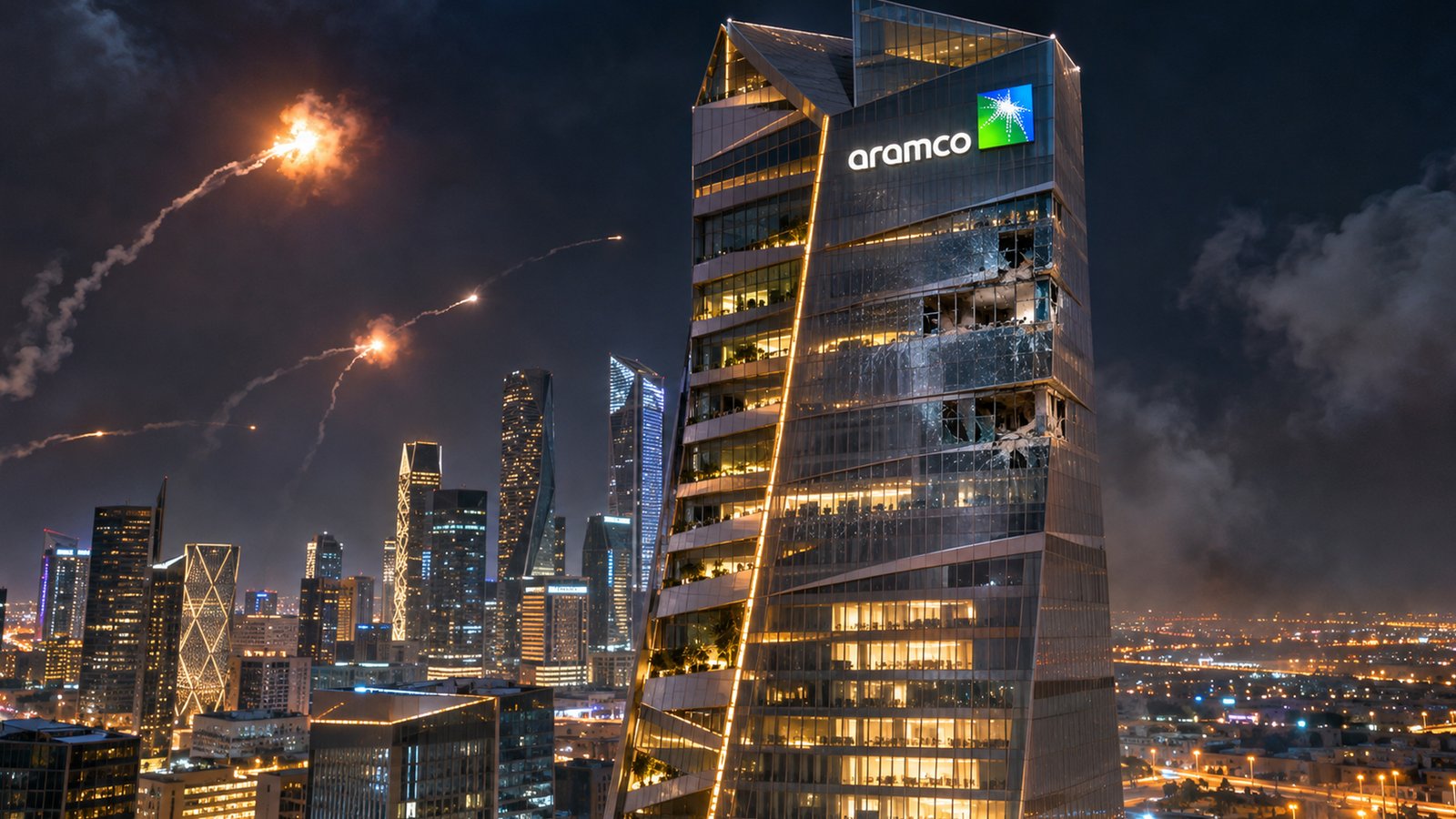
A missile attack claimed by Yemen’s Houthi rebels damaged a building belonging to Saudi Arabia’s state-owned oil company, Saudi Aramco, in the capital Riyadh on Sunday, November 8. The attack shattered windows across several floors of the tower in the city’s prominent King Abdullah Financial District (KAFD), raising fresh concerns about the safety of Saudi Arabia’s economic and energy infrastructure amid escalating tensions in the Middle East.
Saudi Arabia’s Energy Ministry confirmed that an administrative building belonging to Aramco had sustained damage following an attempted attack. The ministry said falling shrapnel had caused limited damage to the property, but there were no reports of injuries or fatalities.
The damaged building is part of the Aramco Tower complex in the King Abdullah Financial District, one of Riyadh’s most recognisable commercial and financial locations. Photographs and videos circulating after the incident showed broken windows and visible damage across several floors of the high-rise structure.
A Reuters witness who visited the area reported seeing extensive damage to the building’s exterior glass. Several floors appeared to have been affected by the falling debris.
The incident took place after Saudi authorities issued an early-warning alert about a possible security threat in Riyadh. Residents reported hearing several loud explosions in the capital during the early hours of Sunday. Authorities subsequently announced that the immediate danger had passed.
Although the Saudi Energy Ministry confirmed the damage, it did not initially identify those responsible for the incident. However, the Saudi-led military coalition fighting the Houthis in Yemen said its air defence systems had intercepted missiles launched towards the kingdom.
The Houthis later claimed responsibility for the operation, identifying Riyadh’s financial district among the targets of their latest military campaign.
Saudi air defences intercept missiles
According to the Saudi-led coalition, its air defence systems intercepted two ballistic missiles directed towards Riyadh. Two cruise missiles were also intercepted over Riyadh and the kingdom’s southern region, according to separate military statements.
The coalition additionally reported intercepting another ballistic missile targeting Saudi Arabia’s southern region, which shares a border with Yemen.
The interception of the incoming projectiles prevented what could have been a more extensive attack on the Saudi capital. However, debris from the operation fell on the Aramco building, damaging its windows and parts of its exterior.
Saudi Civil Defence authorities also issued warnings in the oil-rich Eastern Province, including areas around Dhahran, where Aramco’s main headquarters is located. The warnings were subsequently lifted after the immediate threat had passed.
The Eastern Province is particularly important to Saudi Arabia because it contains much of the kingdom’s oil and gas reserves. Any attack on the region could have implications for the country’s energy production and international oil supplies.
The coalition said it had also destroyed ballistic missile launchers in Yemen’s Saada and Sanaa regions. According to its statements, the facilities had been used in attacks targeting Riyadh and the Eastern Province.
Houthis claim attacks on Aramco and airport
Houthi military spokesperson Yahya Saree said the group had carried out four military operations involving ballistic missiles, cruise missiles and drones.
The group claimed that its targets included the King Abdullah Financial District, King Khalid International Airport in Riyadh, Aramco oil storage facilities and the eastern Saudi city of Abqaiq.
The Houthis also claimed to have launched another attack against an Aramco facility in Abqaiq.
However, Saudi authorities did not independently confirm damage to all the locations mentioned in the Houthi statement. The confirmed damage on Sunday was to the Aramco administrative building in Riyadh.
The Houthis described the attacks as retaliation for Saudi military operations in Yemen. Their latest offensive comes amid renewed fighting between the group and the Saudi-led coalition supporting Yemen’s internationally recognised government.
The Houthi movement, which seized Yemen’s capital Sanaa in 2014, has increasingly used missiles and drones against Saudi military and economic targets.
Aramco infrastructure under growing pressure
The attack on the Riyadh tower has highlighted the growing security risks facing Saudi Aramco, one of the world’s largest oil producers.
The company plays a central role in Saudi Arabia’s economy and is a major supplier to international energy markets. Its facilities include oil production sites, refineries, storage infrastructure and export terminals.
Aramco has faced repeated attacks in recent months. Its headquarters in Dhahran in the Eastern Province also suffered extensive damage in an earlier incident in October.
Saudi Arabia’s oil infrastructure has become an important target in the renewed confrontation with the Houthis. The group has stepped up missile and drone attacks against airports, ports and energy installations since fighting intensified in July.
The latest attack also carries significance for Riyadh’s business community. The King Abdullah Financial District is a major commercial development featuring high-rise office buildings, financial institutions, international companies and government-linked organisations.
The district represents Saudi Arabia’s ambition to establish Riyadh as an international financial and investment centre under its economic diversification programme.
Damage to a prominent building in the district could therefore raise concerns among businesses and investors about the security of commercial operations in the capital.
Renewed conflict raises regional concerns
The latest confrontation follows the breakdown of a United Nations-brokered truce in Yemen, which had largely reduced fighting between Saudi Arabia and the Houthis since 2022.
Saudi Arabia intervened in Yemen’s civil war in 2015, leading a coalition of Arab countries to support the internationally recognised government against the Houthi movement.
The renewed fighting has intensified since July, with the Houthis expanding attacks against Saudi infrastructure. Their advances towards the strategically important Bab el-Mandeb Strait in September have added to regional security concerns.
The waterway connects the Red Sea with the Gulf of Aden and is an important route for international shipping and energy transportation.
A previous Houthi attack on Riyadh’s King Khalid International Airport on October 10 reportedly killed 13 people and injured more than 300, according to Saudi authorities.
Saudi Arabia has responded to the latest escalation with airstrikes against Houthi positions in Yemen. The renewed hostilities have also prompted the kingdom to seek defensive and offensive military assistance from the United States and other international partners.
Britain announced in October that it would deploy fighter jets on defensive missions to help protect Saudi cities against aerial attacks.
At the diplomatic level, Saudi Arabia has continued discussions with regional countries, including Iran, in an effort to address security concerns and prevent further escalation.