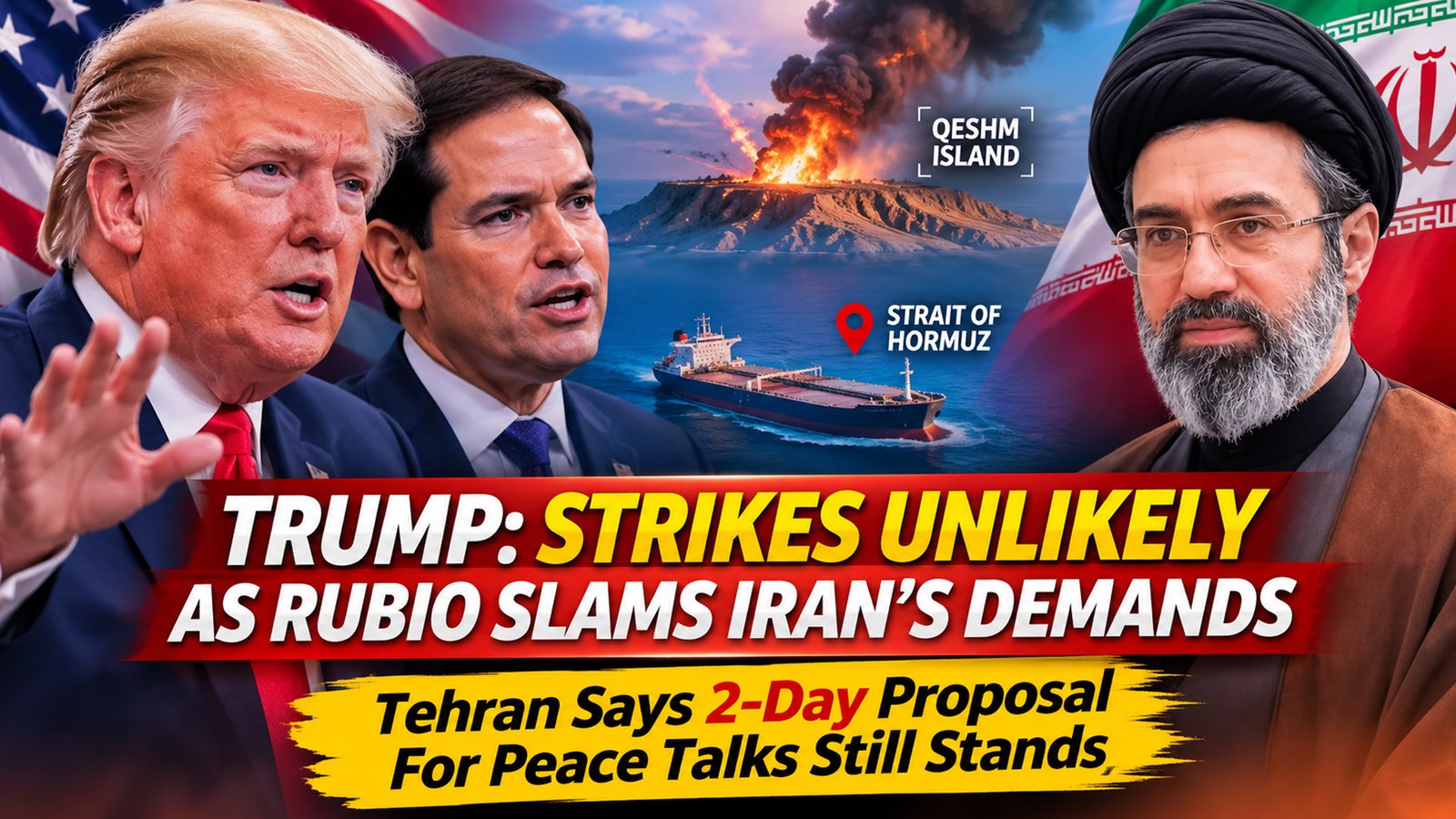
US President Donald Trump has indicated that fresh American military strikes against Iran are unlikely if diplomatic negotiations make progress, even as Secretary of State Marco Rubio criticised Tehran’s demands as unrealistic. The contrasting positions from Washington highlight the uncertainty surrounding efforts to end the conflict, with tensions continuing around the strategically important Strait of Hormuz.
Trump said further military action would probably not be necessary if Iran agreed to a strong deal. He indicated that Washington remained open to negotiations but warned that the outcome would depend on Tehran’s willingness to accept an agreement.
“It depends on whether or not they sign a very strong agreement,” Trump said, adding that renewed strikes were highly unlikely if diplomatic efforts succeeded. However, he maintained that the United States could use military force if required, insisting that American forces had already inflicted significant damage on Iran.
The comments came amid growing concerns over explosions in southern Iran and attacks involving commercial vessels in and around the Strait of Hormuz.
Despite Trump’s relatively conciliatory remarks, Rubio adopted a tougher position while discussing the ongoing diplomatic efforts. The US Secretary of State said negotiations had not reached a breakthrough and accused Tehran of making demands that Washington could not accept.
Rubio maintained that the Trump administration preferred a diplomatic solution but said Iran’s conditions had made meaningful progress difficult. He described Tehran’s demands as outrageous and unrealistic, without publicly detailing every proposal under discussion.
His remarks suggested that Washington remained dissatisfied with Iran’s position despite continuing efforts by regional countries to facilitate negotiations.
The disagreements between the two sides centre on several major issues, including economic sanctions, access to frozen Iranian assets, compensation for war-related damage, nuclear restrictions and control over maritime movement in the Persian Gulf.
Iran has reportedly insisted that the United States end its naval blockade of Iranian ports and lift economic sanctions before meaningful peace negotiations can proceed. Tehran has also sought the release of frozen assets and compensation for damage caused during the conflict.
Washington, meanwhile, wants Iran to reopen the Strait of Hormuz and make concessions concerning its nuclear programme. The competing demands have complicated efforts to reach a settlement.
The Strait of Hormuz has emerged as one of the biggest obstacles to resolving the conflict. The narrow waterway is a critical international shipping route through which a substantial share of the world’s oil and gas supplies passes. Disruptions to commercial shipping have affected energy exports and raised concerns about global fuel prices and economic stability.
The latest developments have added to these concerns. Explosions were reported in several locations in southern Iran, including Qeshm Island, which lies in the Strait of Hormuz. However, Iranian officials initially suggested that the blasts could be connected to military activities rather than fresh American attacks. There was no immediate confirmation that US forces had carried out missile strikes at the locations.
Reports also emerged of explosions involving commercial vessels in the region. Iran’s Revolutionary Guards Navy said two oil tankers had caught fire after hitting mines while attempting to cross what Tehran described as an unauthorised route through the Strait of Hormuz. Another tanker was also reported to have suffered an explosion and caught fire.
The United States, meanwhile, said its forces had disabled a commercial vessel in the Gulf of Oman after it allegedly attempted to breach the American naval blockade on Iranian ports. US Central Command said an American military aircraft fired precision munitions at the vessel after repeated warnings were ignored.
The incidents underline the risks facing international shipping companies operating in the region, particularly as both countries continue to enforce restrictions on vessel movements.
Washington has also announced a new initiative to increase economic pressure on Tehran. The US military’s Central Command has established Task Force Iron Gate to restrict the movement of advanced weapons, sanctioned materials and other prohibited goods through Iran’s land borders and the Caspian Sea.
The initiative is intended to extend the impact of the existing naval blockade by targeting alternative trade routes used by Iran. US officials say the move will make it harder for Tehran to obtain military technology and generate revenue through restricted trade.
Trump has described the initiative as an additional measure to strengthen pressure on Iran. Tehran, however, has dismissed the move, with the Revolutionary Guards maintaining that the country is prepared to deal with further restrictions.
The diplomatic situation has also been influenced by the recent US midterm elections, which dealt a setback to Trump’s Republican Party. The conflict with Iran and rising energy prices have become politically sensitive issues in the United States.
Trump acknowledged that the war had contributed to the party’s poor electoral performance, although he defended his decision to launch military action. Vice-President JD Vance also linked the Republican losses to public dissatisfaction with the conflict.
Iranian Foreign Minister Abbas Araghchi has urged Washington to reconsider its position and maintained that Tehran’s proposal for ending the conflict remains on the table. However, Iran insists that the United States must meet its conditions.
Regional governments, including Qatar, have continued diplomatic efforts to prevent further escalation. Efforts are being made to keep communication channels open and encourage both sides to reach an agreement.
For now, Washington’s position reflects two competing approaches. Trump appears willing to avoid another round of major military strikes if negotiations produce results, while Rubio has made clear that the current Iranian proposals remain unacceptable to the administration.
With shipping incidents continuing and disagreements over sanctions, nuclear restrictions and maritime access unresolved, the prospects of an immediate peace agreement remain uncertain.