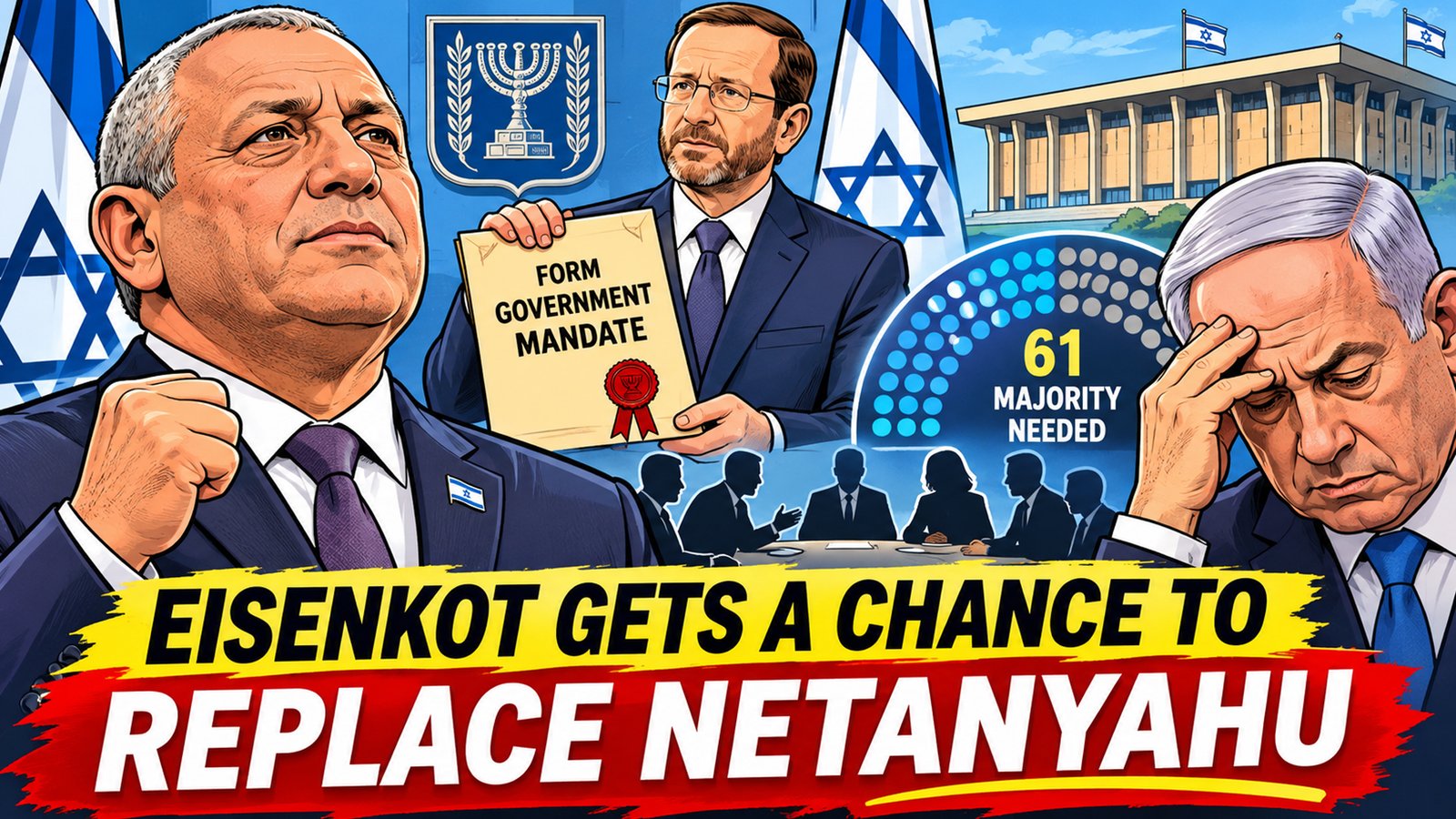
Israel is facing a major political turning point after President Isaac Herzog tasked opposition leader Gadi Eisenkot with forming the next government, creating a fresh challenge for Prime Minister Benjamin Netanyahu. The decision gives the opposition its first opportunity to replace Netanyahu following an inconclusive parliamentary election.
Eisenkot, a former chief of the Israel Defence Forces (IDF) and leader of the centrist Yashar party, received the mandate on Sunday, November 8. He now has 28 days to bring together enough political parties to form a government and secure a majority in the Knesset.
The development comes after Israel’s October 27 election failed to produce a clear winner capable of independently forming a government. Although Netanyahu’s religious-nationalist alliance emerged as the largest political bloc, it fell short of the parliamentary majority required to remain in power.
Accepting the responsibility, Eisenkot called for a national emergency government and argued that Israel needed a change in leadership to address its political and security challenges.
“We are in a state of emergency, approaching a point of no return for the State of Israel,” Eisenkot said during his address at the President’s Residence in Jerusalem.
He also stressed the need to restore public confidence in the country’s institutions and rebuild relationships with international allies, which have come under strain over the government’s policies and the continuing conflict in Gaza.
Eisenkot faces tough coalition challenge
Forming a government will not be straightforward for Eisenkot. Under Israel’s parliamentary system, a candidate needs the support of at least 61 members in the 120-seat Knesset to secure a majority.
Eisenkot’s Yashar party won 21 seats in the October 27 election, while the broader opposition bloc secured 48 seats. Netanyahu’s religious-nationalist alliance obtained 53 seats, making it the largest political grouping but leaving it eight seats short of a majority.
Two Arab-led political groups, Ra’am and the Joint List, together secured 19 seats. Both recommended Eisenkot during consultations with President Herzog, helping him receive the backing of 67 lawmakers. Netanyahu received recommendations from 46 lawmakers, while seven did not endorse either candidate.
However, support during presidential consultations does not automatically translate into participation in a governing coalition. Eisenkot must now persuade political parties with different ideological positions to work together.
The involvement of Arab-led parties could prove particularly difficult. Their support may help the opposition reach the required numbers, but some potential coalition partners have strongly opposed relying on them.
Former defence minister and Yisrael Beiteinu leader Avigdor Liberman has ruled out working with Arab parties. This disagreement could complicate Eisenkot’s efforts to build a stable government.
Opposition leader invites Likud members
Eisenkot has indicated that he is willing to explore different political arrangements to secure a parliamentary majority. He has invited parties across the political spectrum, including members of Netanyahu’s Likud party, to consider joining his proposed administration.
His approach reflects the difficult arithmetic of the election, with neither political camp securing enough seats to govern independently.
Eisenkot has also outlined four broad principles that parties must accept before joining his government. These include recognising Israel as a Jewish and democratic state, respecting the values of its Declaration of Independence, introducing mandatory military service for eligible citizens and recognising Hamas as a terrorist organisation while committing to ending its governing and military power.
The military-service proposal could become a major obstacle during negotiations. Ultra-Orthodox political parties have traditionally supported exemptions from compulsory military service for religious students.
Eisenkot, however, has called for these exemptions to end and for military-service requirements to apply more broadly. His position could make it difficult to secure the support of religious parties, whose participation may be important for building a stable coalition.
Netanyahu seeks national unity government
Netanyahu has continued to push for a national unity government involving Eisenkot. He has argued that Israel needs political stability and cooperation at a time when it faces serious security challenges.
However, Eisenkot’s political campaign has focused on replacing Netanyahu, making an arrangement that allows the incumbent prime minister to continue leading the government difficult to accept.
Eisenkot has previously criticised Netanyahu’s handling of the Gaza conflict and the government’s domestic policies. He has argued that Israel needs a different political direction to restore public trust and improve its international standing.
The leadership contest is also taking place against the backdrop of continuing security concerns involving Hamas in Gaza, Hezbollah in Lebanon and tensions with Iran. Israel’s relationship with the United States and other international partners remains another important issue.
Another election remains possible
Eisenkot has 28 days to secure the support required to form a government. President Herzog can grant him an additional 14 days if negotiations require more time.
If Eisenkot fails to reach an agreement, Herzog could give Netanyahu or another candidate an opportunity to form a government. If these attempts also fail, Israel could face another parliamentary election, extending the country’s political uncertainty.
The decision represents a serious challenge to his political future, for Netanyahu. The mandate is only the beginning of a difficult political test, for Eisenkot
His ability to bring together rival parties, negotiate compromises and secure a majority of 61 lawmakers will determine whether Israel enters a new political chapter or remains locked in another period of uncertainty.