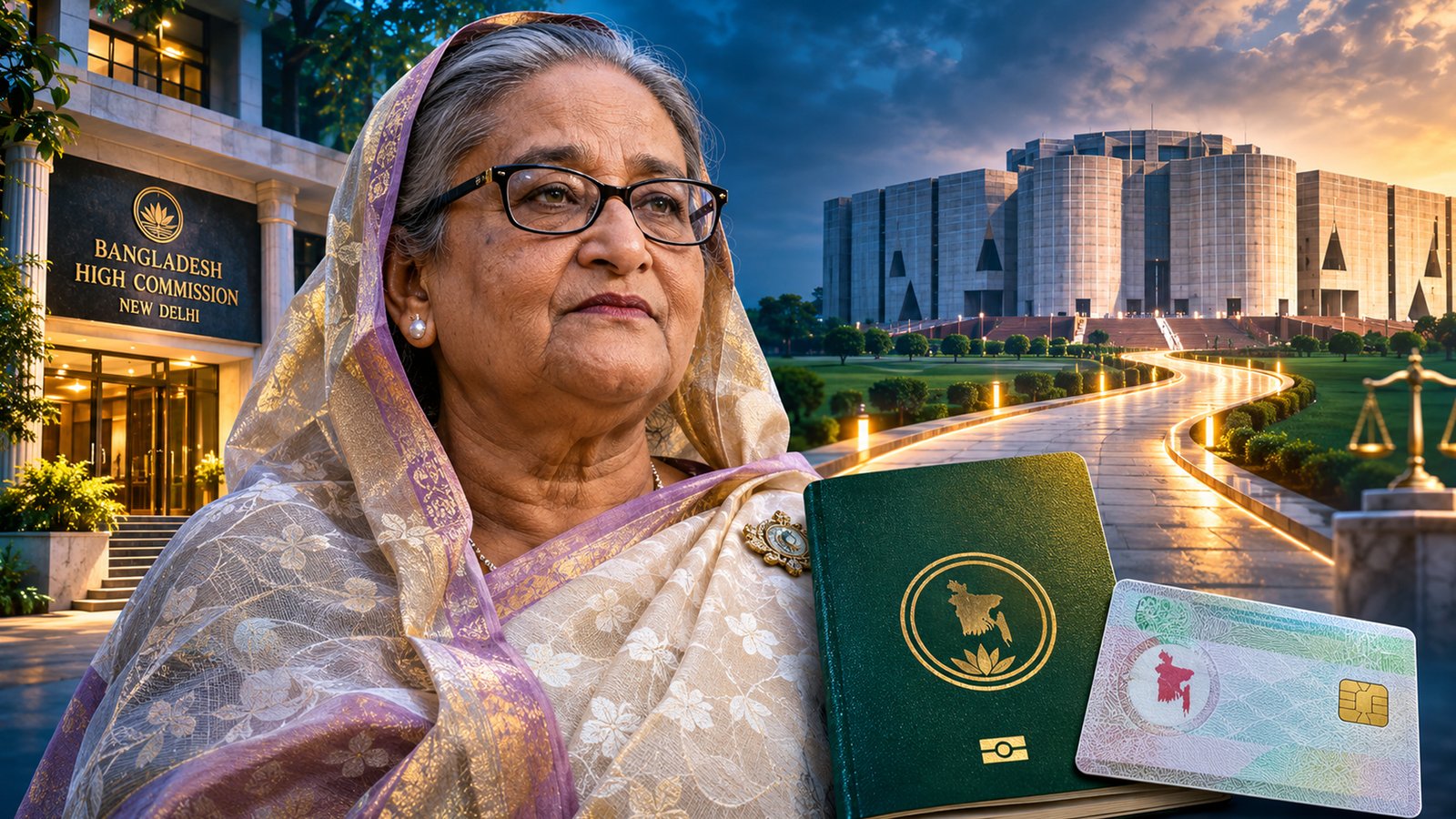
Former Bangladesh Prime Minister Sheikh Hasina has taken a significant step towards her proposed return to Bangladesh by seeking a fresh passport and national identity card (NID) from the country’s diplomatic mission in New Delhi. The request comes more than two years after she fled Bangladesh following a student-led uprising that brought her long political rule to an end.
Hasina’s lawyers have written to the acting High Commissioner at the Bangladesh High Commission in New Delhi, Preeti Rahman, requesting that fresh travel and identity documents be issued to their client. The letter reportedly cites the cancellation of her existing Bangladeshi passport and national identity card by the country’s interim government and other authorities.
The application is being viewed as a practical step towards Hasina’s stated intention to return to Bangladesh in December. She has previously indicated that she is willing to surrender before a court upon returning to the country. However, the proposed homecoming faces significant legal and diplomatic hurdles, particularly as Bangladesh continues to seek her extradition from India.
According to the letter sent by her legal representatives at London-based Matrix Chambers, the request for new documents is based on Hasina’s Bangladeshi nationality. Her lawyers have also asked the embassy to process the applications quickly, referring to Bangladesh’s obligations under international human rights instruments.
The development marks the first reported formal communication of this kind from Hasina’s side since she left Bangladesh in August 2024. It also brings renewed attention to the question of whether she can return voluntarily or whether her movement will be determined by the ongoing extradition process between the two neighbouring countries.
The request has also triggered a fresh political disagreement between Dhaka and New Delhi. Bangladesh’s State Minister for Foreign Affairs Humaiun Kobir has maintained that Hasina should be handed over to Bangladesh under the existing India-Bangladesh extradition treaty rather than being issued a new passport.
Kobir reportedly questioned why Hasina would need fresh travel documents when an extradition arrangement was already in place. He said Bangladesh wanted her returned through the established legal process and indicated that the government would continue pursuing the matter through diplomatic channels.
His remarks underline the difference between Hasina’s approach and the position of the current Bangladeshi administration. While her lawyers are seeking documents that would allow her to travel as a Bangladeshi citizen, Dhaka wants India to facilitate her return through extradition proceedings.
India has previously confirmed that it is examining Bangladesh’s extradition request through the appropriate legal channels. The matter has become a sensitive issue in relations between the two countries, particularly because Hasina has remained in India since leaving Bangladesh.
A return to Bangladesh would not necessarily mean a straightforward homecoming for the former prime minister. She faces serious legal challenges, including a death sentence handed down in November 2025 by Bangladesh’s International Crimes Tribunal.
The tribunal convicted Hasina in absentia in a case involving crimes against humanity over the government’s response to the student-led uprising in 2024. She was accused of ordering a deadly crackdown on protesters. Hasina has denied the allegations and rejected the proceedings against her.
The violence during the uprising claimed hundreds of lives and left thousands injured. Estimates cited by international agencies put the death toll at nearly 1,400.
The protests began over issues surrounding government job quotas but gradually developed into a nationwide movement demanding Hasina’s resignation. The unrest eventually forced her from office on August 5, 2024, bringing an end to her long tenure. She subsequently left Bangladesh and travelled to India.
Hasina has maintained that she wants to return to her homeland and face the legal process. Her aides have indicated that the exact date of her proposed December return will be announced after the necessary formalities are completed.
In an earlier statement, she also expressed her desire to spend her final days in her own country, among its people. Her latest passport application gives a clearer indication that she is attempting to translate that intention into action.
Hasina’s proposed return also comes at a politically sensitive time for Bangladesh. Her Awami League, which was once the country’s largest political party, has been banned following her removal from power. Several party leaders and supporters have been arrested, while others have moved to India and other countries.
Hasina served as Bangladesh’s prime minister for around 20 years across multiple terms. Despite her removal, she continues to have supporters within the country. Her return could therefore reopen political divisions, particularly between those demanding accountability for the 2024 crackdown and those who continue to support her leadership.
Bangladesh is also attempting to restore political stability following more than two years of upheaval. The change in leadership and the legal action against Hasina have reshaped the country’s political environment.
The developments have wider implications for India-Bangladesh relations as well. New Delhi’s decision to provide refuge to Hasina after her departure became a major source of friction between the neighbouring countries. Dhaka’s repeated requests for her extradition have added to the diplomatic strain.
While a possible return could create fresh political tensions within Bangladesh, resolving the issue could also open the door to improving relations between the two countries.
Her December plans have therefore placed both Bangladesh’s domestic politics and its relationship with India back in the spotlight.