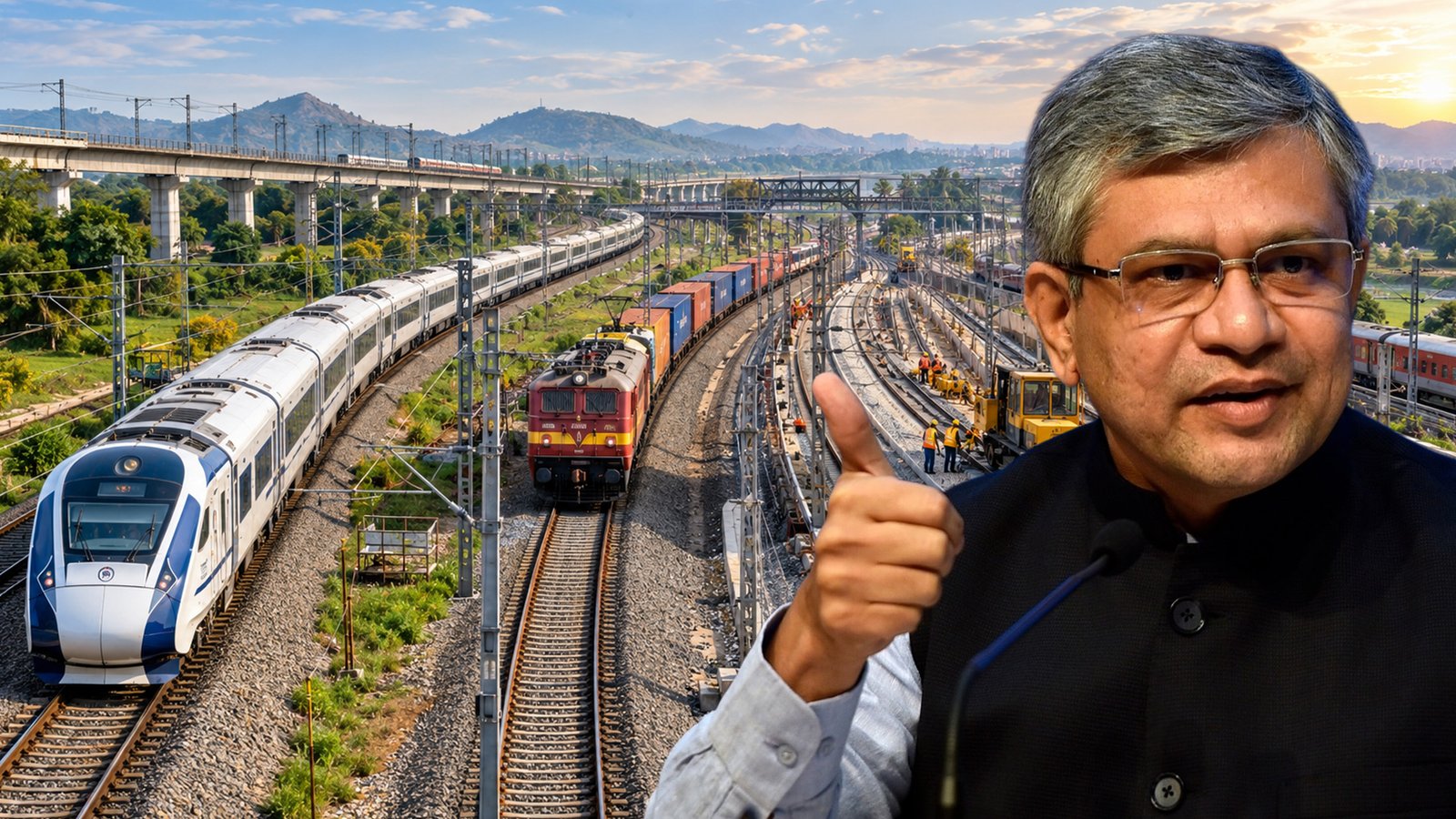
The Union Cabinet has approved eight railway multitracking projects worth ₹20,804 crore, giving a major push to India’s transport and logistics infrastructure. The projects will add around 1,196 km of railway lines across nine states and are expected to improve the movement of both passengers and goods.
The projects, cleared by the Cabinet Committee on Economic Affairs, will be implemented across West Bengal, Jharkhand, Odisha, Madhya Pradesh, Chhattisgarh, Tamil Nadu, Andhra Pradesh, Karnataka and Telangana. The government expects the work to be completed by 2029-30.
From a business perspective, the biggest impact is expected to come from higher freight capacity. The additional railway infrastructure is projected to support around 74 million tonnes of extra freight movement every year. Coal, cement, iron and steel, petroleum products, fertilisers, automobiles, foodgrains and containers are among the major commodities expected to benefit.
The expansion is also aimed at reducing pressure on some of the country’s busiest railway routes. Several high-density corridors are already operating close to their capacity limits, creating bottlenecks for both passenger and freight trains. Adding more tracks will allow trains to operate with greater flexibility and reduce delays caused by congestion.
The projects have been divided between important northern, eastern and southern railway routes. Three projects covering around 656 km and involving an investment of ₹10,783 crore will strengthen railway infrastructure across West Bengal, Jharkhand, Odisha, Madhya Pradesh and Chhattisgarh. These include the Kharagpur-Jharsuguda fourth line, Katni-Pendra Road fourth line and Bilaspur-Pendra Road third line.
The remaining five projects, involving about ₹10,021 crore, will cover 540 km across Tamil Nadu, Andhra Pradesh, Karnataka and Telangana. These include important sections such as Arakkonam-Renigunta, Whitefield-Bangarapet, Hosur-Omalur and Salem-Karur-Dindigul, along with the Secunderabad-Kazipet route.
Improving rail capacity can have a direct impact on transportation costs for businesses. Railways are generally more efficient for moving large quantities of bulk goods over long distances. Faster and more reliable freight movement can therefore help companies reduce logistics expenses and improve supply-chain efficiency.
The projects are also expected to improve connectivity to industrial areas, mining regions, ports, agricultural markets and important tourist destinations. According to government estimates, the new railway infrastructure will benefit around 6,911 villages with a combined population of nearly 1.1 crore.
The Kharagpur-Jharsuguda route is particularly important for freight movement because of its connection to mineral-rich regions and major industrial centres. Similarly, the Katni-Pendra Road and Bilaspur-Pendra Road sections will strengthen links to coal-producing areas in central India.
In southern India, the projects are expected to support the movement of people and goods around major economic centres. The Whitefield-Bangarapet expansion will strengthen the railway connection between Bengaluru and eastern Karnataka, while the Arakkonam-Renigunta route will improve capacity on an important corridor towards Andhra Pradesh and Tirupati.
The government is positioning the investment as part of its wider push to improve India’s logistics network. The projects are aligned with the PM Gati Shakti National Master Plan, which focuses on connecting different modes of transport and creating a more integrated infrastructure network.
The move also comes at a time when the government is increasing spending on railway modernisation. Indian Railways is being used not only as a passenger transport network but also as a key component of India’s economic and industrial infrastructure. Higher rail capacity is particularly important as freight demand rises alongside manufacturing, construction, power generation and infrastructure activity.
The government expects shifting more freight from roads to railways to bring additional environmental and economic benefits. One of the three projects covering 656 km alone is estimated to support around 27 million tonnes per annum of additional freight capacity. It could also reduce fuel consumption and carbon emissions by encouraging greater use of rail for bulk transportation.
The latest approval also comes shortly after the government highlighted the completion of major sections of the Dedicated Freight Corridor, underlining its broader focus on improving the country’s logistics infrastructure. The objective is to create greater capacity across both dedicated freight routes and conventional railway networks.
In the Indian economy, the significance of the latest railway investment goes beyond laying additional tracks. Better connectivity can make it easier for manufacturers to source raw materials, move finished products and reach markets. It can also improve access to industrial clusters and smaller towns, potentially supporting new investment and employment.
The ₹20,804-crore railway expansion therefore represents another sizeable infrastructure investment aimed at tackling one of the key challenges facing India’s growing economy — the need for faster, cheaper and more reliable movement of goods and people. With freight volumes expected to increase in the coming years, the additional railway capacity could play an important role in strengthening India’s logistics network and supporting long-term economic growth.