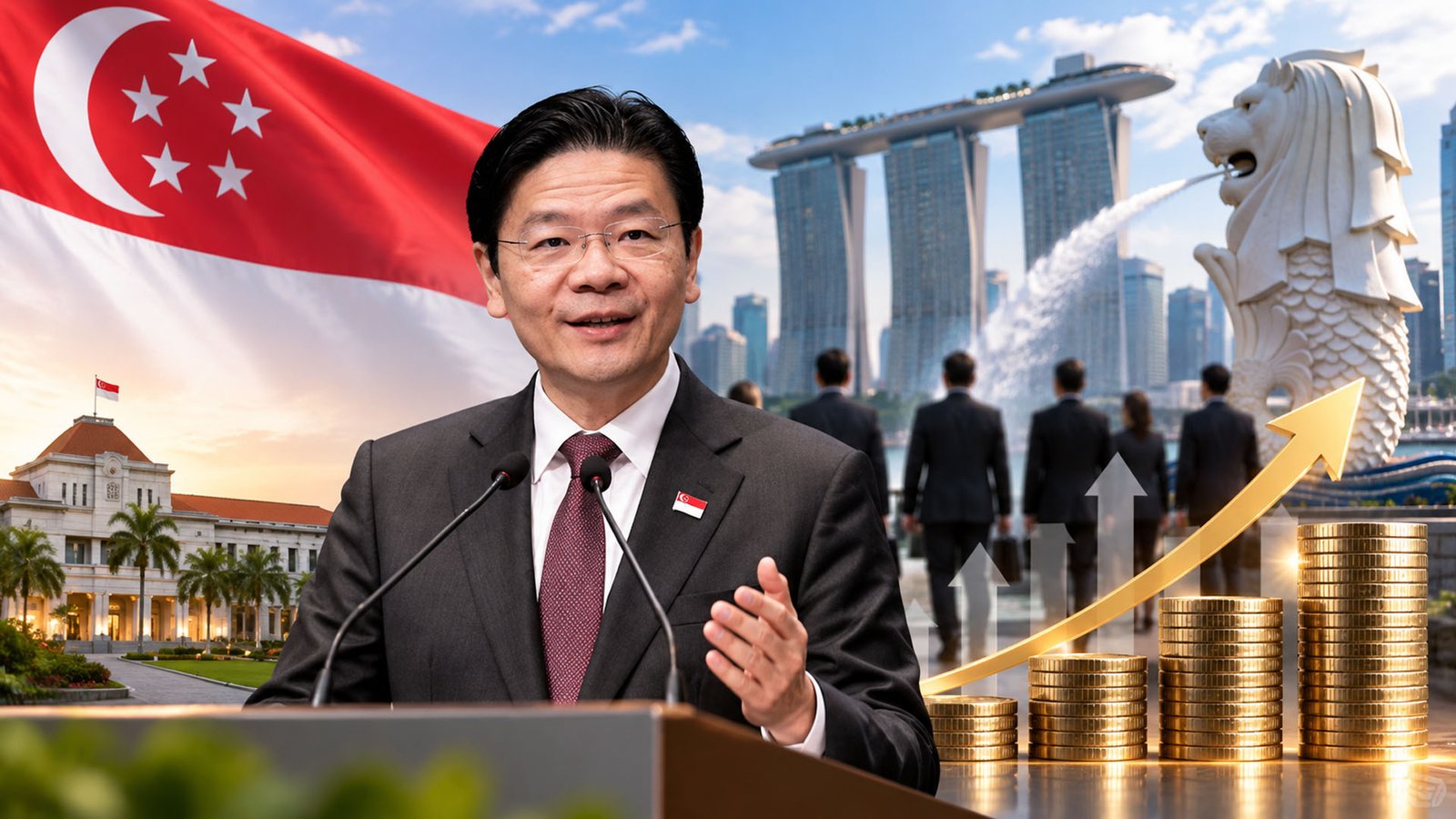
Singapore Prime Minister Lawrence Wong is set to receive a dramatic 64 per cent increase in his annual compensation, taking his benchmark pay to S$3.6 million, or roughly ₹26.9 crore.
The increase, which will take effect from October 15, will make Wong the highest-paid head of government in the world. His current annual compensation stands at about S$2.2 million. The revised figure includes salary and bonuses, so it is not simply a fixed annual salary.
The decision has immediately put Singapore’s unusual approach to political salaries back in the spotlight.
Wong acknowledged that the issue was sensitive. Singapore has some of the highest-paid political leaders in the world, and any increase naturally attracts attention at a time when ordinary households continue to keep a close eye on living costs.
Yet the government says the move is not about making politicians richer. Its argument is that Singapore needs to offer competitive compensation if it wants to attract experienced professionals into politics and retain people capable of running the country.
Singapore has followed this approach for years. Political salaries are benchmarked against the earnings of the country’s top 1,000 citizens, with adjustments made to reflect private-sector pay and public-service considerations. The system is designed to ensure that a senior professional does not have to take an unusually large financial step backwards to enter government.
However, the timing makes the announcement particularly notable for Wong.
This is the first major increase in ministerial salaries in 15 years. Political pay was cut sharply in 2012 following public criticism, while a review in 2017 did not result in an increase. Another review planned for 2023 was delayed amid economic uncertainty.
The latest review has therefore brought the issue back after years of relatively little movement.
Wong has also tried to address the criticism personally. He said he would donate the increase in his salary to charity for the next five years, provided he remains in office. That means the prime minister will not personally retain the additional amount during that period.
The broader changes will affect other political officeholders as well.
The benchmark annual compensation for a junior minister is being raised from S$1.1 million to S$1.8 million. But ministers will not immediately receive the full benchmark amount. Instead, the initial increase will be capped at up to 9 per cent, with future pay linked to performance and responsibilities. Most junior ministers are expected to earn around S$1.35 million by the end of the current government term, with higher earnings possible for those taking on greater responsibilities.
That distinction is important because the headline figures can make the increase appear larger than what ministers will actually receive immediately.
Still, Wong’s new compensation is striking when placed alongside the pay of political leaders elsewhere.
The US president receives a statutory salary of $400,000 a year, while the UK prime minister earns considerably less than Singapore’s leader. On the revised benchmark, Wong’s compensation will be several times higher than that of many other major world leaders.
Singapore’s government believes the comparison should not be viewed in isolation. The city-state says political salaries need to be considered against the salaries available to senior professionals in the private sector and the demands placed on people holding public office.
The government also links the policy to clean governance. Its long-standing argument is that competitive pay can reduce the financial incentive for corruption while helping Singapore attract people with strong professional backgrounds.
That argument has nevertheless faced criticism.
Opponents of high political salaries question whether benchmarking ministers against the country’s richest earners creates too much distance between policymakers and ordinary citizens. The concern is particularly relevant in a country where income inequality and the cost of living remain sensitive political issues.
The debate is therefore bigger than one person’s pay packet.
Singapore is effectively asking whether the country should continue paying its political leaders at a level that is far above international norms in order to compete for talent.
The decision also carries a personal political cost for Wong. He has admitted that leaving salaries unchanged would have been easier politically, but argued that doing so would not be the right choice given how private-sector and public-sector earnings have changed since the last major adjustment.
His decision to donate the increase may soften some criticism, but it is unlikely to end the discussion.
The revised Lawrence Wong salary has once again highlighted Singapore’s distinctive model of political salaries, where high compensation is presented as part of a broader strategy to attract talent, maintain strong governance and discourage corruption.
Whether the public accepts that argument will depend less on the size of the pay cheque and more on whether Singaporeans believe their leaders are delivering results worth that price.