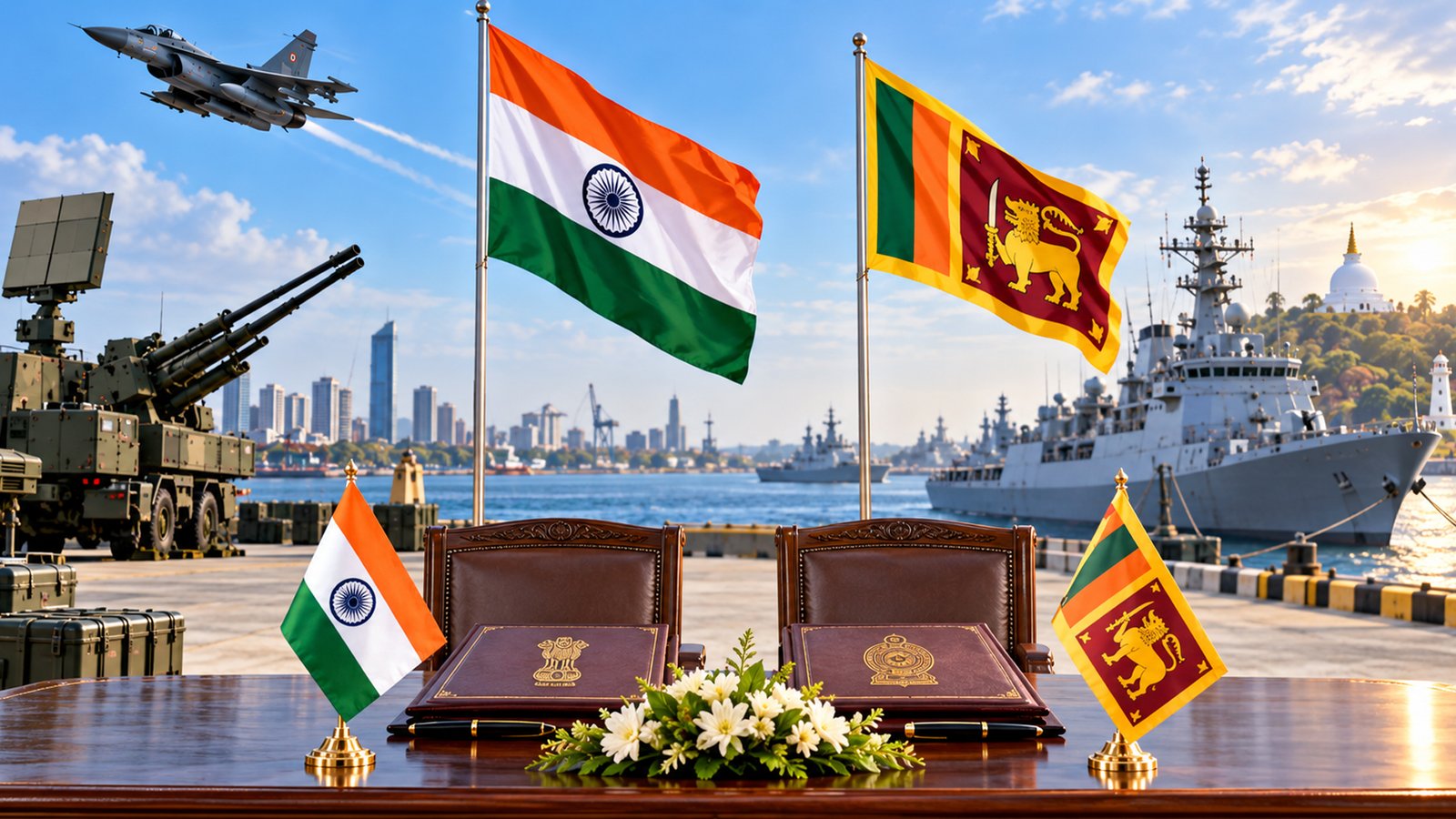
India is expanding its defence partnership with Sri Lanka, moving beyond traditional military training to newer areas such as artificial intelligence, maritime surveillance and equipment modernisation.
The latest push came during Defence Minister Rajnath Singh’s visit to Colombo, where India and Sri Lanka signed three defence-related agreements and discussed a broader framework for cooperation in the Indian Ocean. Singh also met Sri Lankan President Anura Kumara Dissanayake on September 9.
One of the most concrete outcomes was an agreement to upgrade six L-70 air-defence guns operated by the Sri Lankan Air Force. The upgrade will be carried out under an Indian government grant, giving Colombo a way to modernise equipment that is already part of its defence inventory.
The agreement is significant because it reflects a broader shift in India’s defence diplomacy. Instead of focusing only on supplying new equipment, India is also helping partner countries improve and extend the usefulness of systems they already operate.
The two sides also signed agreements involving the National Defence Colleges of India and Sri Lanka and cooperation between their National Cadet Corps. The NCC agreement will formalise the existing youth exchange programme, while the National Defence College arrangement is expected to strengthen academic and professional exchanges between defence institutions.
But the bigger strategic conversation is taking place at sea.
India has proposed an integrated maritime surveillance system linking the two countries’ navies, coast guards and civilian agencies. The proposed network would allow real-time sharing of information about shipping around Sri Lanka and create a common picture of maritime activity.
Such a system could help both countries track suspicious vessels and respond to illegal fishing, narcotics trafficking, smuggling, terrorism and other maritime threats. It would also strengthen coordination in a region where secure sea lanes are vital for trade and energy movement.
Sri Lanka’s location makes this cooperation particularly important. The island sits close to some of the busiest shipping routes in the Indian Ocean, making maritime security closely linked to regional trade and economic stability.
India also has a direct strategic value because of the better maritime visibility around Sri Lanka. A stronger information-sharing network would improve awareness of activity in waters close to India and help the two countries respond more quickly to potential security risks.
The defence relationship is also beginning to move into newer technology. During his visit, Singh announced that India would work with Sri Lanka to establish an artificial intelligence laboratory for the Sri Lankan Army. The facility is expected to support areas such as surveillance, data analysis, logistics and military decision-making.
That announcement gives the partnership a more future-focused character. Artificial intelligence is increasingly being used by militaries for processing large volumes of information, monitoring activity and improving operational decisions. For Sri Lanka, Indian assistance in building such capabilities could support its efforts to modernise its armed forces.
India also used the visit to underline its role as a security partner for Sri Lanka. Singh said India considers assistance to its close neighbour a responsibility and would continue to act as a first responder when Sri Lanka faces a crisis.
The message matters because India’s relationship with Sri Lanka extends well beyond defence. New Delhi has provided significant support to the island nation during periods of economic and other crises, while cooperation has grown across infrastructure, energy, connectivity and development.
The latest agreements therefore come at a time when both countries are looking to give their relationship a stronger strategic foundation.
Sri Lankan President Dissanayake also assured Singh that Sri Lankan territory would not be allowed to be used for activities that could harm India’s security interests. That assurance is important for New Delhi as it keeps a close watch on developments across the Indian Ocean.
The two countries are also seeking greater cooperation in areas such as search and rescue, counter-narcotics and anti-piracy operations. Singh has stressed that safe sea lanes, freedom of navigation and uninterrupted maritime trade are essential to the prosperity of the Indian Ocean region.
There is also a practical infrastructure angle to the relationship. During Singh’s visit, three Bailey bridges built by Indian defence forces in Sri Lanka were virtually inaugurated, highlighting the role of Indian military capabilities in supporting infrastructure and disaster-response needs.
India’s defence sector will benefit through the deeper engagement with neighbouring countries. This creates opportunities for equipment modernisation, technology cooperation and capacity building. The government has increasingly positioned defence exports and domestic manufacturing as important parts of its broader defence strategy.
The Sri Lanka partnership, however, is primarily about regional security rather than commercial defence sales. India is seeking to build a network of trusted partners around the Indian Ocean, with information sharing, training, technology and maritime cooperation becoming increasingly important.
The latest developments show that India-Sri Lanka defence ties are evolving from a conventional military relationship into a wider security partnership. L-70-gun upgrades address an immediate capability requirement, while AI cooperation and maritime surveillance point towards longer-term collaboration.
India and Sri Lanka both aim to strengthen their ability to deal with security challenges together while keeping the Indian Ocean open, stable and safe for trade.