Cheruvayal Raman, the Padma Shri-winning tribal farmer from Wayanad who devoted his life to conserving Kerala’s traditional paddy seeds, died on Wednesday, October 14, while undergoing treatment at Kozhikode Government Medical College Hospital. He was 74.
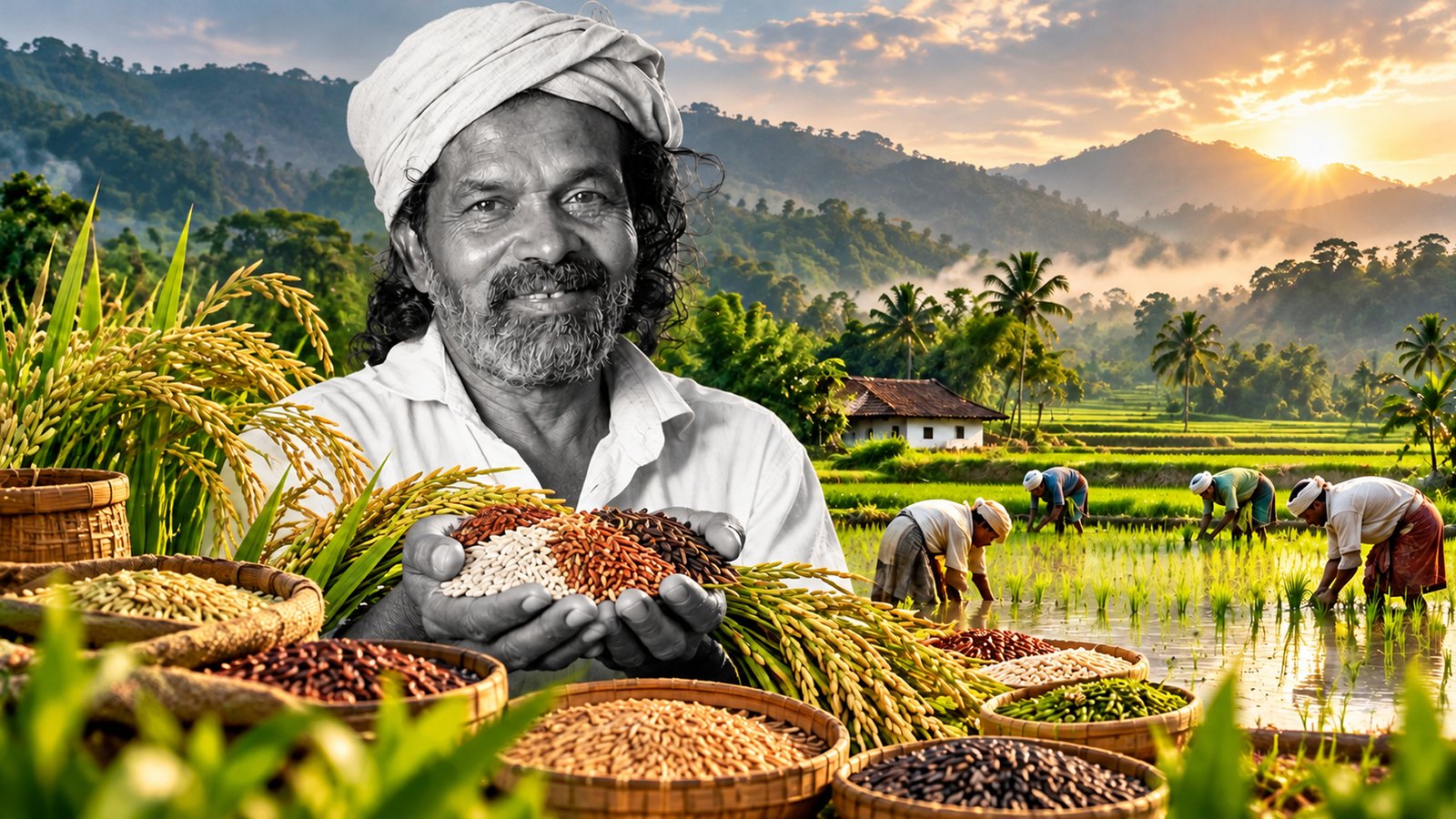
Known affectionately as ‘Nellachan’, or the father of paddy, Raman preserved more than 55 indigenous rice varieties at his farm in Kammana, near Mananthavady. At a time when traditional crops were steadily disappearing from fields, he worked to keep these varieties alive, protecting a valuable part of Kerala’s agricultural heritage.
His death is a significant loss for the farming community and for those working to conserve biodiversity. His contribution went beyond saving seeds: he kept alive the knowledge, practices and relationship with the land that had sustained generations of farmers.
Born in 1952 into the Kurichiya tribal community, Raman developed a close connection with farming early in life. He began working in agriculture when he was around 10 years old, learning through experience and the traditional knowledge passed down within his family. Although he had no formal training in agricultural science or botany, his practical understanding of native crops eventually earned him national recognition.
A lifetime devoted to native seeds
Raman became concerned about the disappearance of indigenous paddy varieties as farming practices changed and farmers increasingly adopted commercially popular high-yielding varieties. He believed that traditional rice seeds deserved to be preserved not merely as remnants of the past, but as living resources for future generations.
He gradually built a collection of more than 55 traditional paddy varieties on his modest farm. His collection included varieties such as Thondi, Mannuveliyan, Jeerakasala and Gandhakasala, each carrying distinct characteristics and a place in Kerala’s farming traditions.
These indigenous varieties represent more than differences in grain colour, aroma or taste. Traditional crop diversity can help protect agriculture against changing weather conditions, pests and diseases. Preserving a wider range of seeds also provides farmers and researchers with genetic resources that may prove valuable in developing resilient crops.
Raman’s work earned him the reputation of a living paddy gene bank. His farm became a destination for researchers, students, agricultural experts and visitors interested in traditional farming and seed conservation.
He also believed that the seeds should remain in circulation rather than be locked away as a private collection. He shared seeds with other farmers, asking them to return an equivalent quantity after harvest. This simple arrangement helped ensure that the varieties could continue to be cultivated and passed on.
Recognition for grassroots conservation
The Union government honoured Raman with the Padma Shri in 2023 for his contribution to agriculture and biodiversity conservation. The award brought national attention to a farmer whose work had largely grown out of a small village and a personal commitment to preserving traditional crops.
He had earlier received the Plant Genome Saviour Award for his role in conserving indigenous plant varieties. His work also brought him recognition from agricultural institutions and biodiversity organisations.
Raman represented Indian farming and seed conservation at international forums, including a biodiversity conference in Hyderabad in 2011. His knowledge demonstrated how farmers who work closely with the land can contribute meaningfully to conservation, even without formal scientific qualifications.
His contribution also had practical value for agricultural research. According to the President of India’s official Padma Awards citation, the traditional paddy varieties Palthondi and Kayama preserved by Raman were used as gene donors in the development of rice varieties at Kerala Agricultural University. A traditional pepper variety from his collection also contributed to the development of the Panniyur-1 pepper variety.
These examples underline the importance of conserving indigenous crops. Seeds preserved through traditional farming can contain genetic traits that researchers may use to improve cultivated varieties.
A simple life and an enduring legacy
Despite receiving one of India’s highest civilian honours, Raman remained closely connected to his farm and traditional way of life. His modest home and seed collection reflected his belief that agricultural knowledge belonged in the hands of farming communities.
His work also challenged the idea that progress in agriculture must come at the cost of traditional practices. He demonstrated that indigenous seeds, organic farming and modern agricultural research need not be opposing approaches. Instead, conservation can provide a foundation for more diverse and resilient farming systems.
Tributes poured in following his death. Congress leader Priyanka Gandhi Vadra recalled her meeting with Raman and said he had called her his daughter, describing the interaction as deeply moving. Political leaders and members of Kerala’s farming community also expressed grief over the loss of the conservationist.
Raman is survived by his wife, Geetha, and their four children, Ramani, Ramesh, Rajesh and Rejitha.
His passing leaves an important question about the future of the seed collection and the knowledge he accumulated over decades. Preserving the varieties he nurtured will require continued cultivation, documentation and the involvement of farmers, researchers and institutions.
Cheruvayal Raman’s greatest achievement was not simply collecting seeds, but ensuring that rare varieties had a chance to grow again in fields beyond his own. The seeds he protected carry forward his life’s work, offering future generations a living connection to Kerala’s agricultural past and a resource for the challenges facing farming in the years ahead.