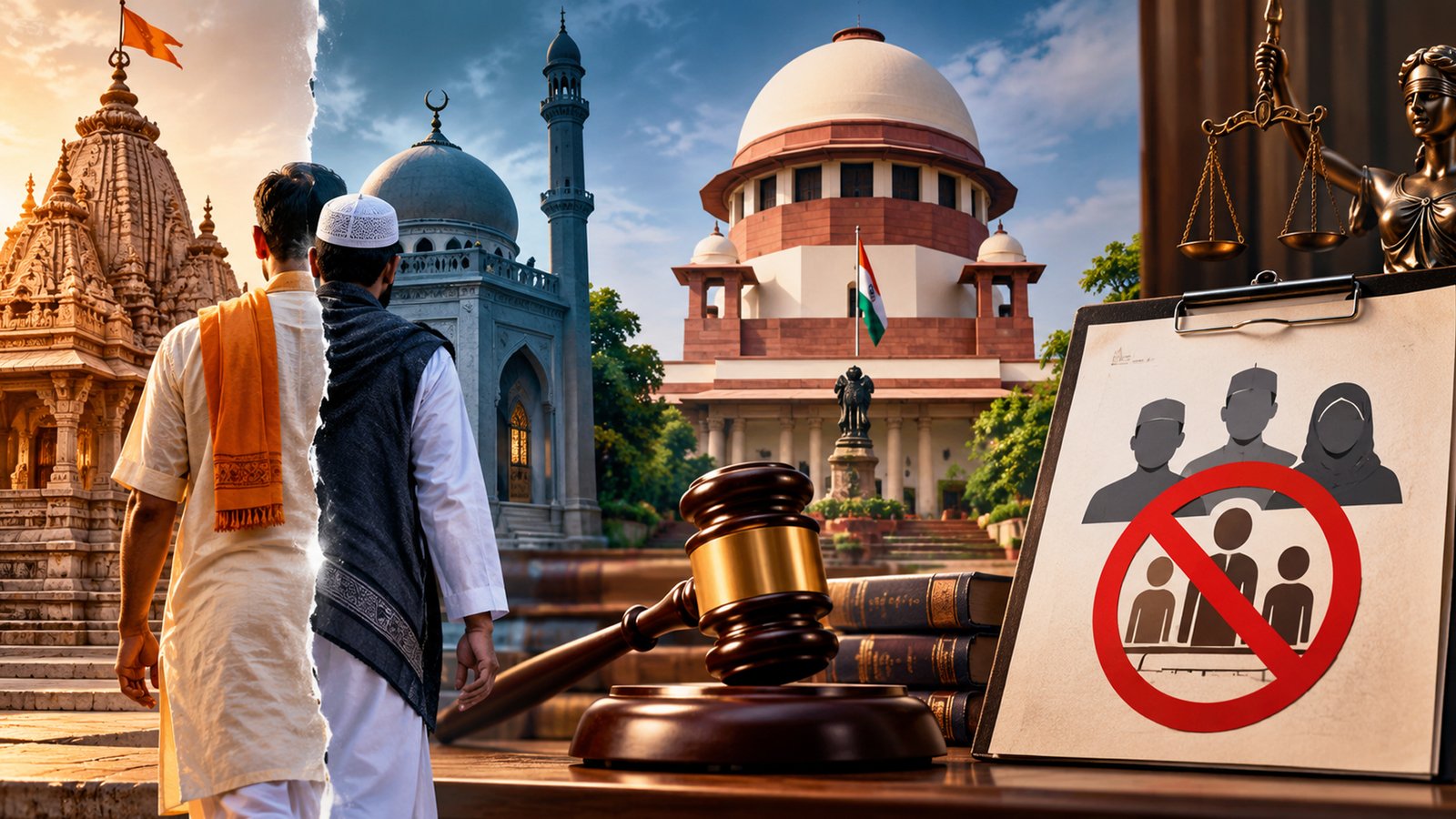
The Supreme Court on Thursday, October 15, ruled that a person converting from Hinduism to Islam cannot claim backward-class reservation benefits solely on the basis of their caste or social status before conversion. The verdict upholds a Madras High Court judgment that struck down a Tamil Nadu government order allowing certain converts to be classified under the Backward Class (Muslim) category.
A bench comprising Justices Prashant Kumar Mishra and Shree Chandrashekhar dismissed the Tamil Nadu government’s appeal, holding that social backwardness associated with a person’s earlier community cannot automatically be transferred to a different religious and social order.
The ruling clarifies an important question concerning reservation eligibility after religious conversion. While individuals have the constitutional freedom to choose their religion, the court said that conversion alone does not establish membership in a different community recognised for reservation benefits.
The case arose from a government order issued by Tamil Nadu on March 9, 2024. The order sought to allow people from Backward Classes (BC), Most Backward Classes (MBC), Denotified Communities and Scheduled Castes (SC) who converted to Islam to obtain community certificates under the Backward Class (Muslim) category.
The Madras High Court struck down the order on June 25, 2026, declaring it unconstitutional. The state government subsequently challenged the decision in the Supreme Court, arguing that the measure was intended to protect people from losing reservation benefits after conversion. The top court has now rejected that challenge.
What the Supreme Court said
The bench held that a person’s former caste or community status cannot automatically be transferred to one of the seven Muslim communities notified as backward classes in Tamil Nadu.
The court said that backwardness experienced in an earlier social order cannot, by itself, provide the legal basis for membership in a different notified backward-class community after conversion.
It also made clear that a private religious organisation cannot conclusively determine a person’s entitlement to statutory reservation benefits. Eligibility must be established under the applicable legal and constitutional framework.
The judgment concerns affirmative action under Article 16(4) of the Constitution, which allows the state to provide reservation in public employment for backward classes that are inadequately represented in government services.
The court’s decision does not mean that religious conversion itself is prohibited or that every person who changes religion automatically loses access to all welfare schemes. Instead, it establishes that a person cannot claim membership in a different notified backward-class category solely because of their previous caste identity.
How the case began
The proceedings originated with Sameer Ahamed, who converted from Hinduism to Islam in 2015. He later applied for a community certificate identifying him as belonging to the Muslim Lebbai community, one of the Muslim communities recognised as a Backward Class in Tamil Nadu.
The local authorities rejected his application. Ahamed then approached the Madras High Court, relying on the state government’s 2024 order to support his claim.
During the proceedings, the High Court examined the validity of the government order itself and concluded that it could not legally allow converts to be treated as members of a notified backward-class Muslim community simply on the basis of their earlier caste status.
The Tamil Nadu government challenged that judgment, arguing that its order followed recommendations from the state’s Backward Classes Commission and was intended to prevent people from losing reservation benefits after conversion.
The Supreme Court, however, agreed with the High Court that the order could not stand. It said conversion alone did not establish the necessary social and legal connection to a different notified community.
What about Scheduled Caste status?
The judgment also reiterated the constitutional restrictions governing Scheduled Caste recognition.
Under the Constitution (Scheduled Castes) Order, 1950, Scheduled Caste status is restricted to people professing Hinduism, Sikhism or Buddhism, subject to the applicable legal requirements. A person converting to Islam or Christianity cannot retain Scheduled Caste status solely on the basis of their former caste identity.
The court also addressed the position of people who later return to Hinduism. It said that reconversion does not automatically restore eligibility for reservation benefits. Authorities must independently examine whether the person’s original caste or social identity has genuinely been restored and whether the relevant constitutional and legal requirements have been met.
Why the ruling matters
The verdict has implications for reservation policy, community certificates and the legal treatment of caste identity following religious conversion. It reinforces the requirement that eligibility for affirmative action must be determined under the relevant legal provisions rather than assumed from a person’s previous social classification.
For Tamil Nadu, the decision means the 2024 government order cannot be used to automatically extend Backward Class (Muslim) status to people converting from other communities. Applicants must satisfy the applicable criteria for the category they seek to claim.
The ruling also draws a distinction between religious freedom and eligibility for state benefits. A person may exercise the right to change their faith, but access to a particular reservation category depends on the legal conditions governing that community.
By upholding the Madras High Court’s decision, the Supreme Court has settled the immediate legal challenge to Tamil Nadu’s notification. The judgment places the emphasis on recognised community membership and statutory eligibility, rather than the automatic transfer of backward-class status after religious conversion.